Sunday, October 16, 2011

Skirmish at Landsdowne Hall

Landsdowne Hall in 1942
During the night of September 30, 1861, one of the earliest skirmishes of the Civil War in Eastern Kentucky took place at Landsdowne Hall, an impressive brick mansion which stood a half a mile distant from Grayson, Carter County, Kentucky, and was owned by Dr. Andrew Jackson Landsdowne. Landsdowne Hall had its origin with the family of Colonel William Grayson "Billie" Carter and his wife Susan Shelby Carter, grand-daughter of Kentucky’s first governor Isaac Shelby.
Isaac Shelby, Kentucky's first governor
Susan Carter was mainly responsible for the construction of the house. She hired a brick layer and had the bricks made on site by slaves. The house was finally finished in the 1830’s. Her husband Colonel William Carter was a state senator, representing Lewis, Greenup and Lawrence Counties from 1834-1838. Carter County, Kentucky, was named for him. Upon his death from cholera in 1849, Susan Carter sold the house to Dr. Andrew Jackson Landsdowne, along with 3000 acres, for which he paid in gold. He gave the estate the name “Luck Enough” but soon changed it to “Landsdowne Hall.” Landsdowne was born on October 14, 1814, in Prince William County, Virginia, the only son of Colonel George Landsdowne and Lucy Robinson. His mother died when he was still a small boy. His father moved to Kentucky and in 1819 married the widow of Richard Menefee, state legislator and one of Owingsville's founders. In 1830, Colonel Landsdowne purchased Olympian Springs, 36 miles east of Lexington, a popular resort known for the spring's medicinal value. In 1833, many Kentuckians summered at Olympian Springs to escape the cholera epidemic that swept Kentucky.
Dr. Andrew Jackson Landsdowne, ca. 1861
Andrew Jackson Landsdowne received his medical education at Transylvania University and in 1840 moved from Bath to Carter County, Kentucky. On May 24, 1842, he married Mary Buckner Hord, daughter of Col. Thomas Todd Hord. The 1860 Carter County, Kentucky Federal Census indicates that Dr. Landsdowne was a well to-do man and, aside from his real estate holdings, owned a considerable amount of private property. This included 11 slaves who were living in two slave houses built on the property. Soon after the Civil War began, the Landsdowne family began aiding the South by providing food and shelter to men on their way to the Confederate Army. During the night of September 29, 1861, a group of 25 men assembled near Greenupsburg, for the purpose of making a descent upon Grayson and disarming the Union home guards and then making off to the Confederate recruiting camp in Prestonsburg, according to Union sources. Landsdowne Hall was chosen as the place of rendezvous. However, their presence was soon detected and immediately reported. While eating dinner with the Landsdowne family, the men were surprised by 15 home guards under Captain McGuire who surrounded the house. According to a report by Col. Eifort of the Grayson Home Guard and Captain W. C. Stewart of Kinniconick, Lewis County, Kentucky, “one of the secesh rushed out, drew a revolver, and exclaimed, ‘Shoot, and be G-d d-d.’ A lad thirteen years of age, son of Judge McGuire, obeyed orders, and shot the fellow through the heart. The firing then commenced and lasted about five minutes, when the secesh stampeded.” Four men escaped, including a lawyer by the name of McCombs, law partner of Judge Adams. Nine year old Julia Landsdowne, with her mother and two of the slaves, fled down the hill toward the Little Sandy River and were being shot at. Julia Landsdowne later recalled, “I was shot at good and proper. Bullets whistled right through my clothes and my mother’s.” Killed during the fight was William A. Bartley and William Henry. The home guard succeeded in arresting John McCoy, B. J. McComas, S. H. Wolcott, Geo. Martin, Will. A. Bartley, Orlando Nichols, Benj. F Chinn, John White, Henry C. Davidson, P. B. Byrne, Will. Henry, Sam Womack, Will. Womack, __ Strother, Robert L. Stewart, W. H. Campbell, A. J. Landsdowne, and C. Carroll Pomeroy. George Martin was seriously wounded by a ball passing through is neck, which made his removal unadvisable. Captain McGuire’s men captured twelve horses and the weapons of the rebels. Julia Landsdowne later claimed that the home guard looted the house right after the fight. “One of those no-count Yankees,” she said, fairly shouting in her indignation, “pointed to the dining room table and cried, ‘a damn pretty table for Rebels!’ Then he took a rifle and smashed everything in sight.” As soon as word of the incident had spread, "the country...was in a blaze of excitement," according to the Ironton Register. "Reports had it that Grayson had been burned, and the number of rebels marching for the Ohio was 1,500..." Within a short time, more than a thousand Union men from the surrouding counties had mobilized and were at Grayson,"to defend the place", including a home guard company from Boyd County. The prisoners were taken to Louisville. After being brought to trial, Dr. Andrew Jackson Landsdowne was released on condition of taking the oath of allegiance. Records show that after his return, Dr. Landsdowne left Carter County for the duration of the war and moved to Boyd County, Kentucky. He leased to George W. Mead, "Dr. Lansdowne's salt furnace, with all the appurtenances thoreto belonging, together with salt wells sufficient for the manufacture of salt at said furnace and the privilege of using coal, &c., in the business of making salt. Also ‘the house and premises thereto belonging, known as the said Dr. Lansdowne's new store, for three years from said date,' in consideration of the said Mead building a yard fence around said house and putting it in general good repair. Also to construct a salt furnace for the manufacture of salt at the furnace above described and opening and working such wells as the said Mead may deem most expedient."
Major General John C. Breckenridge
Calling herself "the only Confederate Veteran in Carter County", Julia Landsdowne remained indignant for the rest of her life about the affair that took place at her home in the fall of 1861. It must have given the nineteen year old Julia a certain degree of satisfaction when former US Vice-President and Confederate General John C. Breckenridge presented her with a medal of approval in 1871, for managing, “to protect some Confederate prisoners from a mob.” It was an engraved coin which was given to the General by a dying Confederate soldier, and was carried by Breckenridge all through the Confederacy and his European exile, so that, as he gleefully remarked, "I never was without a dollar in my pocket." Sadly, Landsdowne Hall is no more. Ravaged by time, it was only a shadow of its former past when the house’s image was last captured by a photographer of the Huntington Herald-Dispatch on a cold January morning in January 1942. All we have left now are the memories. This specific article was researched and written by Marlitta H. Perkins, October 2011, and is under full copyright. Copyright © 2011, All Rights Reserved.

Update added, October 3, 2022

Cincinnati Daily Press, Oct. 4, 1861

As recent research has found, the majority of men captured at Landsdowne Hall were from Greenup County, Kentucky. It also appears that members of Captain William C. Kouns' State Guard Company were involved in the affair. For additional information about Dr. William S. Kouns, see this link: Dr. William Smith Kouns - "Rank Rebel Now and Forever"

Marlitta H. Perkins, September/October 2022. Copyright © 2022, All Rights Reserved.

Monday, October 10, 2011

Civil Disobedience - Calvin Wright and the IRS

The roots of the Internal Revenue Service go back to the Civil War. In July 1862, President Abraham Lincoln and Congress created the office of Commissioner of Internal Revenue and enacted an income tax to offset the rising war expenditures. Named the Revenue Act of 1862, it was passed as an emergency and temporary war-time tax.

Income subject to tax included wages and salaries, interest and dividends, and no exemptions were provided for children. Taxes were withheld on salaries of government employees and dividends paid by corporations, the first withholding system. Additional taxes were levied on public utilities, distilled spirits, tobacco, banks and insurance companies.

In 1862, the rate was 3% on income between $600 and $10,000, and 5% on income over $10,000. In 1864, the rate was 5% on income between $600 and $5,000, 7.5% on income $5,000–$10,000 and 10% on income $10,000 and above. By the end of the war, 10% of Union households had paid some form of income tax, and the Union raised 21% of its war revenue through income taxes.

Below is an alphabetical IRS Tax Assessment List of persons in Lawrence County (Division 7, Collection District No. 6) of the State of Kentucky, taken in July 1865, by William M. Patton, Assistant Assessor and Samuel L. Sanders, Assessor. (click on images to enlarge)


Since the Revenue Act was designed to finance the Federal Government’s war efforts against the South, it is not surprising that southern sympathizers refused to pay the tax levied against them. Such appears to be the case with Calvin Wright who lived in Lawrence County, on Little Fork of Dry Fork of Little Sandy - present-day KY Rt. 1 - near Webbville, Kentucky. Although a known Rebel sympathizer, Calvin Wright never enlisted in the Confederate army. On occasion he could be seen in company of rebel soldiers going to their camp, perhaps to visit his brother Bill Wright or seizing an opportunity to do some business. Calvin made a living distilling whiskey and brandy. At the end of November 1861, a federal patrol under Captain Oliver D. Botner appeared at his house, confiscated his stock of brandy and took Wright to headquarters in Louisa. He expected payment for his brandy but was disappointed in his hopes. Shortly after the war, Calvin Wright brought suit against Botner in the Lawrence County courts for compensation but Botner claimed that he “was acting under the orders of superior officer in whos [sic] command he was…”

Calvin Wright property near Webbville, KY

Meanwhile, a 5% Internal Revenue Tax was levied against Calvin Wright which he refused to pay. Considering his Southern leanings, and the fact that his brother William "Bill" Wright, a former Confederate soldier, was lynched in Louisa just a year earlier, Calvin Wright’s unwillingness to lend financial support to the federal government is certainly understandable. It is also conceivable that he felt that the government was indebted to him for the brandy that was taken from him and thus refused payment of the revenue tax.

Whatever Calvin Wright’s motives were, in September 1867, "after failing and refusing to pay his debt to the US government", his property was seized, to be sold at public auction. After advertising the sale at the post office nearest to Calvin Wright’s residence, plus two other public places in Lawrence County, the property was finally sold on October 1, 1867, at the house of George W. Webb, in Lawrence County, Kentucky. Nobody bid on the property so the US Government bought it for $392.58, the amount of taxes owed, plus penalties, interest and costs incurred.

The right of redemption, upon application, was granted once twelve months or more had elapsed after the seizure and sale of the property and payment could be made to have it returned by the US government. In all likelihood Calvin Wright availed himself to this option. He continued to live on his property until the time of his death at the age of 46, on August 11, 1872.


This specific article was researched and written by Marlitta H. Perkins, October 2011, and is under full copyright, including photographs taken by the author. Copyright © 2011, All Rights Reserved.

Monday, September 5, 2011

Carter County Confederate Soldiers

Carter County, KY
Lloyd's official map of the State of Kentucky, 1862
Image from Library of Congress

On May 4th, 1867, elections were held in the Ninth Congressional District* for the office of Representative in Congress. The candidates were Samuel McKee, a Republican (or radical) and John D. Young, a Democrat (or conservative) as well as Thomas M. Green. Young won the election by a reported majority of 1,471 votes over McKee. The vote cast for Green was so so small that it did not significantly influence the outcome of the elections in one way or another.

* The Ninth Congressional District consisted of the following counties: Lewis, Greenup, Fleming, Morgan, Rowan, Carter, Boyd, Magoffin, Pike, Johnson, Lawrence, Floyd, Montgomery, and Bath. It was lost to redistricting in 1953.

Samuel McKee subsequently contested Young's election, questioning his opponent's loyalty to the Union during the Civil War. He also challenged the legality of certain votes, claiming they were cast by former Confederates who were ineligible to vote in elections.

During the lengthy investigation, a great number of people were questioned and gave affidavits in regard to voters in their respective counties who had served in the Confederate Army.

I will provide the list of names as they were given, by county. The first installment, August 3, 2011, covered Morgan County Confederates. The following information was given in Carter County, Kentucky.


Deposition by John P. Stephens, a resident of Grayson, Carter Co. KY, November 29, 1867

Q. State what men, if any, voted for John D. Young at the general congressional election in May, 1867, in Carter county, who had been in the so-called Confederate States army.

A. All of the following named men were in the Confederate States army, and voted for John D. Young at the election in May, 1867, to wit: Henderson Flanery, Robert Eldridge, Joshua Iron, Jas. F. Johnson, Chas. Iron, Henry Johnson, Wm. Kegley, Reuben Iron, Willis Johnson, R. H. Oney, Jas. Hooverton, Lytle Johnson, Martin Iron, Hugh Johnson, Jesse Johnson, jr., Wm. Johnson, jr., S. R. Elliott, Wm. F. Evans, Abraham Kegley, E. B. Elliott, Wm. W. Evans, John Lewis, Samuel Mauk, Joseph Mauk, Thos Williams, Andrew Lewis, Elisha Hall, Silas Walker, Amos Justice, Wm. Johnson, Wm. E. Miller. W. R. Walker, F. M. King, David Bailey, Squire Cox, J. C. Rabbe, J. C. P. Horton, R. D. Horton, Huston King, David Craft, John A. Justice, Henry Justice, L. K. Hall, F. M. Johnson, F. Ratcliff, Jno. Reed, Henry Johnson, Jas. Rice, Jacob Roberson, Martin Justice, Wm. M. Rice, Elijah Osborne, Henderson Osborn, Jas. F. Johnson, Wm. Justice, Jno. Slous, Thompson Yates, T. W. Hugeons, Jas. Right, Jesse Slous, Jno. D. Rucker, S. P. Williams, A. J. Hall, A. J. Bayle, Andrew Jackson, Geo. W. Huffman, Solomon Hoffman, Jos. Huffman, Wm. Goble, E. L. Huffman, R. W. Ward, Thos. K. Frizell; in all seventy-two.

All the above named men were in the rebel army. I saw the most of them in the rebel army, and heard the balance say they were in it; but as to this, of my own knowledge, I do not know...I think there were near two hundred men went from Carter county into the rebel army.


Deposition of William Bowling, a resident of Grayson, Carter Co. KY, September 4, 1867

Q. Have you examined the poll-books of Carter county for the general congressional election in May last; and do you know how many, if any, votes were given for John D. Young by men who had been soldiers of the army of the so called Confederate States of America?

A. I cannot give any number that I positively know to have been in the rebel army. The following named persons appear upon the poll-books of Carter county at the May election, 1867, as voting for John D. Young, viz: F. M. King. John T. Horton, jr., Squire O. Cox, I. Horton, Shelby Nickel, John M. Elliott, William Goble, B. W. Ward, Thomas A. Frizell, William E. Miller, Rees D. Horton, Huston King, J. C. Rabbe, John T. Horton, Adam Cox, E. B. Elliott; of the above-named persons I have heard F. M. King, Squire O. Cox, I Horton, Shelby Nickel, William Goble, B. W. Ward, Thomas A. Frizell, Huston King say that they were in the rebel army. Witness never saw any of them actually in the service, but saw Thomas A. Frizell while he was a prisoner, and heard him say that he was a rebel prisoner; also saw Adam Cox while a prisoner, but knows nothing about his ever being in the rebel army. That E. B. Elliott, John T. Horton, J. C. Rabbe, Rees D. Horton, William E. Miller, and John M. Elliott were absent from Carter county part of the time, some of them nearly all the time, and were said to be in the rebel service. I have heard nearly all of them talk about being with the rebel army, and being in the State of Virginia. John T. Horton, jr., appears to have voted for John. D. Young. If this John T. Horton, jr., is the son of Travis Horton, witness has heard him talk about being in the rebel army. I have examined the poll-books of Carter county at the May election, 1867.

Q. Don't you know that a great many of those persons you speak of as having been in the rebel army left that army during the latter part of the year 1862 and came home, remaining at home during the remainder of the war ?

A. I know that some of the persons I named above came back to Carter county about the latter part of the year 1862. John M. Elliott, F. M. King, Squire O. Cox, T. Horton, William E. Miller, Rees D. Horton, I think, came back about that time, as I now remember it.

Q. Do you not know that some others of them came back soon after the year 1862, and remained at home until the war was closed?

A. John T. Horton, jr., I think, came back in the summer or fall of 1863, and remained at home during the balance of the war.

Q. How many of those men named by you were members of the thirty-first regiment Kentucky enrolled militia, who were called into the service; by whom called; and did they not act in concert with the Union army?

A. F. M. King and Squire O. Cox were called out as active militia by an order of Governor Bramlette, and served as such for some time during the summer of the year 1864, and acted in concert with the Union army. My best recollection is that John M. Elliott and William E. Miller were also called out, and served in the militia at the same time.

Q. Examine the list of the officers of the election on the 4th day of May, 1867, and state how many of the precincts, and which of them, had officers of different politics, or belonging to the different political parties of the day.

A. At the Grayson precinct the officers of the election were all of the same politics—Union. The officers of the Boone precinct, I think the officers were all of the same politics—Union. At McGlowe's precinct the officers who held the election were all of the same politics—Union. At the Olive Hill the officers who held the election were all of the same politics—Union. At Upper Tygart the officers who held the election were all of the same politics—Union. At the Cliff of Sandy or Bear's Mill precinct the officers of the election, according to their votes, were of different politics. At the Deer Greek precinct the officers of the election were of different politics. At the McDavid precinct the officers who held the election were all of the same politics—Union. At Savage's precinct the officers who held the election were of different politics. At the Star Furnace precinct the officers who held the election were all of the same politics—Union.


Deposition by Moses Nethercutt, a resident of Carter County, November 29, 1867

Q. How many persons, if any, voted for John D. Young in Carter county in the May election, in 1867, who had been in the army of the so-called Confederate States?

A. The following named persons were in the rebel army and voted for John D. Young, in May, 1867, in Carter county, Kentucky, to wit: P. C. Reynolds, Geo W. Bare, Francis M. Bare, Henderson Whisman, Ranson Burton, Allen Harper, B. A. Oakly, Wm. C. Day, Jno. Burchfield, Jas. Scaggs, J. C. Lyon, Sam'l Leady, Jno. Lawson, Wm. Kegly, J. W. Lyons, Henry Porter, Lincoln Binion, W. G. Leady, E. H. Cox, Odom Cox, Jackson Gray, Jas. H. Elliott, Jno. M. Elliott, B. F. Elliott, W. W. Oney, W. H. H. Whisman, Isaac Debord, Jno. J. Kegley, Jas. Holbrook, Jno. O. Royal, Jno. Parson, Shelby Nichols, Dan'l Day, Rob't L. Rose, Jas. Porter, Alfred Catron, R. P. Whitt, Isaac Sparks, Wm. M. McCoy, Samuel Kegly, R. C. Mauk, Jno. P. Rose, Jesse Rose, Elijah Luckett, Wm. C. Horton, T. D. Horton, Jno. T. Horton, Jno. T. Horton, jr., Trav. Horton, S. B. Gordon, and Levi W. Gordon—in all, fifty-one. I have heard the deposition of John P. Stephens read and know many of the rebels named therein. None of the persons named in the deposition of Stephens are named in the list above given.

Q. How do you know that the persons named in your examination were rebels and voted for J. D. Young?

A. I saw twenty or more of them going through the country wearing gray clothes; the rest of them told me they had been in the rebel army. I do not know of my own knowledge that any of these men were sworn into the confederate service.


This specific article was researched and written by Marlitta H. Perkins, September 2011, and is under full copyright. Copyright © 2011, All Rights Reserved.

Friday, August 26, 2011

Kentucky Senator Henry M. Rust


Henry Madison Rust was born about 1827 in Virginia, possibly Loudon County, the son of Benjamin Rust and Frances Davis. His father was a well to do farmer and slave owner. Henry M. Rust studied law and by 1850 he was living in Pike County, KY, pursuing his trade as lawyer. He was boarding near the town of Pikeville with Thomas Owens and his wife Mary. Within a few years, Rust moved to Catlettsburg, Greenup (now Boyd) County, where he continued his law practice and susbsequently removed to Greenupsburg (present day Greenup). In 1857, Rust ran for the office of Kentucky State Senator on the Democrat ticket for the counties of Greenup, Carter and Lawrence. He won the elections and served as senator from 1857 to 1861. In August 1858, Rust leased space from the county court for an office that was to be built on the public square, fronting Main and Harrison Streets in Greenupsburg, for a period of 35 years, at a rate of $10.00 annually.

During the 1859-60 session, the Kentucky legislature enacted an ordinance to reorganize the commonwealth's militia. The law was signed by the governor on March 5, 1860. Officers were appointed and a variety of units were organized across Kentucky in 1860 and early 1861.
In Greenup County, local physician William S. Kouns began raising the Greenup Guards in February 1861, which were finally commissioned on March 16, 1861. Officers were Dr. William S. Kouns, Captain; James L. Warring, 1st Lieutenant; J. H. Blake, 2nd Lieutenant; and John P. Twyford, Brevet 2nd Lieutenant.

In addition to the line officers and regular State Guard Companies, an inspector for militia was appointed for each county. On May 29, 1861, Henry M. Rust was commissioned as inspector of militia for Greenup County, KY. The State Guards were, with a few exceptions, Southern in sentiment. Aided by the governor, as well as the adjutant-general and quartermaster-general, the State Guards controlled most of the arms of the state, much to the horror of the Unionists in Kentucky.

Henry M. Rust made no secret about his allegiance to the South when the Civil War erupted. Being a Virginian by birth, and his native State having declared for secession on April 17, 1861, he felt morally bound to follow her in the war. Rust found a kindred spirit in Dr. Kouns and it was feared by local Union supporters that both men would use their positions and influence to the advantage and support of the Southern Confederacy should Kentucky abandon its position of neutrality. Henry Blake, a member of Kouns’ company noted on May 7, 1861, “Is Mr. Rust Emproved with the full authority to Enroll Any Co into Service. Im Satisfied An Underhand game is being played with our Company to bind Myself with a Secesionparty in Any way. I firmly will oppose it __ to the Sacrifice of My life...”

During their regular meeting at the court house, members of the Masonic Lodge No. 89 in Greenupsburg circulated a petition, expressing their concerns about Rust’s position. According to Henry Blake, “a large remonstrance went up against Senator Rust. I did Not Sign it from personal Consideration though it in the Main spoke My Sentiment … Patriotism & Enthusiasm for the Union Unanimously prevailed."

County officials in front of the Greenup County Clerk's Office (building with steps), showing the Court House in the background. Ca. 1890
Source: Greenup County Public Library

On May 4, 1861, during state-wide special elections for delegates for a border state convention, a poll was opened in Boyd County which was expected “to get all the votes”, demanding Rust’s resignation. J. Paul Jones wrote, “If Rust had made his appearance in Ashland on the day of the Election (Saturday) he would have been hanged higher than Haman. I like Rust personally, and hope he will not come back unless he changes his tacticks [sic], for i have heard grave, sober respectable men swear by their countrys Flag & the "God of Israel" that if he, acting as their Representative Misrepresented them, "death would be his potion."

Public sentiment did not influence Rust to digress from his chosen path and in the fall of 1861, he was actively engaged as recruiting officer for the Confederate Army. On Oct. 21, 1861, Colonel John S. Williams, a Mexican War hero, who was leading the effort to organize the 5th Kentucky Infantry and was later promoted to Brigadier General, directed a letter to Rust from Prestonsburg,

Henry M. Rust
Dear Sir:

--I am in receipt of your of yesterday.

The army we are rallying here is intended to defend the mountains. We shall sweep the mountains of every foe before we move forward. The right mode for the mountain people to defend their homes is to come in at once and bring their guns. I received instructions from Richmond yesterday to muster in for twelve months.

Get up a force at once; a force strong enough to defend Pike county. I want a force at Pikesville immediately. I will muster them there for twelve months.

Attend to this at once; no time is to be lost. Don't rest a moment until it is done.

Yours, truly,
John S. Williams.


Colonel John S. "Cerro Gordo" Williams

On November 8, 1861, Union forces under Brigadier-General William “Bull” Nelson clashed with the Confederates under Colonel John S. Williams at Ivy Mountain in Pike County, KY. During the battle, Rust, who served with the rank of Lieutenant, was mortally wounded. General Nelson simply noted in his battle report, “Among the wounded in our hands is H. M. Rust, late State senator from Greenup County, Kentucky.”

Colonel Williams wrote, “In the Ivy fight our loss was 10 killed, 15 wounded, and 40 missing. Some of the missing men have gone back to their homes, and others join us daily. We lost Lieutenant Rust, who fell gallantly in the discharge of his duty.”

Battle of Ivy Mountain Monument
Floyd County, KY


Close-up of Monument

Newspaper reports of Rust’s capture and death greatly varied, depending on the source consulted. The pro-Southern Louisville Courier wrote:

“We are exceedingly pained to hear that Hon. Henry M. Rust, of Greenup county, State Senator from that district, who was engaged in the brilliant achievement of our little army at Gauley*, near Piketon, on the 8th inst., fell pierced by seven balls and is supposed to be mortally wounded. His brave and impetuous spirit made him render his person too conspicuous a mark for the enemy. He was rescued by his comrades, who, after carrying him two miles, found he was too seriously injured to be conveyed further, when he was left at a farm- house in the neighborhood. Subsequently he was taken prisoner by the Lincolnites, who placed a guard over the house where he was lying.--We sincerely trust his valuable life may be spared although we know he would infinitely prefer death, than to be a prisoner in the hands of the Hessians.”

The Portsmouth Times of December 7, 1861, re-printed an article that appeared originally in the pro-Union Maysville Eagle.

Died Game
The generous can admire courage, says the Maysville Eagle, even in a public enemy, and we may well be excused for expressing sentiments of kindness toward the deceased Henry M. Rust, who was slain, fighting at his post, in the battle of Ivy Mountain. He was in command of a company from Bourbon county, and after they had deserted him and all the other rebels had left the field, he continued fighting alone until his body was pierced through and through by several bullets, and he had not sufficient strength to raise his rifle. When taken he was kindly cared for by Dr. Bradford** and other surgeons, but their skill was unavailing to preserve his life. Before his death he avowed that he had been conscientiously a Secessionist, and that he had been wounded in the discharge of what he had regarded as a duty, but that if it pleased God to spare his life he would abandon the cause of the Secessionists, with whose cowardice in the fight he had become disgusted. He died bitterly execrating the Bourbon poltroons, as he called them, who left him alone and sought only their personal safety. What a contrast such a death, lending dignity even to a bad cause, bears to the shameless conduct of Williams, who had seduced Rust and many others to conspire against their Government, but who was the first to flee, upon the approach of an enemy.”


The truth, undoubtedly, lies between the two above accounts. 27 years later, historian Dr. William Ely, who authored the book “The Big Sandy Valley”, wrote a sympathetic and somewhat sentimental account about Rust. Forgotten were the heated tempers and the excitement of the early days in the war. Time seemed to have erased the memory…

“His death was not only lamented by his Confederate friends, but he was mourned by the people of Boyd and Greenup with the most bitter sorrow; for all knew him to be a man of superior talents, and possessing a most generous nature. What made his fate the more sad was the fact that he was betrothed to a beautiful young lady, whose father was a distinguished senator. Some time after the battle his remains were carried to Catlettsburg, and buried.”

It is more than likely that Henry M. Rust was laid to rest in the Old Catlettsburg Cemetery. Later records do not list his name and today, the cemetery is more or less non-existent. His exact burial place is known but to God.


Notes:
*The battle on Nov. 8, 1861, took place at Ivy Mountain, in Floyd County, KY, not Gauley, which is in West Virginia.
**Dr. Bradford was General Nelson’s brigade surgeon.

Links:
Battle of Ivy Mountain


This specific article was researched and written by Marlitta H. Perkins, August 2011, and is under full copyright. Copyright © 2011, All Rights Reserved.

Wednesday, August 17, 2011

The Arrest of Daniel K. Weis - August 1862

On August 4, 1862, elections were held in Kentucky to fill district and county offices. They were the first elections to take place since the state had entered the Civil War and were considered an important indicator in regard to the general feeling of the state.


Boyd County candidates in the 1862 Elections
Sandy Valley Advocate, July 31, 1862

On July 21, 1862, Brigadier-General Boyle, commander of the District of Kentucky, issued General Orders No. 5 – “No person hostile in opinion to the Government, and desiring its overthrow, will be allowed to stand office in the District of Kentucky. The attempt of such a person to stand for office will be regarded as is itself sufficient evidence of his treasonable intent to warrant his arrest. He, who desires the overthrow of the Government, can seek office under the Government only to promote its overthrow. In seeking office, he becomes an active traitor, if he has never become one otherwise, and, is liable, both in reason and in law, to be treated accordingly. All persons of this description, who persist in offering themselves as candidates for office, will be arrested and sent to these headquarters.”

In order to weed out secessionists from loyal citizens, the authorities relied on the Expatriation Act, passed by the Kentucky legislature on March 11, 1862, requiring that every person who came to the polls to vote should take an oath "that he has not entered into the service of the Confederate States, nor of the so-called provisional government of Kentucky, in either a civil or military capacity…”

Captain Charles G. Matchett, Co. G, 40th Ohio Infantry, Provost Marshall at Catlettsburg, promptly published the full Expatriation Act in the Sandy Valley Advocate, along with General Order No. 4, warning the citizens that force would be used to enforce the act to the fullest spirit and intend.

Critics regarded Boyle’s order and the enforcement of the Expatriation Act as an unwarranted exercise of authority by the military as well as an attempt to control and influence the outcome of the elections. Supporters considered it, “the most serious duty to all loyal citizens to see that the spirit of that bill is fully complied with … Let no man vote who has been a traitor to his country – who has been so recreant to the obligations of a good citizen, that the Legislature has been compelled to guard the purity of the elective franchise against his assault.”

On election day, Daniel K. Weis, a lawyer, former state senator from Carter County, and leading community leader of Ashland who had facilitated the formation of the Kentucky, Iron, Coal & Manufacturing Co., went to the polls to vote but was promptly challenged. According to the Maysville Eagle, an “Ohio Captain, acting as Provost Marshal of Ashland, had announced that all challenged persons would be required to take a certain oath prescribed by himself, the oath being different from that required by the Election-Extradition laws of Kentucky. Mr. Weis went to the polls to vote for Union men, as he has always heretofore done, but was challenged of the ground of disloyalty. He was willing to negative on oath the propositions of the Kentucky laws, but declined to take the oath prescribed by the Ohio Captain, and the judges refused to permit him to vote.” Weis instituted a civil suit against the Judges of Election. “For this perfectly legal proceeding he was arrested and sent to the military prison at Louisville,” noted the Maysville Eagle. "On last Thursday night, D. K. Weis, of Ashland, passed down the river under arrest by the military authorities.” Within days of his arrest, Weis was released by Gen. Boyle, upon giving bond and security to the United States in the sum of $5,000, taking the oath of allegiance, and dismissing the suit against the Judges.


This specific article was researched and written by Marlitta H. Perkins, August 2011, and is under full copyright. Copyright © 2011, All Rights Reserved.

Monday, August 8, 2011

The Life and Times of Milton Freese

Milton Freese was born in Medina County, Ohio, on November 10, 1819, the son of John Freese and Sarah Stearns. Milton’s father was a native of Berkshire County, Massachussetts, but later moved to Kinderhook, New York. He worked as a schoolteacher at the Kinderhook Academy where he also tutored young Martin Van Buren. In 1816, John Freese and his family moved to the Western Reserve and settled in Brunswick, Medina County, Ohio, where he later became associate judge of Medina County.

In the spring of 1837, Freese moved to Cincinnati with his brother-in-law Archibald Miles, a somewhat controversial man who had run several stores in Medina County, OH, but cheated one of his business partners out of several thousand dollars. In 1833, Miles began experimenting with various vegetable extracts and began manufacturing "hygiene" pills of his own invention, taking several barrels full to Cincinnati. He assumed the title of Dr. Miles, reportedly set up a laboratory and began selling his pills under the name of "Dr. Miles' Compound Extract of Tomato." The product was endorsed by the Association of Physicians of which, coincidentially, Dr. Miles was the president and Freese the secretary. It should not be surprising that Miles and Freese were also the only members listed. A former neighbor from Medina stated, "With respect to Miles being a physician: when here he made no pretension of the kind...He was as far from it as any thing you can imagine." Miles began an aggressive advertising campaign and demand soon was strong.

Nevertheless, within a year, Miles ran into some problems with a direct competitor, Dr. Guy R. Phelps from Connecticut who was manufacturing similar pills. Rumors about the safety of Miles' product began circulating to which Miles responded with a full scale attack on Phelps in the New York Journal of Commerce in September 1838. The whole situation developed into a full scale and very public "Tomato Pill War" war that was slugged out for more than a year in the Connecticut Courant and various other papers. By 1840, sales declined and the market for tomato pills collapsed. Miles ended his national adertising campaign during the summer of the same year and both Miles and Freese turned their attention to other ventures.

In 1843, Milton Freese went into partnership with Dr. Miles and opened an auction house, "Freese and Miles", on Main Street in Cincinnati. By 1846, Miles was running a real estate brokerage firm by the name of "Miles & Co." which was located opposite the Dennison House in Cincinnati. Within the year, Miles had set his sights on Eastern Kentucky. Marcus T. C. Gould, a Cincinnati resident, invested in a huge tract of land surrounding the Esculapia Springs area, in Lewis County, KY. In April of 1846, Gould contracted with Dr. Archibald Miles, giving him the "sole privilege of erecting at Esculapia Springs buildings and appurtenances necessary to conduct all the sports and diversions usual to watering places in the United States." Miles was also given the right to erect a building to sell goods and wares.

In 1847, Milton Freese, Archibald Miles and his son George, as well as Robert Crutcher arrived in Prestonsburg, Floyd Co. KY, looking to invest in coal property. On Feb. 15, 1847, Miles entered into a deed and working agreement for over 110 acres with Burwell Vaughn, who had been operating a coal mine since 1843 on the Big Sandy River, south of and adjacent to Prestonsburg. Miles & Co. was in business. It appears that George Miles was in charge of operations, and Freese acting as trustee of Miles' Coal Mines.


Floyd Co. KY - Lloyd's Official Map of Kentucky (1863)
Note Miles' Coal Mines, south of Prestonsburg
Source: Library of Congress

Meanwhile, Freese began a courtship with Vaughn's daughter Minerva Jane, and on May 24, 1848, the couple was married in Floyd Co. KY. It was a happy union and over the next seven years, three children were born to the Freese family – Frank, Mary and Kate. The couple acquired a town lot on Main Street in Prestonsburg. Freese engaged in merchandising and became a money lender before the Civil War. In December of 1850, Freese became one of the commissioners for the newly formed Louisa, Paintsville, Prestonsburg and Pikeville Turnpike Road Company who endeavored to build a new turnpike, connecting the Owingsville and Big Sandy turnpike road with the Virginia turnpike road.

In the early 1850's, Miles' coal mines were experiencing money problems and Archibald Miles, who had left Floyd County before 1850 and was living in Cleveland, Ohio, claimed to be unable to pay off obligations and forced the creditors to file suits against Miles and to foreclose on the mortgages. In one of those suits, brought for a debt of $200 for "goods, wares, and merchandise, for work done and performed," the plaintiff's lawyer referred to Miles and his son as "the biggest rascals that ever was in the county." As a result of the lawsuits, Miles lost his interest in the Vaughn land and coal mine. It seems at this point, Freese and Miles parted ways for good. In May of 1853, Freese bought part of the property, under a court order, James P. Harris, complainant. By the end of the 1850's, Freese held separate mortgages on property owned by each of the local mining companies.

In April 1858, Freese obtained a license to open a tavern at his residence. Eight months later, he moved his tavern across the street from his house and into a barn that stood on a town lot also owned by him. Business was good and Freese renewed his license for the next two and a half years.

He also held the office of postmaster at Prestonsburg for a number of years, from 1851 until before 1854. In 1860, Freese and his family were living in household #22 in Prestonsburg, Floyd County, KY. He was a merchant, with $3500 real estate and $4105 personal property.

When the Civil War broke out, Freese soon became a supporter of the Confederate cause but in a more or less civilian capacity. There is no documentary evidence that he actually joined the military. In the fall of 1861, James Weddington, who lived on the main road between Prestonsburg and Pikeville, about five miles below the latter place, saw Freese, accompanied by John M. Rice. According to Weddington, neither of the men wore a Confederate uniform, even though Freese had a new belt and gun. Freese made his wagon and team available to the army and reportedly participated in foraging raids on Union supporters. However, his activities were soon put to an end.


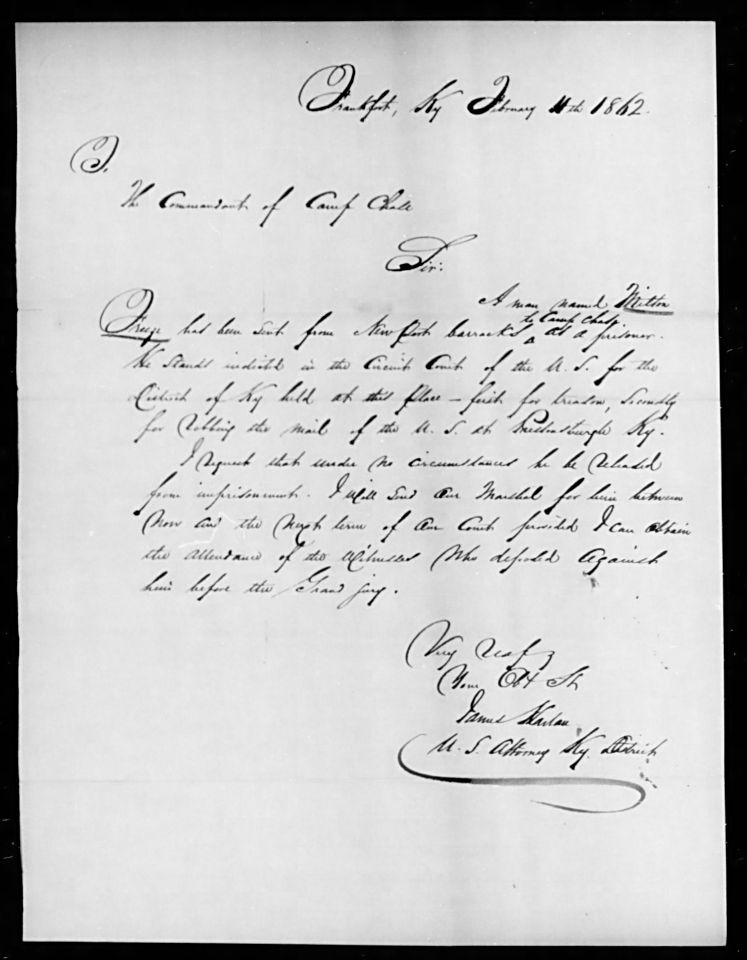
On November 6, 1861, Freese was indicted in the US District Court at Frankfort under Judge Bland Ballard, on the charges of treason and robbing the US mail at Prestonsburg. On January 27, 1862, Freese was arrested at his home in Prestonsburg and sent to Newport Barracks. Here he was held as prisoner, awaiting trial, until February 10, 1862, when he was transferred to Camp Chase, Ohio.

On February 11, 1862, James Harlan, US Attorney for the District of Kentucky, addressed a letter to the Commandant of Camp Chase, requesting that Freese “under no circumstances he be released from imprisonment. “ Harlan informed the commander that, “I will send a Marshall for him between now and the Next term of our court provided I can obtain the attendance of the witnesses who deposed against him before the Grand Jury.”


Milton Freese remained a prisoner at Camp Chase for another nine months until finally released on Nov. 8, 1862, by virtue of an order by the US Secretary of War and upon taking the Oath of Allegiance. Freese was listed as a resident of Floyd County, Kentucky and described as 42 years old, fair complexion, dark hair and whiskers, 5’11” tall and hazel eyes.

During Freese’s absence, his wife Minerva Freese was attending to her husband’s affairs at Prestonsburg. On Oct. 28, 1862, Capt. W. W. Cox, Quartermaster of the 5th KY Mounted Infantry (CS), paid Minerva $10.00 for use of the wagon and team and damage done to same while hauling Guns and ammunition from the Forks of Middle Creek to the Pike County Steam Mill on Sandy River.”


After his return to Eastern Kentucky, Milton Freese gave up his residence in Prestonsburg and moved to Louisa, Lawrence County, KY. His war-time activities seem to have come to an end and he turned to more peaceful pursuits. Freese operated a livery stable in Louisa. He also engaged in steam boating on the Big Sandy and Ohio Rivers and established the first reliable and successful packet line. The Sallie Freese and Fannie Freese, named after two of his daughters and the latter piloted by his oldest son Frank, and the Fleetwood, owned in partnership with R. F. Vinson, were three of the better known steamers that were plying the waters of the Big Sandy and Ohio Rivers in later years.


The Fleetwood, at Ironton, OH, 1866
From R. L. Hunster collection.
Wiki of The Public Library of Cincinnati and Hamilton County

In 1865, Milton Freese suffered the loss of his wife Minerva. At the end of the year, Freese’s past came to revisit him one last time. On December 28, 1865, Payne Johnson from Pike County filed a lawsuit against him and other parties, claiming that during the fall of 1861, Freese, as well as James M. Rice, John M. and Harvey Burns, John and L. B. Sword, Thomas and C. Cecil, and Thomas May, Sr., took, “with force and arms and against the will and consent of the Plaintiff,” a large lot of personal property from him, including horses, live stock and forage.

In November 1867, Milton Freese married Kate McGuire, of Louisa, the daughter of Nicholas McGuire. In 1872, the couple purchased an antebellum two-story brick house plus five acres in Louisa from former Union Captain Thomas D. Marcum (14th KY Infantry) for $3,150. The house is still in existence today and is located at the end of Sycamore Street, overlooking the Big Sandy River.


Freese House, Louisa, KY

Freese later established the Louisa Roller Flouring-Mills which had a capacity of seventy-five barrels per day. Despite being a successful business man throughout his life, Freese fell onto hard times and in 1894 had to sell his house in Louisa at auction for $200, reportedly the amount of debt he owed.


Louisa Roller Flouring Mill
later known as Louisa Supply Co.

Milton Freese died 10 years later, on September 14, 1904 and was buried at Pine Hill Cemetery, in Louisa, KY.

Article researched and written by Marlitta H. Perkins, Aug. 2011 and is under full copyright. Copyright © 2011, All Rights Reserved.

Wednesday, August 3, 2011

Morgan County Confederate Soldiers

Morgan County, KY
Lloyd's official map of the State of Kentucky, 1862
Image from Library of Congress

On May 4th, 1867, elections were held in the Ninth Congressional District* for the office of Representative in Congress. The candidates were Samuel McKee, a Republican (or radical) and John D. Young, a Democrat (or conservative) as well as Thomas M. Green. Young won the election by a reported majority of 1,471 votes over McKee. The vote cast for Green was so so small that it did not significantly influence the outcome of the elections in one way or another.

* The Ninth Congressional District consisted of the following counties: Lewis, Greenup, Fleming, Morgan, Rowan, Carter, Boyd, Magoffin, Pike, Johnson, Lawrence, Floyd, Montgomery, and Bath. It was lost to redistricting in 1953.

Samuel McKee subsequently contested Young's election, questioning his opponent's loyalty to the Union during the Civil War. He also challenged the legality of certain votes, claiming they were cast by former Confederates who were ineligible to vote in elections. The President's proclamation of amnesty of May 29, 1865, specially excepted from the benefits thereof, "all persons who left their homes within the jurisdiction and protection of the United States, and passed beyond the federal military lines into the pretended Confederate States, for the purpose of aiding the rebellion." Therefore, on the 4th day of May, 1867, all returned rebel soldiers in Kentucky were not only paroled prisoners of war, but were also unpardoned rebels, whom the reconstruction acts had not affected, as they did not apply to Kentucky. Accordingly, former Confederates were not considered legal voters.
Furthermore, some of the judges of election had been in the rebel army, and were disqualified to act as such judge by the laws of Kentucky.

After establishing the facts of this case, McKee successfully contested John D. Young's election and served in the Fortieth Congress from June 22, 1868, to March 3, 1869.

During the lengthy investigation, a great number of people were questioned and gave affidavits in regard to voters in their respective counties who had served in the Confederate Army. The following information was given in Morgan County, Kentucky.

Deposition of Thomas B. Lovelace, Nov. 13, 1867
"the names of all those who voted for John D. Young ... at the Hampton Mills precinct, in this (Morgan) county, who, during the late rebellion, were in armed rebellion against the government of the United States and citizens of this county."

Hampton Mills Precinct
James Dunaway
Matthew McClure
R. Cock
Samuel H. Osborne
Thomas Perry
Louis Henry
John H. Perry
Levi Montgomery
E. Ratliff
William Burton
R. W. Richardson
Preston Saxton
Louis McClannahan
John Fryett
Joshua Cock
James Cock
James M. Stamper
William Cock
Johnson V. Oahly
William Fugert
A. C. Nichell
W. J. Perry

Deposition of G. W. Stamper, Nov. 13, 1867

Blair's Mill Precinct
Jesse Hall
William Hall
J. M. Hall
D. Jennings
John Jennings
Coleman Brown

River Precinct
Joel Adkins
David Row
James Pennington
Nelson Pennington
James Horton
Jasper Adkins
Elisha Adkins (all that I know about Elisha Adkins is that I saw him a prisoner in the federal hands)
John Click
J. W. Carter
G. P. Carter
John W. Well
S. S. Adkins
Augustus Murry
P. M. Fannin
Rhoda Horton (don't know whether he was in the rebel army; he went off to Virginia during the war)
Daniel DeHart (from general reputation)
H. D. Porter (was taken prisoner and carried to Camp Chase)

The following told me they were soldiers: James Pennington, Nelson Pennington, James Horton, John Click, J. W. Carter, G. P. Carter, and T. M. Fannin; the remainder of the list that I have deposed to I only know from hearsay.

The men whose names I have given were rebel soldiers, as they stated to me, at some time during the war, but whether they were so at its close I do not know.
William Myneer was, before the war, and when it began, circuit court clerk, and W. W. Cox, sheriff of this county. Both are said to have been engaged in the rebellion. I have heard them say so. William Myneer has been, since January last, county judge of this county, and W. W. Cox, the sheriff.

Deposition of Miles W. Nickell, Nov. 13, 1867

John Livingston
M. B. Cox
J. J. Culbertson
Wm. Mynhier
John W. Kendall
W. W. Cox
Joseph Elam
Wm. Ward
John T. Hazelrigg
Marion Jones
M. T. Byrd
Sanford Davis
Allen Barker
Granville Fugett
R. F. Carhy
Lewis Henry, jr.
S. J. May
Wm. Lewis, Jr.
Wm. T. Havens
Edward Murphy
Peter J. Livingston
John T. Williams
James Davis
S. J. Havens
Davis Johnson
John E. Cooper
Luther Johnson
Elijah Prescott
A. J. Parker
Woodson Johnson
John W. Harris
W. W. Burns
Jackson Baily
Geo. W. Phillips

These are the names I remember to have been in the rebellion. Wm. H. Cartmill I saw with the rebel army; he was off with them, but told me he was only a tailor for them. I will add Uriah Elam. Ben. Wells was also with the army; saw him, and he told me he was. A. B. Reed was here at a fight; think he had a gun, but did not do much fighting; heard him say this. Geo. D. Phillips also had a gun, but told me he did not get into the fight; was out on the hill. Judge R. C. Day, who went up the hill with his gun, had his horse shot through the nose. Isaac N. Cottle was also a rebel soldier, and voted for Young. I think the above list comprises all whom I knew.

The following men were soldiers in the confederate army at the close of the war, as they stated to me, to wit: John Livingston, J. J. Culbertson, J. W. Kendall, Joseph Elam, Allen Barker, W. T. Havens, P. J. Livingston, Davis Johnson, L. Johnson, M. B. Cox, Wm. Mynhier, W. W. Cox, Sanford Davis, Lewis Henry, jr., Wm. Lewis, jr., E. Murphy, J. T. Williams and Woodson Johnson. These are all that I now remember of having stated to me they were soldiers at the close of the war.

Deposition of H. W. Vest, Nov. 13, 1867

Hampton Mills Precinct
J. W. Perry
Curtis Cock
George Cock
Reuben Ratliff

Deposition of Henry (Harry) Whitt, Nov. 13, 1867

Caney Precinct
William Lykins
John D. Reed
William Thomas
Cornelius Frisby
William Benton
Moses Whitley
F. W. Purcell
Peter W. Lykins
B. F. Stags
Henry Benker
James Benton
Greenbery Lykins
T. W. Brown
Simpson Debord
Isaac W. Lykins
Hennry Kellgon
Eli Lykins
Leburn Lykins
Levi Lykins
W. B. Lykins
J. D. Taulbee
Lilburn Henry
H. G. Castle
William webb
David J. Lykins
Robert Patrick
William H. Vance

William Lykins, sr., told me he was a chaplain in the rebel army. As to all the remainder, I derive my knowledge from having heard them talk of being in the rebel army, or from having see them myself going off.

Deposition of Walter C. Easterling, Nov. 13, 1867

River Precinct (No. 8)
S. J. May
W. W. Lewis
W. R. Davis
H. Wyatt
Uriah Castle
Thos. Jones
H. Rider
S. Helton
Isaac Perkins
C. T. Adams
J. E. Lacy
J. H. Williams

Deposition of Frank Hunter, Nov. 13, 1867

Little Sandy, Middle Fork Precinct
R. Elliott
J. W. Fryum
John Stevens
L. Osborne
Wm. Bidley
James Eldridge
Sol. Stevens, jr.
Mart. Iron
J. Fields
H. Davis
N. Prince
J. Hargis
John Gillen
J. Osborne
A. Sparks
James Gibson
Thomas Reed
Jesse Terry
Thad. Williams
G. Stevens
H. Stevens
H. W. McGuire
Daniel Stevens
John Kendall
James Greenwood
S. Bailey
H. Adkins, jr.
J. S. Adkins
C. W. Carter, jr.
California Bill Adkins
S. D. Adkins
William Gidons
William Parsons
Joseph Baily
G. G. Adkins
H. G. Adkins

River Precinct
Joel Adkins
Timothy Row
William Mays
William McMillen
Samuel Brown
G. W. Carter
S. F. Gray
James Pennington
Jesse Stafford
James Stafford
Phasoms Holbrook
Nelson Pennington
George Mays
John Howerton
Jasper Adkins
Lewis Garnell
W. D. Mays
William Whitt
John Click
G. P. Carter
L. D. Row
John W. Wells
James Porter
Augustus Murray
A. W. Murray
John W. Adkins
Michell B. Adkins
Phillip Barker
B. S. Hamilton
J. B. Horton
P. M. Larmins
H. C. Porter
Rhoda Horton

Paint Precinct
William Keater
George Larmins
John O'Neal
John B. Hurst
John Hammilton
James Fyffe
D. Iron
Robert Jenkins
James M. Ferguson
J. W. Robins
D. Iron, jr.
Joseph Fyffe
R. Ferguson

Q. - Please state how you know the foregoing voters whom you say voted for J. D. Young for Congress in this district in May, 1867, were in the rebel army?
A. - They went off from my neighborhood in 1861, and a great portion of them were in Captain James Hunter's company.

George Barker, as he told me, was a confederate soldier, but I do not know of anybody else being a confederate soldier at the close of the war. I was in the State of Ohio from 1863 to 1866.

The evidence also showed that at Little Sandy (Middle Fork) precinct, in Morgan County, G. G. Adkins, one of the judges of election, had been in the rebel army, and was disqualified to act as such judge by the laws of Kentucky.


This specific article was researched and written by Marlitta H. Perkins, August 2011, and is under full copyright. Copyright © 2011, All Rights Reserved.