Showing posts with label Prestonsburg. Show all posts

Friday, December 30, 2022

The Big Sandy Valley on the Eve of the 1862 Confederate Invasion of Kentucky

On June 20, 1862, Confederate General Braxton Bragg replaced Beauregard as commander of the Confederate Army of Mississippi, later renamed the Army of Tennessee. He devised a plan to shift the focus of the war in the Western Theater by invading Kentucky. This became known as the Confederate Heartland Offensive, the Kentucky Campaign and the Confederate Invasion of Kentucky. Once in the state, Bragg planned to combine forces with Lieutenant General Edmund Kirby Smith's forces and move against Buell's Army of the Ohio. 

On August 15, 1862, the first Confederate troops under Scott entered Kentucky near Monticello. The following day, Heth's column passed through Big Creek Gap while Kirby Smith moved through Rogers' Gap. On August 17, Stevenson's division arrived in front of Cumberland Gap which was occupied by federal forces under command of General George W. Morgan. On the evening of the same day, Kirby Smith struck Morgan's line of communications at Barboursville and Cumberland Ford, effectively isolating Cumberland Gap from the outside world. General Humphrey Marshall was still in Abingdon, Virginia, but expected to cross the border into Kentucky at any given time.

Preceding these movements were reports of increased activity and "a general uprising for the invasion of Kentucky all along the Virginia border." During the first week of August, the Pike County home guards encountered Confederate troops under Moore, Witcher, Menifee and Harmon on three occasions. Citizens were robbed and killed and stores plundered. Eventually, the Home Guards were  driven from Piketon. A few days later, a small group of rebels made their way to Prestonsburg and burned some US Government supplies and stole a number of horses from the citizens. On August 16, 1862, according to historian Damian C. Beach, Confederate cavalry repulsed and defeated a unit of Home Guards near Warfield, Lawrence County.  

Marshall finally entered Kentucky on August 19, 1862, through Pound Gap. As the situation in Kentucky quickly became unraveled,  rumors were rife. According to newspapers reports, "There is said to be no doubt but that the Confederates intend to take possession of the Big Sandy region, drive the Federal force out, and carry the war to the Ohio border." 

A letter from Camp McClure in Louisa, Kentucky, clearly illustrates the impending danger that Eastern Kentucky was facing during those days of uncertainty in August of 1862. Written by a soldier to the Cincinnati Commercial, it was re-published by the Louisville Courier-Journal on August 21, 1862.

Lower Big Sandy Valley
Map by Campbell & Barlow, ca. 1861

Upper Big Sandy Valley
Map by Campbell & Barlow, ca. 1861
Library of Congress

THE SITUATION IN NORTHEASTERN KENTUCKY.

Camp McClure, Louisa, KY., Aug. 16.

A word in reference to the excitement in Eastern Kentucky, caused by the threats of the secesh to "wipe us out in the Sandy Valley, and follow it up by the invasion of Ohio." Is there reason to fear the execution of these threats? I will give a little of what we know of their proceedings, and let you judge.

A few days since, fifty of the 4th Virginia V. L., in charge of their Major, were recruiting, seventy miles above here, on Tug Fork, and while leisurely eating dinner, disarmed, were fired upon by two hundred mounted rebels. ** They seized their arms, and fought for half an hour, when the Major, with two privates, fell, mortally wounded. By this time the little party, being nearly surrounded and overpowered by numbers, saw their doom if they did not fight their way out. So, with one determined effort, most of them made their escape, leaving but few taken prisoners. Being rapidly pursued, they scattered, every one for his own safety. In the course of a few days, twenty-six of them had wandered into our camp, bringing one severely wounded.

The 200 guerrillas are the companies that so terrified that part of Kentucky by stealing and murdering before we drove them out last winter, and have long deserved the fate Strutton met in this last affair. He was Captain of one of the companies, and was not only killed, but the "Devil of the Mountains," Witcher, Captain of the other company, was severely, and though to be dangerously wounded.

At about the time of this engagement two or three other rebel companies came down the other fork of Sandy to Piketon, took possession of the town, not, however, without some considerable resistance from the Home Guards, who gave them a war on reception from the bushes, killing and wounding several; but their number was so small they were compelled to retreat to the rocks and caves. They were not satisfied with the appropriation of everything, belonging to Union citizens, but had the daring impudence to come down to Prestonsburg and burn all the provisions we had not yet moved from there. The loss was but small, as the stuff had been condemned.

The guerrillas are making great efforts at recruiting men, but secure many by telling them they will be sent to Richmond if they don't enlist, and that they will not be allowed to stay at home as long as they can carry a gun.

Captain Ford *, of the Home Guards, above Piketon, has just arrived with the news that Col. Williams's regiment of 700 mounted men had also crossed the mountain, and have now taken up quarters in Piketon, not, however, without first giving him a call, and that too with a volley of musketry which told him and his squad to skedaddle for their lines. The Captain was exposed to a perfect shower of bullets for one-fourth of a mile, some of them hitting his horse and saddle, but leaving him unhurt. What became of the rest of his men is yet unknown. The Captain is confident, from the number he saw and from the most reliable information, that there is at least one full regiment of mounted rebels.

This is not all. It is believed, and most reliable accounts lead to the conclusion, that these are only the advanced scouts of Humphrey Marshall's expected large army, with which he has so violently threatened Eastern Kentucky.

They are now committing more desperate outrages than ever. Beyond the mountains, every man that does not join the army is sent off as a prisoner, and his family driven from whatever possession they have, which is confiscated to "Southern rights." Capt. Ford saw a party of these poor, unfortunate, home-robbed families that had crossed the mountains, seeking a place to keep from starving to death.

The efforts made to penetrate Kentucky through Cumberland Gap and Pound Gap simultaneously only go to verify their threats of the conquest of Kentucky and the invasion of Ohio. Any one acquainted with the geography of the country through Eastern Kentucky well knows that the Sandy Valley is one of the best natural inlets from Dixie to the Northern States, and that the rebels want no better place than the mountains and hills at the head of Big Sandy to gather and conceal a strength sufficient to annihilate us, and make a march into Ohio in less than three days.

All we want is more force, especially cavalry, and we will wipe them out so effectually that they never again will want to avenge their defeats at Ivy Mountain, Middle Creek, and Pound Gap. Col. Cranor, having been in this part of Kentucky ever since he led the gallant charge at the battle of Middle Creek, is well acquainted with the hills, roads, and creeks, and the people from here to the mountains. His fighting qualities and good generalship make him well prepared to take command of whatever force is sent here. This is an important item, as our success or defeat depends to a very great extent on a perfect knowledge of the geography of the battle ground. To fight these skulking rascals considerable marching  must be done - of this we had experience enough to know we might have accomplished tenfold more had we had a more intimate knowledge of the country.

-Cor. Cin. Com.


Notes

* Pike County Home Guard Captain William Ford later enrolled as Captain in the 39th Kentucky Infantry (US), Company B, on September 2, 1862. He was 41 years old. He died on November 24, 1864, of dysentery, at Lexington, Kentucky.

** This engagement is known as the Battle of Beech Creek and took place on August 6, 1862.


Links of Interest

Excellent article by Randall Osborne, Pike County Historical Society

While on a mission which had previously seen them trek across McDowell and Wyoming counties in West Virginia, a group of Confederate soldiers from Virginia, led by Lieutenant Colonel Vinson A. Witcher, making up the 34th battalion under his command, encountered and clashed with a portion of the 4th West Virginia Union regiment under Major Hall, resulting in a battle. The two groups confronted each other near the Cannaday farm on Beech Creek in what was then Logan County, West Virginia but is now considered Mingo County. During the battle, Witcher's right hand man, the 34th battalion's Major William Straton, was severely wounded in both his right arm and his chest, though he later recovered and was able to rejoin the Confederate army.

By Brandon Ray Kirk

On the 6th of August, 1862, Major Hall, with a force of forty-eight men, at Beach Creek, near Logan Court House, encountered 200 Confederated mounted infantry, under Colonel Stratton and Major Witcher. The fight was a stubborn one, Major Hall and two enlisted men were killed and twelve wounded. Of the Confederates, Major Witcher was killed; upon the death of their commander the Confederates retreated. In the death of Major Hall, the 4th Regiment suffered a great loss. He was a graduate of West Point, was young, brave, and of course well qualified for all the duties of a soldier.

Union Civil War Pass for Mrs. G. Vincent, Camp McClure, Louisa, from July 21, 1862 to August 1, 1862.


Researched, transcribed and written by Marlitta H. Perkins, December 2022. Copyright © 2022, All Rights Reserved.

Monday, December 13, 2021

Flemingsburg Welcomes the 33rd OVI, October 16, 1861

 At the beginning of October 1861, General William "Bull" Nelson began assembling troops at the newly established Camp Kenton in Mason County, near Maysville, Kentucky. His objective was to move against the Confederates who were assembling in a camp near Prestonsburg, Floyd County, Kentucky. Nelson left Camp Kenton on October 16, 1861, to join up with additional troops and consolidate his force at Olympian Springs. Accompanying Nelson was the 33rd OVI from Portsmouth, Ohio, commanded by Colonel Joshua W. Sill. 

Colonel Joshua W. Sill, 33d OVI

The following letter was published in the Cincinnati Daily Commercial, October 21, 1861.

FROM THE THIRTY-THIRD OHIO REGIMENT.

How Well the Ohio Soldiers are Received by the Union Men of Kentucky.

Flemingsburg, KY., Oct. 17, 1861.

EDS. COM.: - We left the Fair Ground where we had been since Monday night, near Maysville, yesterday at 3 P. M. , and arrived here at 8; and such a welcome awaited us as no soldiers ever had before. God bless the people of Flemingsburg! The whole town turned out to greet us - houses illuminated, handkerchiefs waving, voices cheering - a perfect ovation. The ladies prepared a supper for us with their own fair hands, and waited on us in every possible way to make us comfortable and glad. We not only had the substantials in the way of eatables, but delicacies of every kind - fruit, sweetmeats, cakes, &c.

Talk about Union people in Ohio, the Kentuckians beat us all. We have seen nothing like this since we have been in the service, and many of us are three months men, re-enlisted, and have been on duty in Virginia, Eastern and Western.

No wonder "Secesh" wanted to hold such a State, and no wonder that we have resolved at any cost to sustain such a loyal and generous people.

In the morning we received the same care and attention. The ladies vied with each other in bestowing upon us their smiles, and what some of us perhaps liked equally well their hot coffee, rolls, beefsteaks, broiled and friend chicken, &c., &.

Wasn't this some for soldiers? Who wouldn't enlist to defend such homes as these? This is much nicer of a town than I had supposed; has an air of comfort as well as business; and the country hence to Maysville is certainly the finest I have yet seen. I tell you it was a nice sight to see those beautiful ladies going to and fro like ministering angels, as they are - mothers and daughters - even the children - with their refreshments to our jaded boys. One such welcome and scene as this, will repay countless privations that may await us. Every door was thrown open to us; every hand was open to receive and welcome us. Can such a people perish? Never, never!

We leave for Mt. Sterling in a few moments; our gallant Col. Sill having just received orders to march there instead of "Olympian Springs," as we had supposed. We leave behind us here four of our men sick; they will be in good hands.

If anything of special interest turns up, I will try in my feeble way to advise you.

It has been raining in torrents all the morning, and still continues.

33d SCRIBE.


Before their departure from Flemingsburg, the 33rd OVI addressed the citizens of Flemingsburg and vicinity, thanking them for the hospitality shown to them.  It was published in the Fleming Star and re-printed in the Louisville Courier Journal, October 31, 1861.

(From the Fleming Star).

TO THE CITIZENS OF FLEMINGSBURG AND VICINITY.

The undersigned officers of the Thirty-third Regiment Ohio Volunteers United States Army, take this means of expressing their heartfelt thanks to you for the warm and enthusiastic reception that the regiment has met at your hands. They have often heard of the hospitality and loyalty of Kentucky; but war had wrought such changes amongst our countrymen that it was feared that the first march of a regiment of Ohioans would be viewed with distrust by her citizens. But our reception last evening, and the substantial cheer our soldiers received at the hands of your fair ladies, have dissipated all such fears, and we now feel that we are fighting not only for a great principle, but by the side of those who properly appreciate our motives, and who will not let us suffer for sympathy. A heart-warm adieu! 

(Signed)  J. W. SILL. Col. 33d O. V.

               O. F. MOORE, Lieut. Col.

               J. V. ROBINSON, Jr. Maj.

               E. E. COLBURN, Qr. Master

               J. M. KENDRICK, Adj.

               J. D. MUBRY  }

               A. J. PHELPS } Med. Staff

October 17, 1861


Counties of Mason, Fleming, Bath and Montgomery
Lloyd's Official Map of Kentucky, 1862
Library of Congress

Additional Sources

33rd Ohio Infantry, Ohio in the Civil War, compiled by Larry Stevens

Joshua W. Sill Biography

For a detailed look at General William "Bull" Nelson's 1861 Eastern Kentucky Campaign

The Most Brilliant Little Victory, by Marlitta H. Perkins (epub)

The Most Brilliant Little Victory, by Marlitta H. Perkins (print)


Transcribed by Marlitta H. Perkins, December 2021. 
Marlitta H. Perkins © 2021. All Rights Reserved

Monday, July 8, 2013

Dear John ~ The Hazards of Mail Delivery


Patriotic cover, postmarked April 14 (1862) at Catlettsburg, KY 
The Post Office Department of the Confederate States of America was established February 21, 1861, by an act of the Provisional Congress of the Confederate States. On March 6, 1861, former U.S. Congressman John Henninger Reagan was appointed postmaster general of the Confederate States of America by President Jefferson Davis.

Reagan instructed southern postmasters to continue to render their accounts to the United States as before until the Confederate postal system was organized. In May 1861, Reagan issued a proclamation stating that he officially would assume control of the Post Office Department of the Confederate States on June 1, 1861. US Postmaster General Blair  responded by ordering the cessation of United States mail service  throughout the South on May 31, 1861. This also included mail going from North to South and vice versa.

After this time, private express companies, such as Adams Express, American Letter Express, and Whiteside's Express, still managed to carry the mail across enemy lines, until the U.S. Post Office ordered an end to such traffic, effective August 26, 1861.

Mail delivery was carried out by private contractors. Transporting the mails was filled with danger, particularly along the Kentucky and Virginia border which was infested with bushwhackers. Interrupted service, robberies and guerrilla sniping were a common occurrence. On Sept. 5, 1861, the Daily Louisville Democrat reported that, "In the counties along the Kentucky and Virginia line, several mails have been robbed by men, who came from Virginia, across the line, for that purpose."

One such incidence took place on Wednesday, August 21, 1861, when the mail from Louisa to Warfield, via Cassville (VA), was robbed. Nathan Holt, a wealthy Wayne Co. VA farmer and one of the first local constables, was the mail contractor. The mail boy, his 17 year old son Bernard P. Holt, had left Warfield at 6 o'clock in the morning with the mail and was travelling on the Virginia side of the Big Sandy River toward Cassville. About 5 o'clock in the evening, Bernard arrived within 1 1/2 miles from town when he noticed two men, Alex. Vinson and John Walker, on the road side waiting for him. The boy was knocked from his horse by Vinson and Walker who swore that they were going to have that Lincoln mail. Bernard Holt engaged in a fight with Walker while Vinson cut the mailbag and took out and destroyed all the mail matter, and then took the horse from the boy. Both men left together.

Bernard P. Holt alerted the citizens who made pursuit and captured Vinson about three miles from the place of the robbery. He was brought back to Cassville, and had a hearing before Justice James Stone, who held him over for further trial. Vinson was then put in custody of Constable Bow, who summoned two citizens as guard to watch Vinson through the night. He however made his escape before morning. The Sandy Valley Advocate noted, "He and Walker are now at large. From what we can learn, all the officers were secessionists, as well as the guard, and therefore do not wonder at the escape of the prisoner."

Within days after the incident, Bernard P. Holt was fired on by someone in ambush near Taber's creek, between Turman's Ferry and Cassville. The constant threat of rebel incursions made it increasingly difficult to safely maintain postal service in the area, which may have contributed to the closing of the Falls of Tug (William Ratcliffe, post master) and Palmetto Post Offices on Sept. 3, 1861. David Holt, Bernard's older brother, had held the position of post master at Palmetto since March 9, 1858.

 Nevertheless, Nathan Holt entered into another contract with the US post office on April 24, 1862, to carry the mail twice a week between Warfield and Louisa, KY. In the end, however, Holt failed to execute the contract.

Instead, Nathan Holt joined Union Capt. David Bartram Company, 167th Militia, on June 2, 1862, together with his sons William, David, John W. and Bernard. The Holts continued in the militia service until 1864, in Capt. William Bartram's Wayne County Scouts. 

Sanford Scott, who was contracted to carry the mail six times a week between Guyandotte to Catlettsburg, failed to arrive at Catlettsburg on May 4 and June 28, 1861 and 8 times in July of 1861. Scott completely omitted service for the quarter ending Dec. 31, 1861. Deliveries were resumed by John H. Ford, of Catlettsburg, beginning February 21, 1862.


Catlettsburg Postmark, March 14 (1862)
The situation in Kentucky along the Big Sandy River was very similar.  Stephen Bartram who was contracted to carry the mail twice a week from  Catlettsburg to Prestonsburg, a distance of 73 miles one way, encountered similar problems. Bartram failed to arrive at Catlettsburg with the mail on July 24, Sept. 12 and 26, 1861. After being robbed several times, mail service was finally suspended until the end of December of 1861 when the presence of Union troops along the Big Sandy River made it to a degree safer again to carry the mail.

During the first week of November 1861, the Grand Jury, United States Court, in session at Frankfort, KY, found indictments against Harvey T. Hawkins and Milton J. Freese, for robbing the mail. Bail was set at $ 3,000 each, and $3,000 surety.


Cincinnati Postmark, May 13 (1862)
At the beginning of fall 1861, safety concerns led to the discontinuation of mail service on several Eastern Kentucky routes, under act of Congress of February 28, 1861. The act authorized the Postmaster-General to discontinue the postal service on routes where, in his opinion, it "can not be safely continued, or the postal revenues collected, or the postal laws maintained, by reason of any cause whatever, till the same can be safely restored."

Effective Oct. 17, 61, Route # 9555: Mt. Sterling/Piketon, 2 weekly round trips, D. Cooley (contractor)

Effective Oct. 17, 61, Route # 9556:  Mt. Sterling/West Liberty, 2 weekly round trips, H. C. Berkley (contractor)

Special Agent Miller was authorized to employ service upon the above mentioned routes "as far as safety would permit, at not exceeding the rate of the old pay, from Nov. 11, 1861."


Effective Oct. 17, 61, Route # 9578: West Liberty to Louisa, 1 weekly round trip, Wm. P. Davis (contractor)

Effective Nov. 29, 61, Route # 9569: Greenup Court House/Louisa, 1 weekly round trip, Charles Callahan (contractor)
Louisa Postmark, August 13 (1862)
Several Post offices were discontinued in Eastern Kentucky during the Civil war. Given are the dates of closing name of the post masters and date when the post office was re-established, if applicable.

Lawrence
Cherokee, Sept. 13, 1861 (William W. Graham), re-est. Sept. 10, 1867
Warfield, Nov. 4, 1862 (Mark Dempsey) re-est. Aug. 29, 1870
Bolton, Nov. 2, 1861 (Greenville Bolt) see Boyd Co. KY
Riffe's X Roads, June 25, 1863 (Isaac Belcher)
Georges Creek, July 31, 1863 (Thomas P. Salyer)
Lockwood, Dec. 8, 1865 (Jacob Lockwood)
Buchanan (formerly Round Botton, Wayne, VA) est. Sept. 3, 1861 (George Buchanan, followed by Joseph F. Hatten, Sept. 29, 1863)

Floyd
Coal Grove, Feb. 28, 1863 (Stephen Ferguson)
Lanesville, July 31, 1863 (James S. Layne), re-est. Oct. 27, 1865

Pike
Breckenridge, July 21, 1863 (William R. Bevins)
Democracy, Feb. 28, 1863 (William H. Johnson)
Lonville, Oct. 10, 1862 (Thomas L. Marrs)
Piketon, May 20, 1864 (Lewis C. Dils), re-est. Oct. 28, 1865
Robinson Creek, Nov. 5, 1861 (Samuel Keel), re-est. Sept. 28, 1866
Hamilton's Store, July 31, 1863 (Nelson Hamilton)

Boyd
Grass Land, Jan. 30, 1862 (William Davis); re-est. Aug. 28, 1862 and discontinued Feb. 28, 1863 (Madison M. Hensley), re-est. June 11, 1875
Sandy Furnace, Feb. 28, 1863 (Pleasant Barber)
Amanda, Aug. 22, 1862 (George P. Walker)
Bolton, July 21, 1863 (John W. Bolt)

Greenup
Three Prong, Nov. 2, 1861 (J. R. Warnock), re-est. Jun 23, 1866 (Mrs. Martha Warnock)
Truittsville, May 30, 1862 (George W. Truitt)
Callahan, Dec. 2, 1861 (John R. Callahan)
Argylite, Oct. 26, 1861 (James Lampton), re-est. June 24, 1874 (as  Argilite)

Carter
Bell's Trace, April 15, 1863 (Nelson T. Rice)
Bruin, July 31, 1863 (John Hood), re-est. Jan. 16, 1867
Estill Flats, June 4, 1863 (Wesley Fults), re-est. Sept. 10, 1863
Rice's X Roads, July 31, 1863 (Paris Rice)

Lewis
Clarksburgh C. H., Feb. 8, 1864 (Isaac Bassett)


Morgan
Black Water, July 21, 1863 (John C. Dennis), re-est. Feb. 1, 1866
Caney, March 20, 1862 (David F. Lykins), re-est. July 7, 1874
Christy's Fork, Feb. 26, 1862 (Thornton W. Sanford)
Grassy Creek, July 31, 1863 (Thomas Goddwin)
Hampton's Mills, March 20, 1862 (George M. Hampton)
Johnson's Fork, Sept. 10, 1862 (Eli Williams), re-est. in Magoffin Co. KY Jan. 9, 1863 (Mrs. Lodicky Denham)
Little Sandy, Jan. 9, 1864 (William B. Wheeler)
Relief, July 31, 1863 (Wallace W. Brown)
Devil's Fork, Jan. 9, 1864 (George W. Stamper)

Wolfe
Still Water, Feb. 14, 1865 (Wm. W. Waterman)
Devil's Creek, July 31, 1863 (Sandford R. Shackelford)
Hazel Green, Nov. 8, 1865 (Addison H. Tracey), re-est. Feb. 1, 1866

Rowan
Blue Rock, Oct. 10, 1863 (Wm. H. K. Garvin), re-est. in Carter Co. Feb. 9, 1864

Bath
Gill's Mills, July 31, 1863 (William M. Ragland), re-est. Sept. 23, 1865, in Rowan Co. KY
Laurel Fork, April 15, 1863 (Andrew J. Connoy)
Rockhouse, Dec. 14, 1861 (Thomas N. Perry), re-est. Feb. 6, 1867
Bald Eagle, Jan. 21, 1863 (Joseph Willson), re-est. Jan. 21, 1874

Fleming
Pleasant Grove Mill, Dec. 15, 1864 (Squire A. Day)
White Oak Hill, Feb. 26, 1862 (Benjamin G. Johnson)

Letcher
Cornett's Mill, Oct. 10, 1863 (Peyton M. Duke)
Indian Bottom, July 31, 1863 (John Dickson), re-est. Aug. 25, 1868

Perry
Brasherville, Juy 31, 1863 (Robert S. Brashears)
Cutshin, Juy 31, 1863 (James C. Brewer), re-est. Aug. 22, 1872

Breathitt
Frozen Creek, July 31, 1863 (Samuel H. Holmes)

There were no closings in Johnson and Magoffin County, KY, during the Civil War.

Paintsville Postmark, August 27 (1862)


Links of Interest


Article researched and written by Marlitta H. Perkins, July 2013. Unauthorized use and/or duplication, including images, without express written notice by the author is strictly prohibited. © 2013. All Rights Reserved.


Friday, June 15, 2012

John McConnell Rice

John McConnell Rice was born in Prestonsburg, Floyd County, Kentucky on February 19, 1831, the son of James Madison Rice and his wife Jane H. Burns. Rice, undoubtedly, was named after John M. McConnell, a lawyer from Greenup County, Kentucky, who was a close friend of his father.
John McConnell Rice
Brady-Handy Collection, Library of Congress
In 1805, James Madison Rice, himself a successful lawyer, had come with his parents from Gyandotte, Virginia to Greenup County, Kentucky, who settled in the Coulton (now Boyd County)area. He moved to Floyd County, KY, when he was elected county attorney in 1827. Subsequently, he held various offices during his distinguished career - Magistrate (District 6, Floyd Co., KY, 1832) and circuit judge (Floyd Co. KY, 1850/Lawrence Co. KY, 1868). By 1850, Rice was also a substantial slave holder, who owned 14 slaves.

His son John M. Rice received a rudimentary education in Eastern Kentucky. He soon decided, like his older brother Jake, to follow in his father’s footstep and pursue a legal career. In 1850, the 19 year old was living in Lawrence County, Kentucky, in the household of his father and was listed as a student at law – but law books were not the only thing that held his interest. During the previous summer, Rice met 16 year old Junietta Garrett, who was living with her brother Marshall, the wharf boat keeper, in Louisa. Their romantic relationship resulted in the birth of a daughter, Mary Louise, on March 15, 1850. The child did not appear in the 1850 census with either parent and may have been raised away from Lawrence County, quite possibly to avoid a scandal.

Rice did not marry Junietta - perhaps she was not considered a proper match for John M. Rice or regarded as an unwelcome distraction to his blossoming career. He soon left Lawrence County to attend Louisville Law School from where he graduated in 1852. Within months of his return, on November 25, 1852, Rice was married to Sarah Frances Poage, the daughter of William Poage and Eliza Van Horn. Her aunt Permelia VanHorn was the wife of Frederick Moore, a prominent business man in Louisa. His son Laban T. Moore, a lawyer and future US Congressman, would later raise the 14th KY Infantry, the first Union regiment in the Big Sandy Valley.

Frederick Moore

Permelia VanHorn Moore
In 1853, John M. Rice was admitted to the bar and soon thereafter opened a law practice in Pikeville, Pike County, KY. On January 30, 1854, his daughter Eliza J. Rice was born. During the same year Rice was elected superintendent of schools of Pike County and in 1856, prosecuting attorney of Pike County. Rice soon set his sights on a political career and successfully ran for state representative in 1858. In 1861, he ran for re-election and won another term. It was during this time that John M. Rice relocated to Louisa. Meanwhile, his family had grown steadily. The Rices welcomed daughter Ida in 1856, Adda Maria on Feb. 5, 1859 and James William on July 22, 1861.

Unfortunately, their happy home life was overshadowed by the outbreak of the Civil War. John M. Rice was regarded as a southern sympathizer and even though he did not try to influence any one to join the confederate forces, according to John Dils, Jr., he “was a warm advocate of their cause; when talking on the subject of the war, he always spoke in their favor.” In May of 1861, Dils sold him a shotgun which Rice later nicknamed “Yankee Killer.” During the summer of 1861, Rice gave speeches at several political meetings in Eastern Kentucky, including Louisa, KY. Thomas McKinster recalled that “the subject discussed to the best of my recollection was neutrality. There was no disagreement at the meeting as I knew of - no one replied.”

Meanwhile, Rice approached John Pigg, a local Louisa blacksmith, and asked him to make him a saber but Pigg declined because it “did not suit my principles … I was for the Union.” Yet, John Keller, who owned a saddle and leather shop in Blaine, made a cartouche-box and pistol-case for Rice.

Around the middle of September, 1861, John M. Rice left Louisa on a business trip to Prestonsburg, in order to collect money. He was accompanied by Melissa Franklin and Mrs. A. A. Wellman.

When Rice arrived at Prestonsburg, the Confederates were in the process of establishing a camp near town, on the farm of Samuel May. There was a great influx of people from all over the state who were either on their way to Virginia or had made the trip with the intention of joining the Confederate Army.

Samuel May House
Prestonsburg, KY
Rice established himself in Milton Freese’s hotel in town and was soon visited by two Lawrence County men, George R. Diamond who had known Rice since his childhood, and Jesse Meek. According to Diamond, “there was a company temporarily organized at Prestonsburg by John Sparks. In that organization Jesse Meek was elected first lieutenant and myself second lieutenant, and from some cause I do not remember, Sparks left the company.” Diamond and Meek tendered Rice the command of the company, but he refused to accept it.

According to Daniel Hager, several companies, or parts of companies, had come to Prestonsburg for the purpose of joining the Confederate army under John M. Rice. Even though Rice was sympathetic to the Southern cause he had no intentions of entering the military service or recruiting for the Confederate Army. Hager noted that “those parts of companies who came there said that they had come for the purpose of joining the army, and if such men as John M. Rice and J. M. Elliott and others would not go into the army they would not; and they disbanded and went home, and I understood afterwards that a large portion of the men went into the federal army.”

Rice endured a great deal of harsh criticism for his course of actions. Hager remarked that “the officers considered, by said act, there was at least one regiment of men lost to the confederate army, and they blamed John M. Rice and others for not going into the army, as he was considered a man of influence in the Big Sandy Valley.” George R. Diamond noted, “I do know that he incurred the displeasure of the confederates. I frequently heard General John S. Williams say that Rice could, if he would, recruit a regiment or brigade in Northeastern Kentucky if he would. I heard him say that such men as John Rice should be forced to go into the confederate service or leave the country. I have also heard other confederate officers complain of John M. Rice's not entering the confederate service.” According to James Honaker John M. Rice was “considered at coward, and abused by Williams’s men and officers; and I heard John S. Williams curse him to his face and tell him he was a coward or he would join the army. The abuse above named was because he would not join the army and aid them in the army.”

Colonel John S. "Cerro Gordo" Williams
While still at Prestonsburg, Rice’s sister Amanda arrived and brought the news that their father, as well as two of his brother-in-laws, George B. Poage, and Samuel Short, had been arrested by the federal authorities. Rice immediately realized that he was in danger of suffering the same fate. He informed Mrs. Wellman that he did not intend to return to Louisa and requested her to tell his wife to send him word when it was safe to come back home. He then concluded his business in Prestonsburg and traveled further up the Big Sandy where he boarded with Hibbard Williamson at Pikeville. Williamson noted that Rice “came up here to keep from being arrested and sent off to prison. His wife sent to him while he was at my house … not to come home, for he was in danger of being arrested and sent off.” Rice left Williamson’s place after two weeks but soon returned upon Jake Rice's wife’s request. “Jake Rice was taken sick,” noted Williamson, “and we all thought he would not live, and he was sent for to come and see his brother; he staid with me all the time he staid in town or while he staid in the county…”

During the Battle of Ivy Mountain, Rice was still at Williamson’s place but decided that it was time to leave. The following morning, on November 9, 1861, John M. Rice, together with his brother Jake and Coburn Cecil, Jr. left Pikeville ahead of the Confederate troops, and went on their way to Southwest Virginia via Pound Gap. Cecil noted, “John M. Rice and myself, together with others on the approach of Nelson and his forces, left and went out to Virginia; my reason for going was the rumor and personal enemies that was with Nelson and his forces; I did not think it was safe to fall into their hands. The rumor was that they were treating the citizens very badly; was killing or would kill them, or many of them. From the conversation that I had with Rice the same reason induced him to go to Virginia that induced me.” Talk was that lawyers, as a class, were, as a general thing, hunted down and mistreated, especially by those who had been prosecuted for crimes or those who had been in litigation.

The men proceeded to Abingdon, Virginia and boarded at the Virginia Hotel (also known as Benham’s Hotel). According to Jake Rice, “soon after we got there C. Cecil, jr., was taken sick and John M. Rice put in the most of his time in waiting on him.”

During his stay at Abingdon, Rice was visited by John Dils, Jr.’s wife Ann whose husband had been arrested by Col. Johns S. Williams, along with other Pike County Unionists and sent off to prison in Richmond, Virginia. Ann Dils turned to Rice for help, asking him to accompany her to Richmond to assist her in pursuing her husband’s release. Rice declined, stating that he, for the moment, was taking care of Colbert Cecil, Jr. and that he had determined to return to his home. He also doubted that his presence in Richmond would do any good. Nevertheless, he addresses a letter to William E. Braxton & Henry C. Burnette, the only acquaintances he had in Richmond, appealing to them to assist Mrs. Dils in pursuing her husband’s release. He explained the reasons for Dils’ arrest and gave assurances that Mrs. Dils was a lady of respectability. Ann Dils carried the letter to Richmond and eventually affected her husband’s release from prison.

John M. Rice returned to Kentucky about the time when General Humphrey Marshall and his troops were moving from Virginia through Pound Gap into the Big Sandy Valley at the beginning of December 1861. Once again, Rice boarded at Hibbard Williamson’s house but was also seen on occasion in Floyd County, Kentucky. When General Marshall and his troops arrived at Prestonsburg, he had a chance encounter with Rice at Friend’s Tavern. Marshall, as other Confederates before him, felt that Rice should be aiding the Confederate Army and he “urged him to exert himself in raising a command; but he declined; at least he took no step in that direction.“ Marshall continued, “I remember this because I remember the solicitude upon the subject, as I knew the influence of his family in the mountain counties of Kentucky, and I was anxious to avail our cause of the benefit to result from such an accession. I failed to secure it in the person of Mr. Rice, and thought he was acting badly to refuse to give his services to a cause which then commanded my best wishes, and to which I was devoting my own energies.”

General Humphrey Marshall
On January 10, 1862, Marshall engaged James A. Garfield in battle at Middle Creek, near Prestonsburg, which resulted in a Confederate defeat. Miles away, at present-day Betsy Layne, John M. Rice, along with another guest, Stephen G. Loar, was lodging with James Shannon Layne, a well known early pioneer settler in Eastern Kentucky, and his wife Caty.

James Shannon Layne and wife Caty (Hager) Layne
The conversation turned to Anthony Wayne Hatcher, who was married to Layne’s grand-daughter Jane Layne. Hatcher had been wounded severely in November 1861 during the Battle at Ivy Mountain when a bullet shattered his leg. Despite his wounds, Hatcher had managed to escape capture and was being cared for by the Tandy Stratton family. Rice and Loar decided to visit Hatcher, who lived about a mile above the Layne’s opposite the mouth of Mud Creek (present-day Harold, Floyd Co. KY) where he operated a store. The following day, according to plan, the two men set out for Mud Creek. As a precaution, Rice left his horse at Hatcher’s neighbor James W. Cecil, who lived across the ridge from Hatcher. Lucas B. Sword and Harrison Ratliff were visiting at the time at Widow Hatcher’s place, which was just across the river, about 300 yards away, to hear how the fight came off at Middle Creek. Sword and Ratliff witnessed what happened next.

At Anthony Hatcher’s house, Rice and Loar found another man, David A. Powell, who was visiting. Before long, a group of local home guards and soldiers under Lieutenant Martin Thornsberry, who had been on a hunt after a man named Platt Moore on the near-by Stratton farm, arrived at Hatcher’s place. Upon entering the house, Rice, Loar and Powell were promptly arrested. Thornsberry’s group included Dr. Stephen M. Ferguson, who lived nearby, as well as Lewis, M. C. W., Thomas J. and Henry C. Sowards, and “a good many others, some twenty or twenty-five, composing the party making the arrest.” Thornsberry, who had known Rice for more than twenty years, struck up a conversation with him and noted that he “was very badly scared at the time of his arrest. I think he regarded his life in danger ... I know that the Sowards were very malicious toward Mr. Rice.” He implored Thornsberry, “to keep them (the Sowards) from killing him, and asked me if I would let them kill him, and I told him I would not.” According to Thornsberry, Rice stated, “if I would not let the Sowards hurt him, he would get his pistol and give it to me; he got the pistol and gave it to me. He said he had a good horse, and asked me if I would let them take it away from him? I told him no; that he might ride it himself.” Lucas B. Sword witnessed, “Thornsberry, I thought, and some other man, go across the ridge to James Celis (Cecil’s), after Rice's horse, and seen them leave Anthony Hatcher's with John M. Rice on his horse.”

Thornsberry and his men proceeded with their prisoners to federal headquarters at Paintsville and delivered them to Col. J. A. Garfield, with the exception of David A. Powell who had jumped off his horse and managed to escape into the darkness of night.

Garfield examined Rice’s case and interviewed Thornsbury, asking him why he had brought Rice to Paintsville. He stated that Mr. Rice was a member of the Kentucky legislature. “That fact, at that time, to my mind seemed to be prima facie against Mr. Rice, so far as his loyalty was concerned,” noted Garfield. “Still, I did not consider it as conclusive. I asked Thornsberry whether he had any evidence that Mr. Rice belonged to the rebel army. He stated he found him twelve or fifteen miles south of my encampment, and in the neighborhood where the rebel army had recently been. I further examined him as to any evidence he might possess that Mr. Rice belonged to any rebel force. There was no evidence given to me that he belonged to the rebel army, nor that he had done any overt act which would justify me in regarding him as a soldier or an enemy.”

Garfield also examined one or two of the persons who were brought in with Rice. He stated that, “the result of my examination was that I did not find sufficient ground to hold him as a prisoner, or to send him to Camp Chase, Ohio.” Accordingly, Garfield issued Rice a written discharge.

Headquarters Eighteenth Brigade Paintsville, Kentucky, January 14, 1862

Mr. John M. Rice, of Louisa, Kentucky, having pledged himself not to aid or abet directly or indirectly, the confederate forces in the present war, is hereby released on his parole, and granted safe conduct into the camps and through the lines of the Union troops, subject to all proper guard and police regulations.


By order of Colonel J. A. Garfield, commanding brigade
W. H. Clapp
Assistant Adjutant General

John M. Rice's pledge of honor
After his long absence from home, Rice was finally able to return home to his wife and children in Louisa. The following months were a time of peace and calm for the Rice family. Garfield’s departure from the Big Sandy Valley in April of 1862 would change all that.

Colonel Jonathan Cranor, 42nd OVI, now in command of the federal troops in the Big Sandy Valley, had different ideas how to conduct business. Although efficient as an officer he lacked Garfield’s benevolence, understanding and warmth. He ran things with an iron fist and soon became feared and even hated among the Confederates to the point that an assassination plot against him was planned but not carried out. Cranor continued arrests among the citizens in Eastern Kentucky and a network of spies kept him well informed of the enemy’s movements.

In July of 1862, Gen. J. T. Boyle, commander of US Forces in Kentucky, sent orders to Cranor to have a number of Eastern Kentucky men arrested in hopes to affect the exchange of several prisoners taken by the Confederates in Morgan County, KY, in spring of 1862. Cranor doubted the success of this undertaking, especially since he had made two previous ineffectual attempts to have the prisoners released. Nevertheless, Cranor arrested Green M. Whitten, S. Walker Porter, J. G. Trimble, David D. Sublett, Alexander S. Martin, John M. Burns, Henry G. Hager, as well as John M. Rice and his father James M. Rice and held them in custody as potential hostages. He then paroled Green M. Whitten and John M. Burns who left to go to Virginia in early August 1862, in order to arrange a possible exchange of prisoners with Gen. John T. Williams. As predicted, the attempt failed and Whitten and Burns were back in Eastern Kentucky by August 29, 1862.

Green M. Whitten
There are no subsequent prisoner records for Rice on file, so it stands to reason that he was paroled, gave bond and was released by the federal authorities, even though Cranor felt that most of the hostages should,” be sent off and confined where their influence would not be exerted and felt in this valley.”

By 1863, Louisa had become the principal post for the Union forces in Eastern Kentucky and many of the officers boarded in private residences in town. From fall 1863 until the end of the war, John M. Rice quartered Captain Randolph Botts, assistant quartermaster; Captain John S. Rodgers, and wife; Lieutenant Dan. Brown, wife, and child; J. M. Kelley, and family, chief clerk quartermaster's department, as well as Lieutenant James D. Foster, regimental quartermaster of 14th Kentucky Infantry.

In 1864, when the enrolled militia was called into service, John M. Rice served as regimental quartermaster of the Sixty-eighth Kentucky Enrolled Militia. When the militia was called out a second time, Rice was acting in the capacity of quartermaster sergeant. Foster noted, “In the latter part of the year 1864 I commenced to board with said Rice, and considered his house my home the most of the time till June, 1868 … During the year 1863, when I visited brother officers at Rice's, and up to the present time, I have never seen or heard of Rice's saying or doing anything that was not perfectly courteous and gentlemanly.”

On September 9, 1864, Sarah F. Rice gave birth to their last child, John McConnell Rice, Jr. Within a few months, the oil boom hit Eastern Kentucky. John M. Rice became involved in the oil lease business and made a handsome profit. Martin Thornsbury jokingly told him that he ought to divide the money with him that he made since he captured him. "Yes, says he, you caused me to make from five to ten thousand dollars; he said he had no idea but that he would have been with the rebels yet if I had not captured him."

The end of the Civil War brought peace to the country. Nevertheless, there still were some lawless elements such as guerrillas, former Confederates, federal deserters, &c. prowling the hillsides of Eastern Kentucky. On April 27, 1866, Bill Wright and John and James Lyon murdered the merchant George P. Archer at Bear Creek, Lawrence Co. KY. They were soon apprehended, but, despite a set trial, the three men were hung on July 17, 1866, at Louisa, by a lynch mob that numbered more than 150 people. According to accounts, the men composing the mob were members of some of the best families in the Sandy Valley, but they were indicted, regardless. Through the influence of John M. Rice, and Major Drury J. Burchett, former federal officer in the 14th KY Infantry, who was at this time a member of the Kentucky Legislature, they were pardoned by Governor John W. Stevenson.

Rice soon settled into a more normal life and began pursuing a political career. In 1868, Rice ran on the Democrat ticket for Congress in the 9th District. On November 3, 1868, he successfully beat his adversary, Col. John L. Zeigler, former commander of the 5th West Virginia Infantry (US). However, Zeigler disputed the legitimacy of the election results. He contested Rice’s right to a seat in Congress by raising questions about Rice’s loyalty to the federal government during the Civil War. The seat remained vacant until the dispute was settled. After a lengthy investigation, the Committee of Elections cleared Rice of any wrong-doings and awarded him the seat on July 11, 1870. Rice served as representative in the Forty-First and Forty-second Congress. He was not a candidate for re-nomination.

He resumed the practice of law in Louisa, KY and in 1883 was appointed judge of the Lawrence County criminal court of the Sixteenth Judicial District. He was elected to the same office in 1884.

Within a few years, Rice’s health began deteriorating. He had an attack of rheumatism, slight at first, which soon developed into sciatic rheumatism, with acute shooting pains in his hips and gradually extending downward to his feet. His condition deteriorated to the point that his kidneys, liver and bladder were affected and he was unable to walk. In 1888, attended by his son John, Rice visited Hot Springs, Arkansas, in hopes that the climate would benefit his condition. After a stay of several months his hopes were dashed and he returned home. In 1890, John M. Rice was re-appointed Circuit Judge but due to his health, was not able to devote much attention to his duties. In 1891, Rice went to Silurian Springs, Waukesha, Wisconsin but his health remained unchanged. In 1893, Rice retired permanently from active life as judge.

On September 3, 1895, the Maysville Evening Bulletin noted that John M. Rice, “one of the most prominent men in Eastern Kentucky, is very ill at his home in Louisa from a complication of ailments of long standing, and it is feared that he will not recover from the attack.” On September 18, 1895, 64 year old John M. Rice passed away. His remains were taken to Pine Hill Cemetery, Louisa, KY.


Article researched and written by Marlitta H. Perkins, June 2012. Unauthorized use and/or duplication without express written notice by Marlitta H. Perkins is strictly prohibited. © 2012. All Rights Reserved.


Monday, August 8, 2011

The Life and Times of Milton Freese

Milton Freese was born in Medina County, Ohio, on November 10, 1819, the son of John Freese and Sarah Stearns. Milton’s father was a native of Berkshire County, Massachussetts, but later moved to Kinderhook, New York. He worked as a schoolteacher at the Kinderhook Academy where he also tutored young Martin Van Buren. In 1816, John Freese and his family moved to the Western Reserve and settled in Brunswick, Medina County, Ohio, where he later became associate judge of Medina County.

In the spring of 1837, Freese moved to Cincinnati with his brother-in-law Archibald Miles, a somewhat controversial man who had run several stores in Medina County, OH, but cheated one of his business partners out of several thousand dollars. In 1833, Miles began experimenting with various vegetable extracts and began manufacturing "hygiene" pills of his own invention, taking several barrels full to Cincinnati. He assumed the title of Dr. Miles, reportedly set up a laboratory and began selling his pills under the name of "Dr. Miles' Compound Extract of Tomato." The product was endorsed by the Association of Physicians of which, coincidentially, Dr. Miles was the president and Freese the secretary. It should not be surprising that Miles and Freese were also the only members listed. A former neighbor from Medina stated, "With respect to Miles being a physician: when here he made no pretension of the kind...He was as far from it as any thing you can imagine." Miles began an aggressive advertising campaign and demand soon was strong.

Nevertheless, within a year, Miles ran into some problems with a direct competitor, Dr. Guy R. Phelps from Connecticut who was manufacturing similar pills. Rumors about the safety of Miles' product began circulating to which Miles responded with a full scale attack on Phelps in the New York Journal of Commerce in September 1838. The whole situation developed into a full scale and very public "Tomato Pill War" war that was slugged out for more than a year in the Connecticut Courant and various other papers. By 1840, sales declined and the market for tomato pills collapsed. Miles ended his national adertising campaign during the summer of the same year and both Miles and Freese turned their attention to other ventures.

In 1843, Milton Freese went into partnership with Dr. Miles and opened an auction house, "Freese and Miles", on Main Street in Cincinnati. By 1846, Miles was running a real estate brokerage firm by the name of "Miles & Co." which was located opposite the Dennison House in Cincinnati. Within the year, Miles had set his sights on Eastern Kentucky. Marcus T. C. Gould, a Cincinnati resident, invested in a huge tract of land surrounding the Esculapia Springs area, in Lewis County, KY. In April of 1846, Gould contracted with Dr. Archibald Miles, giving him the "sole privilege of erecting at Esculapia Springs buildings and appurtenances necessary to conduct all the sports and diversions usual to watering places in the United States." Miles was also given the right to erect a building to sell goods and wares.

In 1847, Milton Freese, Archibald Miles and his son George, as well as Robert Crutcher arrived in Prestonsburg, Floyd Co. KY, looking to invest in coal property. On Feb. 15, 1847, Miles entered into a deed and working agreement for over 110 acres with Burwell Vaughn, who had been operating a coal mine since 1843 on the Big Sandy River, south of and adjacent to Prestonsburg. Miles & Co. was in business. It appears that George Miles was in charge of operations, and Freese acting as trustee of Miles' Coal Mines.


Floyd Co. KY - Lloyd's Official Map of Kentucky (1863)
Note Miles' Coal Mines, south of Prestonsburg
Source: Library of Congress

Meanwhile, Freese began a courtship with Vaughn's daughter Minerva Jane, and on May 24, 1848, the couple was married in Floyd Co. KY. It was a happy union and over the next seven years, three children were born to the Freese family – Frank, Mary and Kate. The couple acquired a town lot on Main Street in Prestonsburg. Freese engaged in merchandising and became a money lender before the Civil War. In December of 1850, Freese became one of the commissioners for the newly formed Louisa, Paintsville, Prestonsburg and Pikeville Turnpike Road Company who endeavored to build a new turnpike, connecting the Owingsville and Big Sandy turnpike road with the Virginia turnpike road.

In the early 1850's, Miles' coal mines were experiencing money problems and Archibald Miles, who had left Floyd County before 1850 and was living in Cleveland, Ohio, claimed to be unable to pay off obligations and forced the creditors to file suits against Miles and to foreclose on the mortgages. In one of those suits, brought for a debt of $200 for "goods, wares, and merchandise, for work done and performed," the plaintiff's lawyer referred to Miles and his son as "the biggest rascals that ever was in the county." As a result of the lawsuits, Miles lost his interest in the Vaughn land and coal mine. It seems at this point, Freese and Miles parted ways for good. In May of 1853, Freese bought part of the property, under a court order, James P. Harris, complainant. By the end of the 1850's, Freese held separate mortgages on property owned by each of the local mining companies.

In April 1858, Freese obtained a license to open a tavern at his residence. Eight months later, he moved his tavern across the street from his house and into a barn that stood on a town lot also owned by him. Business was good and Freese renewed his license for the next two and a half years.

He also held the office of postmaster at Prestonsburg for a number of years, from 1851 until before 1854. In 1860, Freese and his family were living in household #22 in Prestonsburg, Floyd County, KY. He was a merchant, with $3500 real estate and $4105 personal property.

When the Civil War broke out, Freese soon became a supporter of the Confederate cause but in a more or less civilian capacity. There is no documentary evidence that he actually joined the military. In the fall of 1861, James Weddington, who lived on the main road between Prestonsburg and Pikeville, about five miles below the latter place, saw Freese, accompanied by John M. Rice. According to Weddington, neither of the men wore a Confederate uniform, even though Freese had a new belt and gun. Freese made his wagon and team available to the army and reportedly participated in foraging raids on Union supporters. However, his activities were soon put to an end.


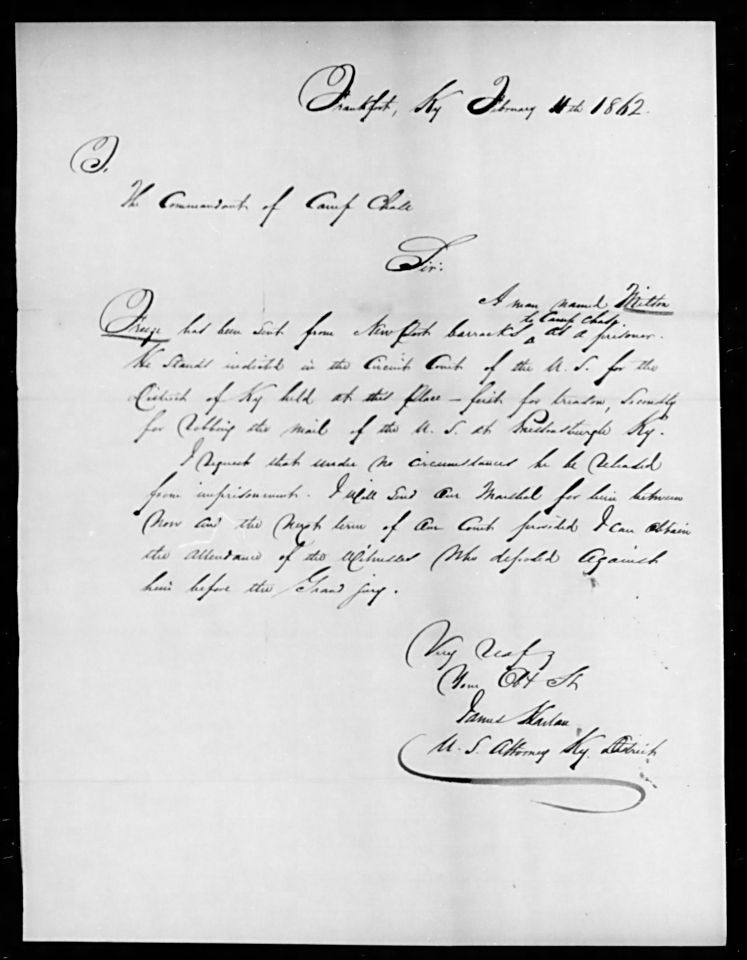
On November 6, 1861, Freese was indicted in the US District Court at Frankfort under Judge Bland Ballard, on the charges of treason and robbing the US mail at Prestonsburg. On January 27, 1862, Freese was arrested at his home in Prestonsburg and sent to Newport Barracks. Here he was held as prisoner, awaiting trial, until February 10, 1862, when he was transferred to Camp Chase, Ohio.

On February 11, 1862, James Harlan, US Attorney for the District of Kentucky, addressed a letter to the Commandant of Camp Chase, requesting that Freese “under no circumstances he be released from imprisonment. “ Harlan informed the commander that, “I will send a Marshall for him between now and the Next term of our court provided I can obtain the attendance of the witnesses who deposed against him before the Grand Jury.”


Milton Freese remained a prisoner at Camp Chase for another nine months until finally released on Nov. 8, 1862, by virtue of an order by the US Secretary of War and upon taking the Oath of Allegiance. Freese was listed as a resident of Floyd County, Kentucky and described as 42 years old, fair complexion, dark hair and whiskers, 5’11” tall and hazel eyes.

During Freese’s absence, his wife Minerva Freese was attending to her husband’s affairs at Prestonsburg. On Oct. 28, 1862, Capt. W. W. Cox, Quartermaster of the 5th KY Mounted Infantry (CS), paid Minerva $10.00 for use of the wagon and team and damage done to same while hauling Guns and ammunition from the Forks of Middle Creek to the Pike County Steam Mill on Sandy River.”


After his return to Eastern Kentucky, Milton Freese gave up his residence in Prestonsburg and moved to Louisa, Lawrence County, KY. His war-time activities seem to have come to an end and he turned to more peaceful pursuits. Freese operated a livery stable in Louisa. He also engaged in steam boating on the Big Sandy and Ohio Rivers and established the first reliable and successful packet line. The Sallie Freese and Fannie Freese, named after two of his daughters and the latter piloted by his oldest son Frank, and the Fleetwood, owned in partnership with R. F. Vinson, were three of the better known steamers that were plying the waters of the Big Sandy and Ohio Rivers in later years.


The Fleetwood, at Ironton, OH, 1866
From R. L. Hunster collection.
Wiki of The Public Library of Cincinnati and Hamilton County

In 1865, Milton Freese suffered the loss of his wife Minerva. At the end of the year, Freese’s past came to revisit him one last time. On December 28, 1865, Payne Johnson from Pike County filed a lawsuit against him and other parties, claiming that during the fall of 1861, Freese, as well as James M. Rice, John M. and Harvey Burns, John and L. B. Sword, Thomas and C. Cecil, and Thomas May, Sr., took, “with force and arms and against the will and consent of the Plaintiff,” a large lot of personal property from him, including horses, live stock and forage.

In November 1867, Milton Freese married Kate McGuire, of Louisa, the daughter of Nicholas McGuire. In 1872, the couple purchased an antebellum two-story brick house plus five acres in Louisa from former Union Captain Thomas D. Marcum (14th KY Infantry) for $3,150. The house is still in existence today and is located at the end of Sycamore Street, overlooking the Big Sandy River.


Freese House, Louisa, KY

Freese later established the Louisa Roller Flouring-Mills which had a capacity of seventy-five barrels per day. Despite being a successful business man throughout his life, Freese fell onto hard times and in 1894 had to sell his house in Louisa at auction for $200, reportedly the amount of debt he owed.


Louisa Roller Flouring Mill
later known as Louisa Supply Co.

Milton Freese died 10 years later, on September 14, 1904 and was buried at Pine Hill Cemetery, in Louisa, KY.

Article researched and written by Marlitta H. Perkins, Aug. 2011 and is under full copyright. Copyright © 2011, All Rights Reserved.