Showing posts with label Camp Chase. Show all posts

Thursday, November 15, 2012

The Death of Tandy F. Jones

Tandy F. Jones was born in 1840 or 1841 in Floyd County, Kentucky, the son of John Ray Jones and his first wife Satira Stanley. The Jones family migrated from Virginia, possibly Scott County, by the 1830’s and settled on Mud Creek in Floyd County, Kentucky. After the death of Satira, John Ray Jones married Phoebe Sturgill and moved to Johnson County, Kentucky around 1857 and settled in the Flat Gap area.

Flat Gap, Johnson County, Kentucky
On May 22, 1860, Tandy F. Jones married Susannah Sagraves, daughter of Joseph Sagraves, Jr. and Nancy McDowell. When the Federal Census was taken on July 12, 1860, the couple was still living in the household of Tandy’s father and step-mother, along with several siblings and his grandmother.

By the time the Civil War had begun in 1861, the newlyweds had set up housekeeping, possibly on Susannah’s father’s place. Sagraves operated a mill on Lower Laurel Fork of Big Blaine Creek and was a near neighbor of John R. and John B. Wheeler. All the couple had to their name was one milk cow. In October 1861, Tandy’s older brother Lemuel G. Jones enlisted as a private in Co. D, 14th KY Infantry (US), along with a number of other men from Jones’ neighborhood which was predominantly Union. Tandy on the other hand remained quiet on the subject. Even though his principles seemed to be leaning towards the Secessionists, he never said or did much in support of either side. This all changed in December of 1861, when Tandy, along with his brother-in-law William Sagraves, joined Co. K, 5th KY Infantry, Mtd. (CS) It is questionable whether their enlistment was entirely voluntary. William R. and John B. Wheeler testified that Jones and Sagraves, “would not Have Went if they had not been scared into it by their party we believe them to be Common moral Citizens.”

William R. and James B. Wheeler Affidavit
Events that followed seem to support testimony of the Wheelers. On January 9, 1862, one day before the Battle of Middle Creek, Tandy F. Jones and William Sagraves deserted the Confederates and were making their way toward the Union lines to give themselves up. Sagraves was still armed but Jones was not when they reached the outer picket line of the 14th KY Infantry. They were promptly arrested and taken under guard to the Union camp in Paintsville and placed into the guard house. Commander Col. James A. Garfield stated, “On Examination the(y) confessed that they were from the rebel army and from ignorance or fear did not call any witnesses to show that they had deserted & come in voluntarily.” Unaware that both men had surrendered on their own free will, Garfield sent Tandy F. Jones and William Sagraves as prisoners of war in company with fifteen others from Paintsville to Newport Barracks. After a brief stay, both men were forwarded on February 10, 1862, to Camp Chase in Ohio.

It is not entirely clear how Garfield became aware of the true nature of Jones’ and Sagraves’ arrest, perhaps through the interference by family and friends, but on February 15, 1862, he addressed a letter to Judge Advocate General Colonel Luther Day, with a recommendation that Jones and Sagraves be released on taking the oath of allegiance to the U. S. Government. Garfield enclosed an affidavit by William R. and John B. Wheeler, taken on February 14, 1862, who testified on behalf of both men before Johnson County Justice of the Peace E. Lemaster.

Garfield’s letter was received on March 5, 1862 and forwarded to Adjutant General Lester Thomas. In turn, Garfield’s recommendations were sent to Ohio Governor David Tod who respectfully returned the letter to the Secretary of War, with the recommendation, “that favorable action be had.”

Meanwhile, on March 7, 1862, Jones and Sagraves, along with 42 other Kentuckians who were prisoners at Camp Chase, addressed a letter to, “His Excellency the Governor, the Chairman and Members of the General Assembly of the Commonwealth of Kentucky ... That all constitutional measures may be resorted to by your honorable body for our restoration of our homes, families and loyalty, and for full and complete relief, we would ever pray."

Letter to the Governor of Kentucky
March 7, 1862
 On April 8, 1862, by order from General James A. Garfield, Jones and Sagraves were discharged from Camp Chase, after taking the oath of allegiance on April 7, 1862. Tandy F. Jones’ physical description was as follows – he was 21 years old, stood 5’7” tall, had a light complexion, blue eyes, dark hair and brown whiskers. William Sagraves was 27 years old, stood 5’9” tall, had a dark complexion, dark eyes, dark hair and dark whiskers.

Tandy F. Jones Oath of Allegiance
After their release from Camp Chase, both men returned to their homes in Kentucky. By all appearances, Tandy F. Jones kept the terms of his oath, which in part stated, “I fully understand if I violate this oath and am again found in arms against the Government of the United States or aiding or abetting its enemies the penalty is death.” There is no evidence to suggest that he ever served in another Confederate unit. Tandy took up farming, raised some corn and wheat and tended to one horse, two cattle and five hogs. Nevertheless, military and prison life had left him a sick man. He suffered from dysentery, also known as flux or bloody flux, an intestinal inflammation which leads to severe diarrhea with blood in the stool. This disease was one of the great killers during the Civil War. Jones thought drinking water from a sulphur spring would cure his disease.

In August of 1862, the Confederate invasion of Kentucky began and on September 13, 1862, CS General Humphrey Marshall’s troops, including the 5th KY Infantry, Mtd., arrived at Salyersville in Magoffin County, KY. At this point many who had previously deserted rejoined the 5th KY Infantry, including William Sagraves. Tandy Jones, on the other hand, remained at home.

Between September 14 and October 5, 1862, a scouting party of ten men, under the command of Lieutenant John W. Ferguson, Co. F, 5th KY Infantry, left Salyersville, with orders by their Captain Henry G. Colvin, to shoot any man who wouldn't halt. The scout proceeded to Johnson County, possibly to hunt up deserters and appeared at Tandy F. Jones’ house as he was returning from one of his trips to the sulphur spring. Upon seeing the soldiers, Jones made an attempt to escape. William Tackett, one of Ferguson’s men, testified on May 26, 1863, that “Jones was halted several times, before he was shot. I did not see him shot, he had turned round the house, and when I saw him again he was coming back. My belief is that he was running at the time he was shot. He was running very swiftly when I saw him and had only about 10 steps to go to get into the woods.” A witness by the name of Rice, possibly Sam Rice, who happened to be present when the killing took place, later reported a slightly different story to Tandy’s brother Lemuel “Lem” Jones. According to Rice, when Ferguson’s party came across Tandy Jones, he ran about 15 feet, was halted by Ferguson, and on his coming back, having surrendered, Ferguson gave the order to fire on him, which was done and Jones was killed. Local lore that has been passed down through the years tells of Jones making an effort to escape and crossing a rail fence. When he reached the top, he was shot in the back where his gallowses crossed and died instantly.

Ironically, Ferguson was not aware that Tandy Jones was a deserter when he gave orders to shoot him. Yet Tandy Jones was aware of the danger of being shot as a deserter and attempted to escape. William Tackett confirmed that Jones’ fears were not unfounded. He stated, “I believe they would have shot Jones had they known it was him.” Known members of the scouting party were 1st Lt. John W. Ferguson, 1st Corporal William “Will” Jayne, private William Tackett, and possibly 2nd Lt. Hayden Ferguson. The names of the others have not been discovered. Ferguson’s party was accompanied by former 5th KY soldiers James Patterson, Andrew J. Osborne and possibly by Patterson’s brother-in-law William W. Estep, although his name was never mentioned in any of the existing records.

Tandy Jones’ death created a disturbance among his family, friends and neighbors, the effects of which were felt for years after. This may have been in part due to the fact that Tandy’s wife Susannah was either pregnant with their daughter Alana or the child was just an infant. According to one local historian, the emotional temperature arose to such a great magnitude that a group was organized “for the purpose of safety and to execute the executor.”

Tandy Jones’ killing may have haunted 18 year old William Tackett. He deserted the 5th KY Infantry shortly thereafter and enlisted in the 14th KY Infantry (US), on October 5, 1862, at Paintsville, Johnson County, KY. Tackett was soon gone from the area.

James Patterson and his family disappeared entirely from the Johnson County tax lists in 1863 and thereafter. It appears that Patterson and his family went back to Virginia, quite possibly Rye Cove, sometime after the 1862 harvesting season was over. He may have been accompanied by his nephew William W. Estep, who, according to family stories, left Johnson County with his family about the same time. Patterson and Estep were back in Johnson County by summer of 1864. An assassination attempt nearly cost Patterson his life, which he survived by a stroke of luck. Patterson, a native Tennessean, later returned to his home state.

The fate of Andrew J. Osborne at this point is uncertain. According to local history, a few days after the assault on Patterson, three strange men passed by the house of Andrew J. Osborne and shot him while he was working in his garden. It is believed by some that his death was directly related to his involvement in the killing of Tandy Jones and was an act of revenge. Other accounts claim that Osborne died in the Battle of Paintsville on April 13, 1864. The true circumstances of his death may warrant closer examination in the future.

William W. Estep was killed by a sniper near Flemingsburg, Fleming County, KY, towards the end of the war. His body was disposed of in such a manner that subsequent attempts by the family to locate him were fruitless, despite the fact that he may have been accompanied by one of his brothers when he died.

William Jayne served in the 5th KY Infantry, which was part of the famous Orphan Brigade, until 1865. He voluntarily surrendered on May 5, 1865, at Macon, Georgia. Jayne returned to Johnson County where he lived peacefully and raised a family. About 1906 or 1907, he moved to Boyd County, KY, and lived on a small farm. William Jayne’s final move was to Lake City, Florida, in the spring of 1917, where he died the same year.

Hayden Ferguson continued to serve in the 5th KY until the end of the war. He left Kentucky and settled in Georgia by 1870.

His brother Lt. James W. Ferguson resigned his commission in the 5th KY Infantry in October of 1862. The reason were, he claimed, that, “he had become convinced that he was fighting on the wrong side and that the South was wrong.” Ferguson returned to Johnson County, settled his personal business and disposed of all his properties. He was captured by the 14th KY Infantry (US) on May 12, 1863 and charged with treason and being a rebel officer. After he was tried by a military commission, Ferguson was sent to Camp Chase and later Johnson’s Island. Two months later Ferguson applied to take the oath of allegiance in order to return to Kentucky and remain a "peaceful citizen", but refused to be sent South upon exchange. While at Johnson's Island, the doctors diagnosed him with an incurable disease for which he received treatments. Ferguson was finally released on taking the Amnesty oath on April 27, 1865 at Johnson's Island. He never returned to Johnson County, fearing, perhaps, repercussions in regard to his involvement in Tandy Jones’ death. Ferguson settled in on Briar Fork in Elliott County, KY, where he died from kidney disease on May 8, 1875, at the age of 44.

Nothing is known about the fate of Tandy F. Jones' wife Susannah who disappeared from the records after 1862. Daughter Alana was taken in and raised by her grandparents Joseph and Nancy Segraves. She married James Abraham Garfield Spradlin on Dec. 2, 1880 and moved to Lower Twin Branch, Johnson County, KY. Their marriage was short lived as James died in 1884 at the age of 23, followed by Alana in February 1887, at the age of 26. Thus closed a tragic chapter in the history of Johnson County, KY.


Sources
Provost Marshal Records
Letters to the Adjutant General
Compiled Service Records, Confederate / Union
VF Family History Folder, Johnson Co. KY library: Estep/Cantrell/Salyer Family; account by Elmond Davis.
Hanging files, Johnson Co. KY library, anonymous account.
Johnson County, Ky Tax Lists
Johnson County, KY Federal Census records

Researched and compiled by Marlitta H. Perkins, November 2012. The author would like to thank Mark Bryant for his valuable insights. Unauthorized use and/or duplication without express written notice by the author is strictly prohibited. © 2012. All Rights Reserved.


Thursday, July 26, 2012

"Dear Husband" - Civil War Letter from Cynthia F. Stewart to her Husband James E. Stewart

Envelope, postmarked Catlettsburg, April 14 (1862) 
Cynthia F. Stewart, daughter of Lewis Mayo, one of the leading men in the Big Sandy Valley at the time, wrote the following letter to her husband James E. Stewart while he was a prisoner of war at Camp Chase in Columbus, Ohio. He was arrested at his home in Johnson County, KY, on January 24, 1862, by Col. James A. Garfield and charged with "giving aid and succor to rebels."
 
Page 1

Catlettsburg Ky Apr. 10th/62

Mr James E Stewart.
Dear husband from the abundance of the heart the mouth speaketh on last evening I received three letters from you one of the third one the fourth and one of the fifth from which I learn that you are out of prison on parole and is now in Columbus well I am truly glad to hear that but I feel as though before you get this that you will be back in prison again but hope for the better I dont (sic) see why it is that they wont (sic) let you come to Catlettsburg as Gen. Garfield was willing for your parole to extend to this place why is it that they want to keep you I cannot tell for you havent (sic) done any thing (sic) and you being released would not injury (sic) the Government any had I not got those letters yesterday evening from you I should now of been

Page 2
on my way to of seen you had everything ready to start on the Boston this morning but seeing that you opposed me in coming I declined the idea now if you want me to come say so for I want to see you and if you cant (sic) come to see me and want me to see you I will come although it would be an undertaking for me to go with my babe as it is a weakly little thing. You asked me about those notes whether or not I had collected on any on them or not no I have not tell me if sheriff Ward dont (sic) owe you some I thought that he was one of the men that you told me owed you and I asked him about it and he said that he did not owe you a cent and so it is we cant (sic) collect anything but if you are permitted to stay out of prison you shall not lack for money for you shall have that when what you have given out and so you must

Page 3
write me often and tell me all about it Mr Stewart write to Mr George Brown he is a particular friend of yours he has worked manfully in your behalf he says you shall not want for anything that he can do he lives in this place. Short lives here. Tell me if you let Robertson & Spears have money to come home on. Rice has not got home yet looked for him last evening on the Boston but did not come hope he will be here soon still hope I will hear something more favorably towards your release. Imagine how I felt when I heared that your parole did not extend to this place for I really had a hope that you would be released and would be on the Boston last evening but such is life I have to submit Jimmie is well he is a very pleasant babe wish you could see him I am shure (sic) you would love him he is all that keeps me alive


Page 4

on this earth I some time (sic) feel like that I would be glad to die but then I look at our dear little boy and think what would become of him if you and I both should be taken from him if either has to be I hope it will be me not you but I must stop I fear you have become wearied already hope you will write quite often this is from one that loves you above all things on earth who builds all of her hope on you and with out (sic) which will fall all no more farewell farewell

Cynthia F. Stewart


Research Notes
- Cynthia F. Stewart wrote the letter from Catlettsburg, possibly during a visit to Stewart's parents who were living in town.
- Boston refers to the steamboat "Boston" which was making regular trips between Catlettsburg and Cincinnati.
- Jimmie was Cynthia and James E. Stewart's son James Lewis Stewart who was born in 1861. In 1884, James Lewis Stewart graduated with a Bachelors of Law from the Ann Arbor Law School, University of Michigan. During the closing ceremony, he was exposed to cold which turned into pneumonia. He returned to Louisa and died at the home of his parents on July 18, 1884, at the age of 23 years.
- Mr. George Brown refers to George Newman Brown, the oldest son and seventh child of Richard and Frances Brown. He was educated at Marshall Academy, Virginia, and Augusta College, Kentucky. After his return from college in 1840, he soon began to study law in the office of Judge James M. Rice, of Louisa, Kentucky, and was admitted to the bar October 18, 1844. He practiced in Pike and the adjacent counties in Kentucky for sixteen years, during which time he was elected county attorney four times and represented Floyd, Pike and Johnson counties in the state legislature in 1849-50. In 1860, Brown moved to Catlettsburg and formed a law partnership with Judge Rice, which continued for several years. During the Civil war period he was a non-combatant, although his sympathies were with the South. (A History of Kentucky and Kentuckians, Vol. 3, by E. Polk Johnson, pp. 1365/66)
- Rice refers to Judge James M. Rice.

Additional information about James E. Stewart


A sincere thank you goes to Andrea Parsley who made this letter available.


Images and transcript © 2012 by Marlitta H. Perkins. Unauthorized use and/or duplication of the article as well as the images without express written notice is strictly prohibited.

Monday, August 8, 2011

The Life and Times of Milton Freese

Milton Freese was born in Medina County, Ohio, on November 10, 1819, the son of John Freese and Sarah Stearns. Milton’s father was a native of Berkshire County, Massachussetts, but later moved to Kinderhook, New York. He worked as a schoolteacher at the Kinderhook Academy where he also tutored young Martin Van Buren. In 1816, John Freese and his family moved to the Western Reserve and settled in Brunswick, Medina County, Ohio, where he later became associate judge of Medina County.

In the spring of 1837, Freese moved to Cincinnati with his brother-in-law Archibald Miles, a somewhat controversial man who had run several stores in Medina County, OH, but cheated one of his business partners out of several thousand dollars. In 1833, Miles began experimenting with various vegetable extracts and began manufacturing "hygiene" pills of his own invention, taking several barrels full to Cincinnati. He assumed the title of Dr. Miles, reportedly set up a laboratory and began selling his pills under the name of "Dr. Miles' Compound Extract of Tomato." The product was endorsed by the Association of Physicians of which, coincidentially, Dr. Miles was the president and Freese the secretary. It should not be surprising that Miles and Freese were also the only members listed. A former neighbor from Medina stated, "With respect to Miles being a physician: when here he made no pretension of the kind...He was as far from it as any thing you can imagine." Miles began an aggressive advertising campaign and demand soon was strong.

Nevertheless, within a year, Miles ran into some problems with a direct competitor, Dr. Guy R. Phelps from Connecticut who was manufacturing similar pills. Rumors about the safety of Miles' product began circulating to which Miles responded with a full scale attack on Phelps in the New York Journal of Commerce in September 1838. The whole situation developed into a full scale and very public "Tomato Pill War" war that was slugged out for more than a year in the Connecticut Courant and various other papers. By 1840, sales declined and the market for tomato pills collapsed. Miles ended his national adertising campaign during the summer of the same year and both Miles and Freese turned their attention to other ventures.

In 1843, Milton Freese went into partnership with Dr. Miles and opened an auction house, "Freese and Miles", on Main Street in Cincinnati. By 1846, Miles was running a real estate brokerage firm by the name of "Miles & Co." which was located opposite the Dennison House in Cincinnati. Within the year, Miles had set his sights on Eastern Kentucky. Marcus T. C. Gould, a Cincinnati resident, invested in a huge tract of land surrounding the Esculapia Springs area, in Lewis County, KY. In April of 1846, Gould contracted with Dr. Archibald Miles, giving him the "sole privilege of erecting at Esculapia Springs buildings and appurtenances necessary to conduct all the sports and diversions usual to watering places in the United States." Miles was also given the right to erect a building to sell goods and wares.

In 1847, Milton Freese, Archibald Miles and his son George, as well as Robert Crutcher arrived in Prestonsburg, Floyd Co. KY, looking to invest in coal property. On Feb. 15, 1847, Miles entered into a deed and working agreement for over 110 acres with Burwell Vaughn, who had been operating a coal mine since 1843 on the Big Sandy River, south of and adjacent to Prestonsburg. Miles & Co. was in business. It appears that George Miles was in charge of operations, and Freese acting as trustee of Miles' Coal Mines.


Floyd Co. KY - Lloyd's Official Map of Kentucky (1863)
Note Miles' Coal Mines, south of Prestonsburg
Source: Library of Congress

Meanwhile, Freese began a courtship with Vaughn's daughter Minerva Jane, and on May 24, 1848, the couple was married in Floyd Co. KY. It was a happy union and over the next seven years, three children were born to the Freese family – Frank, Mary and Kate. The couple acquired a town lot on Main Street in Prestonsburg. Freese engaged in merchandising and became a money lender before the Civil War. In December of 1850, Freese became one of the commissioners for the newly formed Louisa, Paintsville, Prestonsburg and Pikeville Turnpike Road Company who endeavored to build a new turnpike, connecting the Owingsville and Big Sandy turnpike road with the Virginia turnpike road.

In the early 1850's, Miles' coal mines were experiencing money problems and Archibald Miles, who had left Floyd County before 1850 and was living in Cleveland, Ohio, claimed to be unable to pay off obligations and forced the creditors to file suits against Miles and to foreclose on the mortgages. In one of those suits, brought for a debt of $200 for "goods, wares, and merchandise, for work done and performed," the plaintiff's lawyer referred to Miles and his son as "the biggest rascals that ever was in the county." As a result of the lawsuits, Miles lost his interest in the Vaughn land and coal mine. It seems at this point, Freese and Miles parted ways for good. In May of 1853, Freese bought part of the property, under a court order, James P. Harris, complainant. By the end of the 1850's, Freese held separate mortgages on property owned by each of the local mining companies.

In April 1858, Freese obtained a license to open a tavern at his residence. Eight months later, he moved his tavern across the street from his house and into a barn that stood on a town lot also owned by him. Business was good and Freese renewed his license for the next two and a half years.

He also held the office of postmaster at Prestonsburg for a number of years, from 1851 until before 1854. In 1860, Freese and his family were living in household #22 in Prestonsburg, Floyd County, KY. He was a merchant, with $3500 real estate and $4105 personal property.

When the Civil War broke out, Freese soon became a supporter of the Confederate cause but in a more or less civilian capacity. There is no documentary evidence that he actually joined the military. In the fall of 1861, James Weddington, who lived on the main road between Prestonsburg and Pikeville, about five miles below the latter place, saw Freese, accompanied by John M. Rice. According to Weddington, neither of the men wore a Confederate uniform, even though Freese had a new belt and gun. Freese made his wagon and team available to the army and reportedly participated in foraging raids on Union supporters. However, his activities were soon put to an end.


On November 6, 1861, Freese was indicted in the US District Court at Frankfort under Judge Bland Ballard, on the charges of treason and robbing the US mail at Prestonsburg. On January 27, 1862, Freese was arrested at his home in Prestonsburg and sent to Newport Barracks. Here he was held as prisoner, awaiting trial, until February 10, 1862, when he was transferred to Camp Chase, Ohio.

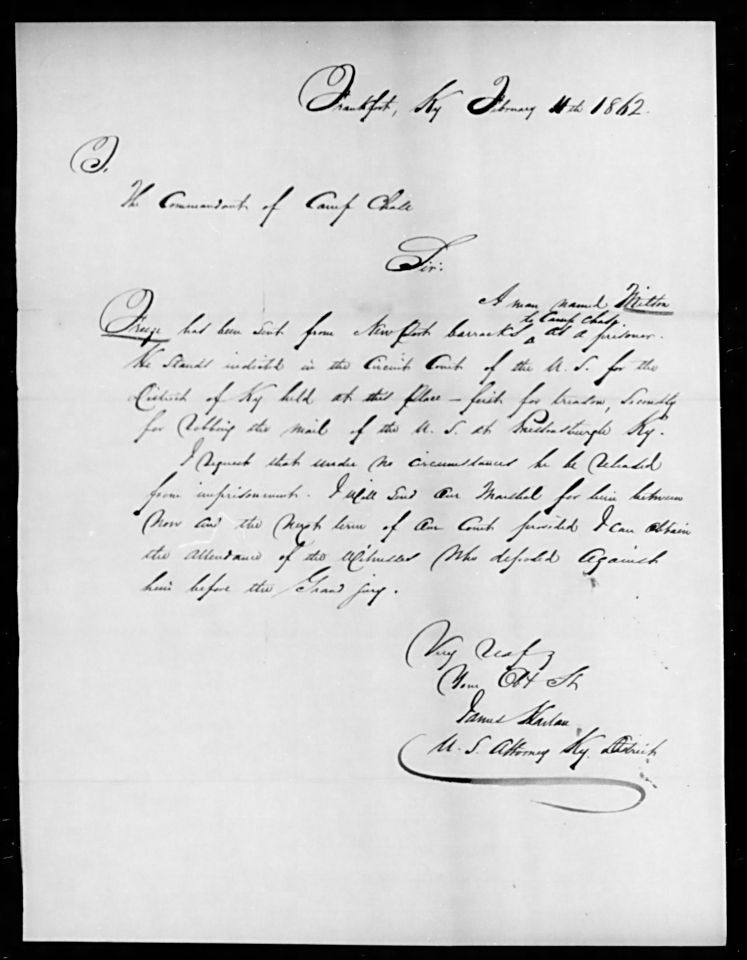
On February 11, 1862, James Harlan, US Attorney for the District of Kentucky, addressed a letter to the Commandant of Camp Chase, requesting that Freese “under no circumstances he be released from imprisonment. “ Harlan informed the commander that, “I will send a Marshall for him between now and the Next term of our court provided I can obtain the attendance of the witnesses who deposed against him before the Grand Jury.”


Milton Freese remained a prisoner at Camp Chase for another nine months until finally released on Nov. 8, 1862, by virtue of an order by the US Secretary of War and upon taking the Oath of Allegiance. Freese was listed as a resident of Floyd County, Kentucky and described as 42 years old, fair complexion, dark hair and whiskers, 5’11” tall and hazel eyes.

During Freese’s absence, his wife Minerva Freese was attending to her husband’s affairs at Prestonsburg. On Oct. 28, 1862, Capt. W. W. Cox, Quartermaster of the 5th KY Mounted Infantry (CS), paid Minerva $10.00 for use of the wagon and team and damage done to same while hauling Guns and ammunition from the Forks of Middle Creek to the Pike County Steam Mill on Sandy River.”


After his return to Eastern Kentucky, Milton Freese gave up his residence in Prestonsburg and moved to Louisa, Lawrence County, KY. His war-time activities seem to have come to an end and he turned to more peaceful pursuits. Freese operated a livery stable in Louisa. He also engaged in steam boating on the Big Sandy and Ohio Rivers and established the first reliable and successful packet line. The Sallie Freese and Fannie Freese, named after two of his daughters and the latter piloted by his oldest son Frank, and the Fleetwood, owned in partnership with R. F. Vinson, were three of the better known steamers that were plying the waters of the Big Sandy and Ohio Rivers in later years.


The Fleetwood, at Ironton, OH, 1866
From R. L. Hunster collection.
Wiki of The Public Library of Cincinnati and Hamilton County

In 1865, Milton Freese suffered the loss of his wife Minerva. At the end of the year, Freese’s past came to revisit him one last time. On December 28, 1865, Payne Johnson from Pike County filed a lawsuit against him and other parties, claiming that during the fall of 1861, Freese, as well as James M. Rice, John M. and Harvey Burns, John and L. B. Sword, Thomas and C. Cecil, and Thomas May, Sr., took, “with force and arms and against the will and consent of the Plaintiff,” a large lot of personal property from him, including horses, live stock and forage.

In November 1867, Milton Freese married Kate McGuire, of Louisa, the daughter of Nicholas McGuire. In 1872, the couple purchased an antebellum two-story brick house plus five acres in Louisa from former Union Captain Thomas D. Marcum (14th KY Infantry) for $3,150. The house is still in existence today and is located at the end of Sycamore Street, overlooking the Big Sandy River.


Freese House, Louisa, KY

Freese later established the Louisa Roller Flouring-Mills which had a capacity of seventy-five barrels per day. Despite being a successful business man throughout his life, Freese fell onto hard times and in 1894 had to sell his house in Louisa at auction for $200, reportedly the amount of debt he owed.


Louisa Roller Flouring Mill
later known as Louisa Supply Co.

Milton Freese died 10 years later, on September 14, 1904 and was buried at Pine Hill Cemetery, in Louisa, KY.

Article researched and written by Marlitta H. Perkins, Aug. 2011 and is under full copyright. Copyright © 2011, All Rights Reserved.