During the fall of 1861, after Confederate forces occupied Paducah and when Kentucky abandoned its position of neutrality in favor of the Union cause, it created turmoil and uneasiness on both sides of the conflict. On Sept. 24, 1861, General Robert Anderson issued a proclamation, noting that he understood, “that apprehension is entertained by citizens of this State who have hitherto been in opposition to the policy now adopted by the State.” He assured that, “no Kentuckian shall be arrested who remains at home attending to his business, and does not take part, either by action or speech, against the authority of the General or State Government, or does not hold correspondence with, or give aid or assistance to those who have chosen to array themselves against us as our enemies.” Anderson’s sentiments were echoed by Governor Magoffin who encouraged the citizens, in case of a collision of hostile armies on Kentucky soil, “Not to engage in said strife amongst themselves on account of differences of political opinion…” but to, “unite in protecting each other in their rights of life, liberty and property, against all and every invasion thereof by unlawful raids, mobs, marauding bands, or other evil disposed persons, and bringing them before the Courts for trial.”
Nevertheless, neither Anderson’s proclamation nor Magoffin’s words did much to ease the populations’ fears in Eastern Kentucky. The establishment of a Confederate recruiting camp at Prestonsburg was certainly a threat and cause for alarm for the pro-Union faction who did not want to be caught living inside Confederate lines, while the organization of a Federal regiment in the upper part of the Sandy Valley raised serious concerns for Southern supporters . One witness noted, “The feeling at that time was exceedingly bitter. My experience was that men did not have to be pressed very much to tell anything they knew against a man occupying a position on the other side of the conflict that was going on. There was an exceedingly bitter state of feeling in that country on both sides.” Colonel Laban T. Moore stated, “It was not safe at that time in this country for persons of known or suspected sympathy with the South to remain at home. I mean such persons would have been arrested.”
On the other hand, Union supporters did not fare any better. Writing from Catlettsburg, Levi J. Hampton noted on Oct. 19, 1861, “We last night learned through some thirty five Union men, who scattered through the woods and arrived here from Pike county, that the rebels have come into Prestonsburg in force, from Virginia, to the number of seven thousand, well armed and equipped, and have extended their pickets down near Peach Orchard, forty miles from this place. Every person is fleeing before them.” James Weddington, who lived on the main road leading from Prestonsburg to Piketon, noted, “… the report of the neighborhood was that people was shifting, some going one way, some another, and that people were arming…” According to James Honaker, a citizen of Pike Co. KY, “There was a great excitement in the country, and every person was on the run in small companies for their safety. Even women, and men that never had anything to do with the army, was on the run.”
What follows is a list of people, even though incomplete, who were arrested on both sides of the conflict during the early days of the Civil War in Eastern Kentucky.
Arrests by Union Forces
On September 27th, 1861, Oliver Martin, landlord of the Hampton House at Catlettsburg was arrested by Zeigler’s 5th Virginia (US). Also taken into custody were Judge George Newman Brown, Wm. O. Hampton, Wm. Campbell, and James R. Ford, plus eight other men, all citizens of Catlettsburg. They were taken to Camp Pierpoint in Ceredo, Virginia (now WV).
 Hampton House, Catlettsburg, KY
Arrests were also made in Lawrence County, KY, by the Federal authorities. Judge James M. Rice, Samuel Short and George B. Poage were among those taken into custody.
On September 30th, a group of rebel recruits arrived at Landsdowne Hall, located 1/2 mile from Grayson, KY. Dr. A. J. Landsdowne and his family were southern sympathizers, and aided men from northern Kentucky and southern Ohio on their way to join the Confederate Army by providing food and safe shelter. While eating dinner with the Landsdowne family, the men were surprised by 15 home guards under a Captain McGuire who surrounded the house. The Confederates made a break for it and in the melee that ensued, two Southerners, William Bartley and William Henry, were killed. One man, George Martin, was wounded, and B. J. McComas escaped with three other men. The remainder of the group was captured, including John McCoy, S. H. Wolcott, Orlando (Leander/Vander) Nicholls, Benj. Chinn, John White, Henry C. Davidson, P. B. Byrne, Sam Womack, Will. Womack and – Strother, Robert L. Stewart, W. H. Campbell, Wm. A. Warnick, A. J. Landsdowne, and C. Carroll Pomeroy.
Toward the end of November 1861, Calvin Wright, a farmer and distiller who lived on Little Fork of Dry Fork in Lawrence Co. KY, was arrested by Captain Oliver D. Botner, Co. G, 14th KY Infantry and taken to Union Headquarters at Louisa. All of Wright's brandy was confiscated and delivered up to the regiment's surgeon, Dr. Yates, for the use of the hospital at Louisa.
On December 5, 1861, the Ironton (OH) Register reported that Maj. Burke, of the 14th KY Infantry, “at Louisa - went down the river...with nine Secesh prisoners, Wm. McKinney, Harrison Young, John Murphy, Johnson Griffith, James R. Rose, John Blankenship, Joseph Primm [Grim?] of Lawrence Co. Ky, and Thos. Chandler and Isaac Chandler, of Johnson County, Ky."
John Hagins, of Magoffin County, Ky., was arrested in Montgomery County, KY, about the middle of December, 1861, and charged with furnishing supplies of stock to the rebel army under General Williams. The Department of State was advised of the arrest by a dispatch dated Cincinnati, December 17, 1861, from E. S. Samuels, Government agent in Kentucky, and C. B. Pitts, deputy U.S. marshal of the same State, who say that he Hagins was taken while "in transit with cattle for the rebels," and also that they have "plenty of evidence to hang him." He was thereupon directed to be taken to Fort Lafayette, which was accordingly done on the 20th of December. He remained at Fort Lafayette until February 22, 1862, when he was released on parole. Upon his release, Hagins, along with nine other paroled prisoners sent the following card to the editor of the New York Times:
“We, the undersigned, this day released from imprisonment in Fort Lafayette, beg leave to say to the public that we have uniformly received at the hands of Lieut. CHARLES O. WOOD, First Lieutenant Ninth Infantry, U.S.A., commanding Fort Lafayette, every civility, courtesy and kindness which, as commanding officer, he was authorized and permitted to extend to us by his superiors in office; who, be it said, required of us the performance of menial services, such only as would be required at the hands of scullions and menials.
We believe, indeed, that he would have made many more provisions for our comfort than we enjoyed under him had it been in his power to do so.
We deem it proper to make this voluntary statement to the public because of certain statements made in the public prints to his disparagement, which some of us know to be wholly without foundation in truth, and all of us believe so to be.
We leave Lieut. WOOD, individually, with our best wishes for his prosperity and happiness.
GEORGE W. JONES, J.M. OGDEN,
A.N. BAKER, E.H. JONES,
R.W. RASIN, JOHN HAGINS,
E.E. COTTRELL, C. LEDWIDGE,
N.S. RENEAU, RUTSON MAURY, JR.
More arrests were made under Col. James A. Garfield during his Eastern Kentucky Campaign in 1861 and early 1862. He stated, “If I found satisfactory evidence that they were in actual communication with the rebel army, and aiding the enemy, I sent them to Camp Chase, at Columbus, Ohio, as prisoners. There was a second class against whom the evidence was not so strong, but sufficiently strong to lead me to suppose that they were at least likely to take an active part against us. With such I adopted the plan of requiring them to give bonds, and take and subscribe an oath not to take any part against our troops. These bonds required that if they were found committing any overt act, it was a confession of the forfeiture expressed in the bond. A third class I required to give their word of honor that they would not take any part against the United States, but would remain peaceable citizens. To these I gave a written discharge.”

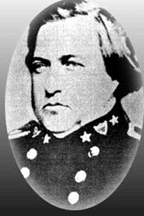
Col. James A. Garfield
The following men, all taken in arms, were arrested by Garfield, sent to Newport Barracks, KY and then forwarded to Camp Chase, Ohio, where they arrived abt. March 19, 1862:
- William Segraves, Lawrence Co. KY - Possibly member of Co. K, 5th KY Mtd. Inf. (CSA)
- Jesse Barker, Lawrence Co. KY - Pivate, Co. D, 5th KY Mtd. Inf. (CSA) Captured Jan. 13, 1862, Johnson Co. KY. Exchanged Aug. 25, 1862
- Chas. Thomas, Lawrence Co. KY - arrested by the 40th OVI, at Middle Creek, Jan. 10, 1862.
- William Z./S./J. Carter, Johnson Co. KY - Possibly a deserter from Co. K, 5th KY Mtd. Inf. (CSA) He was captured Jan. 13, 1862; Exchanged Aug. 25, 1862.
- John Berry - Possibly John L. Berry, Co. C, 5th KY Mtd. Inf. (CSA), listed as deserted, Dec. 31, 1861 to April 30, 1862.
 Newport Barracks, KY
Additional arrests:
- James Stewart, Johnson Co. KY - for giving aid and succor to rebels.
James Stewart was a lawyer who resided in Paintsville and was married to Cynthia Mayo, a daughter of Lewis May, one of the leading men of the Big Sandy Valley. Stewart stated, "I sympathized with the southern people, but had no connection whatever with those in arms, or that was aiding the rebellion. In 1862, I was arrested by said authorities at the instance of prejudiced acquaintances, and upon false testimony was sent to Camp Chase." Stewart remained a prisoner for nearly a year. On being released by exchange, he returned home and soon returned to the practice of law.
- Oliver A. Patton - for serving in the rebel army in Piketon. He later raised a unit named Patton's Partisan Rangers which operated mainly in Eastern Kentucky. The history of this unit was rather short-lived.
- T. P. Taylor - no charges or location given
- James F. Jones
 Camp Chase, Ohio
On February 15, 1862, Garfield addressed a letter to Ohio Governor Tod, recommending the discharge of James F. Jones, William Segraves and Oliver O. Patton. Tod endorsed Garfield's request, but Adjutant General Lorenzo Thomas, in Washington, DC, stated that the Secretary of War declined to grant their release.
On January 11, 1862, David A. Powell, Stephen G. Loar and John M. Rice were arrested at Anthony Hatcher's house, near opposite the mouth of Mud Creek, Floyd Co. KY. The arresting party consisted of Martin Thornsbury, 14th KY Infantry (US) and about 20-25 men, who were more or less acting in the capacity of a home guard group. On the way to Garfield's camp in Paintsville, Powell escaped. Stephen G. Loar stated, "At the time I was arrested I had gone up to see Anthony Hatcher, who was wounded; Rice was with me and went there for the same purpose… I was let out on parole of honor."
In regard to John M. Rice, Garfield questioned Thornsbury, "whether he had any evidence that Mr. Rice belonged to the rebel army. He stated he found him twelve or fifteen miles south of my encampment, and in the neighborhood where the rebel army had recently been. Mr. Rice was brought to me about the 14th of January, 1862. I further examined him as to any evidence he might possess that Mr. Rice belonged to any rebel force. There was no evidence given to me that he belonged to the rebel army, nor that he had done any overt act which would justify me in regarding him as a soldier or an enemy." Accordingly, Garfield issued Rice a written discharge.
Headquarters Eighteenth Brigade
Paintsville, Kentucky, January 14, 1862
Mr. John M. Rice, of Louisa, Kentucky, having pledged himself not to aid or abet directly or indirectly, the confederate forces in the present war, is hereby released on his parole, and granted safe conduct into the camps and through the lines of the Union troops, subject to all proper guard and police regulations.
By order of Colonel J. A. Garfield, commanding brigade
W. H. Clapp
Assistant Adjutant General
Confederate ArrestsWilliam Ferguson, John Dils, Jr. and Clinton Van Buskirk were arrested in Pike Co. KY and taken to Richmond, Va where they arrived on Nov. 12, 1861, under escort by Hon. John M. Elliott, T. W. Porter, and G. T. Magee. Ferguson was accused of being “a Provost Marshal of the Lincoln Government.”
 Richmond Daily Dispatch, Nov. 13, 1861
The Confederate authorities reported the following, "Clinton Buskirk.--Born in Pennsylvania, at Johnstown; has lived in Pennsylvania and Ohio and Logan County, Va., until the spring of 1859, when he removed to Piketon, Ky. Was arrested by Colonel Williams. Says two of his brothers are in Floyd's brigade. On his examination was confused, and I had great difficulty in extracting anything from him. Refused to take the oath of allegiance. General Johnson, of Kentucky, knows nothing of him. Mr. Wilton knows nothing of him except that he has heard he has two brothers in Floyd's brigade. Mr. McDonald, delegate from Logan, proves while in Logan he bore a good character and has one brother in Floyd's brigade. I cannot recommend his discharge, but think he ought to be held as a prisoner to be exchanged for some of our men taken in Kentucky."
"William Ferguson.--Born in Montgomery County, Ky.; arrested by Colonel Williams' command while attempting to serve process issued by Apperson, commissioner of the United States, for two witnesses in Magoffin County, Ky., summoned to testify in the cases of two men arrested as friends of the South. Says he sustains the present Government of the United States although he detests Lincoln; sustains the old government of Kentucky. Will not take the oath of allegiance to the Confederate States, but will take an oath to be neutral, and that he will not take part in the war or give any information to the enemy. General Johnston proves him to be a man of good character, who will stand by his oath. I cannot recommend his discharge, but think he should be held to be exchanged for our friends arrested in Kentucky."
On October 27, 1861, Samuel Pack and his uncle George were arrested by Vincent A. Witcher’s Company Virginia Mounted Rifles. They were bound and driven off on foot. During their examination it was stated that Samuel Pack, "says he was arrested by Captain Witcher on suspicion of being a Union man. Denies he is a Union man. Says he is with the South. Affirms he never had any connection with the Northern army or the Union men of Kentucky or his own neighborhood. He lives near the Kentucky line on the Sandy River. I can procure no information about him and judging from his conduct under examination I should think he was an honest man. I recommend his discharge on taking the oath of allegiance."
The Confederate authorities stated about George Pack, that, "Prisoner says he was born in Giles County, Va. Removed to Lawrence County, Ky., and then to Wayne County, Va. Is the uncle of Samuel Pack. Lives near Sandy, across from Louisa, Ky., and about twenty-eight miles distant on Twelve Pole River from that town. Says he voted for members of time convention held at Richmond and never voted since. Is a Southern man. Never had anything to do with the Union men of Kentucky or of his neighborhood. Says some of his neighbors went to Ceredo and got arms from Zeigler. He remonstrated against it at the beginning of bloody times at home. Took the part of the South. I have no information in reference to this man except from his own examination and his manner creates some doubt in my mind of his sincerity. But he is a very old man (near seventy) and his health much broken by his confinement. He is willing to take the oath of allegiance. I recommend he be discharged on taking the oath of allegiance."
In October 1861, shortly before the Battle of West Liberty on October 23, 1861, Robert H. McAllister from Greenup Co. KY was captured at Prestonsburg. He stated,“I was on Big Sandy river last fall, with a store-boat, near Prestonsburg. Had a considerable amount of my goods taken by the rebel army; and they detained me as a prisoner for some time; was guarded, but permitted to remain in my boat…”
On October 15, 1861, James A. J. Lee, from Owingsville, Bath Co. KY, was arrested by troops under Capt. A. J. May (CSA), at West Liberty, Morgan Co. KY. Lee stated, "About the 15th of October last I went to West Liberty, to get some of my friends and relatives to come home; on my way there they took me prisoner, and I went to Judge B. to get his assistance in getting my release … The reason that Judge B. (Wm. H. Burns) gave me why the military authorities there did not act in my case immediately was, that my case was referred to the authority at Prestonsburg, and they released me before they heard from the authorities at Prestonsburg. Capt. May was in command of the forces at West Liberty, and gave me my release; there was some three or four other prisoners there when I was there; I left them there, and I understand that they were released by the Federal forces.”
John W. Hazelrigg of Morgan Co. KY was also arrested at West Liberty and lodged in the local jail. On October 23, 1861, Federal troops arrived at the town and attacked the Confederates under Capt. A. J. May. A percussion shell exploded some 40 steps from the little brick jail. A fragment struck the building some seven or eight feet from the ground and tore a considerable indentation into the wall. Hazelrigg sustained a head wound during this action. He was consequently freed from confinement.
On November 13, 1861, the Mt. Sterling Whig reported, that, “Four respectable citizens of Morgan and Wolfe, arrived here yesterday in great haste, several of them having traveled all night, and report that there is no doubt of the rebels having come back in the country above with increased force. They had seen and conversed with a number of persons who had been taken prisoners, and gave their names, who had been released on taking the Confederate oath … The Union men in Wolfe and Morgan had given the alarm to each other and nearly all fled, leaving everything behind.”
“My recollection is that some Union men in Morgan County had been arrested, and among them a man by the name of Gordon," recalled Colonel Laban T. Moore. The man in question was Joel W. Gorden, the nephew of the famed Baptist minister Rev. Joel Gordon from Washington Co. KY. Gordon was still held as prisoner in August of 1862, when General J. T. Boyle, commanding US forces in Kentucky, ordered the arrest of several prominent Eastern Kentucky men, Green M. Whitten and John M. Burns, both from Prestonsburg, KY. Whitten took the oath and gave bond, and agreed to go to Virginia with John M. Burns, trying to effect Joel W. Gordon's release. It is unknown at this point, if Gordon was allowed to return to Kentucky at that point, but he survived the ordeal and was living in Morgan Co. KY after the Civil War.
When Confederate General Humphrey Marshall arrived in Eastern Kentucky and established his base near Paintsville, KY, he arrested a man by the name of Chilton/Shelton. Marshall stated on December 22, 1861, "I have taken position here, and have arrested one man within 10 miles of Louisa, the only arrest I have sanctioned. I sent him to the post at Pound Gap, to be detained there until further orders. He ought to have been shot; he is a native of Tennessee, and I found him with an Enfield rifle in hand, a Lincoln uniform on his back, orders in his pockets, and the proof was positive that he was in company when two Southern-rights men were killed by Lincoln bands, and when a store was robbed, and that he was here with Nelson's command, vaporing through these streets, conducting himself towards old, respectable, and defenseless females in the most brutal and insolent manner; in one instance making an old lady named Preston (the wife of a very respectable old man whom they bailed at $25,000) cook for a mess of Irish and Dutch soldiers for a whole week in her own house. I felt like having him shot, but thought imprisonment was probably the best course to take with him.”
 General Humphrey Marshall
On December 30, 1861, Marshall was still incensed about Chilton, "...I sent to Pound Gap as a prisoner one Doctor Chilton and have him there in custody. He ought to have been shot, for he is one of the very worst men in this country and has been a scourge to our friends. I propose to send my prisoners to Pound Gap, where the battalion stationed there can easily guard them and the winds of the Cumberland Heights can ventilate them properly. I have a long house erected there for their especial accommodation. Mr. Chilton is the only tenant as yet."
During the first week of January 1862, Samuel J. Filson, a lawyer from Morgan Co. KY, went to Paintsville and was promptly arrested. "In January last I went to Paintsville; was arrested and taken into the camp of Gen. H. Marshall, commanding the Confederate forces, then near Paintsville."
Also in January of 1862, Frederick Stumbough (Stumbo) from Floyd Co. KY, was arrested by a group of Confederate soldiers who were not uniformed but most likely operated under the command of Humphrey Marshall. Stumbough was taken to Pound Gap and later to Gladesville, VA. He gained his freedom after the Battle of Middle Creek. Years later, Stumbough sued his captors in Pike Co. KY.
Arrests continued in the Big Sandy Valley until the end of the Civil War but probably never again on such a large scale as was witnessed during the beginning stages of the conflict.
Information for this article compiled and researched by Marlitta H. Perkins, Jan. / Feb. 2011.


.jpg)
.jpg)