Sunday, February 20, 2011

Arrests in the Big Sandy Valley During the Early Days of the Civil War

During the fall of 1861, after Confederate forces occupied Paducah and when Kentucky abandoned its position of neutrality in favor of the Union cause, it created turmoil and uneasiness on both sides of the conflict. On Sept. 24, 1861, General Robert Anderson issued a proclamation, noting that he understood, “that apprehension is entertained by citizens of this State who have hitherto been in opposition to the policy now adopted by the State.” He assured that, “no Kentuckian shall be arrested who remains at home attending to his business, and does not take part, either by action or speech, against the authority of the General or State Government, or does not hold correspondence with, or give aid or assistance to those who have chosen to array themselves against us as our enemies.” Anderson’s sentiments were echoed by Governor Magoffin who encouraged the citizens, in case of a collision of hostile armies on Kentucky soil, “Not to engage in said strife amongst themselves on account of differences of political opinion…” but to, “unite in protecting each other in their rights of life, liberty and property, against all and every invasion thereof by unlawful raids, mobs, marauding bands, or other evil disposed persons, and bringing them before the Courts for trial.”

Nevertheless, neither Anderson’s proclamation nor Magoffin’s words did much to ease the populations’ fears in Eastern Kentucky. The establishment of a Confederate recruiting camp at Prestonsburg was certainly a threat and cause for alarm for the pro-Union faction who did not want to be caught living inside Confederate lines, while the organization of a Federal regiment in the upper part of the Sandy Valley raised serious concerns for Southern supporters . One witness noted, “The feeling at that time was exceedingly bitter. My experience was that men did not have to be pressed very much to tell anything they knew against a man occupying a position on the other side of the conflict that was going on. There was an exceedingly bitter state of feeling in that country on both sides.” Colonel Laban T. Moore stated, “It was not safe at that time in this country for persons of known or suspected sympathy with the South to remain at home. I mean such persons would have been arrested.”

On the other hand, Union supporters did not fare any better. Writing from Catlettsburg, Levi J. Hampton noted on Oct. 19, 1861, “We last night learned through some thirty five Union men, who scattered through the woods and arrived here from Pike county, that the rebels have come into Prestonsburg in force, from Virginia, to the number of seven thousand, well armed and equipped, and have extended their pickets down near Peach Orchard, forty miles from this place. Every person is fleeing before them.” James Weddington, who lived on the main road leading from Prestonsburg to Piketon, noted, “… the report of the neighborhood was that people was shifting, some going one way, some another, and that people were arming…” According to James Honaker, a citizen of Pike Co. KY, “There was a great excitement in the country, and every person was on the run in small companies for their safety. Even women, and men that never had anything to do with the army, was on the run.”

What follows is a list of people, even though incomplete, who were arrested on both sides of the conflict during the early days of the Civil War in Eastern Kentucky.


Arrests by Union Forces

On September 27th, 1861, Oliver Martin, landlord of the Hampton House at Catlettsburg was arrested by Zeigler’s 5th Virginia (US). Also taken into custody were Judge George Newman Brown, Wm. O. Hampton, Wm. Campbell, and James R. Ford, plus eight other men, all citizens of Catlettsburg. They were taken to Camp Pierpoint in Ceredo, Virginia (now WV).

    Hampton House, Catlettsburg, KY

    Arrests were also made in Lawrence County, KY, by the Federal authorities. Judge James M. Rice, Samuel Short and George B. Poage were among those taken into custody.

    On September 30th, a group of rebel recruits arrived at Landsdowne Hall, located 1/2 mile from Grayson, KY. Dr. A. J. Landsdowne and his family were southern sympathizers, and aided men from northern Kentucky and southern Ohio on their way to join the Confederate Army by providing food and safe shelter. While eating dinner with the Landsdowne family, the men were surprised by 15 home guards under a Captain McGuire who surrounded the house. The Confederates made a break for it and in the melee that ensued, two Southerners, William Bartley and William Henry, were killed. One man, George Martin, was wounded, and B. J. McComas escaped with three other men. The remainder of the group was captured, including John McCoy, S. H. Wolcott, Orlando (Leander/Vander) Nicholls, Benj. Chinn, John White, Henry C. Davidson, P. B. Byrne, Sam Womack, Will. Womack and – Strother, Robert L. Stewart, W. H. Campbell, Wm. A. Warnick, A. J. Landsdowne, and C. Carroll Pomeroy.

    Toward the end of November 1861, Calvin Wright, a farmer and distiller who lived on Little Fork of Dry Fork in Lawrence Co. KY, was arrested by Captain Oliver D. Botner, Co. G, 14th KY Infantry and taken to Union Headquarters at Louisa. All of Wright's brandy was confiscated and delivered up to the regiment's surgeon, Dr. Yates, for the use of the hospital at Louisa.

    On December 5, 1861, the Ironton (OH) Register reported that Maj. Burke, of the 14th KY Infantry, “at Louisa - went down the river...with nine Secesh prisoners, Wm. McKinney, Harrison Young, John Murphy, Johnson Griffith, James R. Rose, John Blankenship, Joseph Primm [Grim?] of Lawrence Co. Ky, and Thos. Chandler and Isaac Chandler, of Johnson County, Ky."

    John Hagins, of Magoffin County, Ky., was arrested in Montgomery County, KY, about the middle of December, 1861, and charged with furnishing supplies of stock to the rebel army under General Williams. The Department of State was advised of the arrest by a dispatch dated Cincinnati, December 17, 1861, from E. S. Samuels, Government agent in Kentucky, and C. B. Pitts, deputy U.S. marshal of the same State, who say that he Hagins was taken while "in transit with cattle for the rebels," and also that they have "plenty of evidence to hang him." He was thereupon directed to be taken to Fort Lafayette, which was accordingly done on the 20th of December. He remained at Fort Lafayette until February 22, 1862, when he was released on parole. Upon his release, Hagins, along with nine other paroled prisoners sent the following card to the editor of the New York Times:
    “We, the undersigned, this day released from imprisonment in Fort Lafayette, beg leave to say to the public that we have uniformly received at the hands of Lieut. CHARLES O. WOOD, First Lieutenant Ninth Infantry, U.S.A., commanding Fort Lafayette, every civility, courtesy and kindness which, as commanding officer, he was authorized and permitted to extend to us by his superiors in office; who, be it said, required of us the performance of menial services, such only as would be required at the hands of scullions and menials.
    We believe, indeed, that he would have made many more provisions for our comfort than we enjoyed under him had it been in his power to do so.
    We deem it proper to make this voluntary statement to the public because of certain statements made in the public prints to his disparagement, which some of us know to be wholly without foundation in truth, and all of us believe so to be.
    We leave Lieut. WOOD, individually, with our best wishes for his prosperity and happiness.

    GEORGE W. JONES, J.M. OGDEN,
    A.N. BAKER, E.H. JONES,
    R.W. RASIN, JOHN HAGINS,
    E.E. COTTRELL, C. LEDWIDGE,
    N.S. RENEAU, RUTSON MAURY, JR.

    More arrests were made under Col. James A. Garfield during his Eastern Kentucky Campaign in 1861 and early 1862. He stated, “If I found satisfactory evidence that they were in actual communication with the rebel army, and aiding the enemy, I sent them to Camp Chase, at Columbus, Ohio, as prisoners. There was a second class against whom the evidence was not so strong, but sufficiently strong to lead me to suppose that they were at least likely to take an active part against us. With such I adopted the plan of requiring them to give bonds, and take and subscribe an oath not to take any part against our troops. These bonds required that if they were found committing any overt act, it was a confession of the forfeiture expressed in the bond. A third class I required to give their word of honor that they would not take any part against the United States, but would remain peaceable citizens. To these I gave a written discharge.”

    Col. James A. Garfield


    The following men, all taken in arms, were arrested by Garfield, sent to Newport Barracks, KY and then forwarded to Camp Chase, Ohio, where they arrived abt. March 19, 1862:
    - William Segraves, Lawrence Co. KY - Possibly member of Co. K, 5th KY Mtd. Inf. (CSA)
    - Jesse Barker, Lawrence Co. KY - Pivate, Co. D, 5th KY Mtd. Inf. (CSA) Captured Jan. 13, 1862, Johnson Co. KY. Exchanged Aug. 25, 1862
    - Chas. Thomas, Lawrence Co. KY - arrested by the 40th OVI, at Middle Creek, Jan. 10, 1862.
    - William Z./S./J. Carter, Johnson Co. KY - Possibly a deserter from Co. K, 5th KY Mtd. Inf. (CSA) He was captured Jan. 13, 1862; Exchanged Aug. 25, 1862.
    - John Berry - Possibly John L. Berry, Co. C, 5th KY Mtd. Inf. (CSA), listed as deserted, Dec. 31, 1861 to April 30, 1862.

    Newport Barracks, KY

    Additional arrests:
    - James Stewart, Johnson Co. KY - for giving aid and succor to rebels.
    James Stewart was a lawyer who resided in Paintsville and was married to Cynthia Mayo, a daughter of Lewis May, one of the leading men of the Big Sandy Valley. Stewart stated, "I sympathized with the southern people, but had no connection whatever with those in arms, or that was aiding the rebellion. In 1862, I was arrested by said authorities at the instance of prejudiced acquaintances, and upon false testimony was sent to Camp Chase." Stewart remained a prisoner for nearly a year. On being released by exchange, he returned home and soon returned to the practice of law.

    - Oliver A. Patton - for serving in the rebel army in Piketon. He later raised a unit named Patton's Partisan Rangers which operated mainly in Eastern Kentucky. The history of this unit was rather short-lived.
    - T. P. Taylor - no charges or location given
    - James F. Jones

    Camp Chase, Ohio

    On February 15, 1862, Garfield addressed a letter to Ohio Governor Tod, recommending the discharge of James F. Jones, William Segraves and Oliver O. Patton. Tod endorsed Garfield's request, but Adjutant General Lorenzo Thomas, in Washington, DC, stated that the Secretary of War declined to grant their release.

    On January 11, 1862, David A. Powell, Stephen G. Loar and John M. Rice were arrested at Anthony Hatcher's house, near opposite the mouth of Mud Creek, Floyd Co. KY. The arresting party consisted of Martin Thornsbury, 14th KY Infantry (US) and about 20-25 men, who were more or less acting in the capacity of a home guard group. On the way to Garfield's camp in Paintsville, Powell escaped. Stephen G. Loar stated, "At the time I was arrested I had gone up to see Anthony Hatcher, who was wounded; Rice was with me and went there for the same purpose… I was let out on parole of honor."

    In regard to John M. Rice, Garfield questioned Thornsbury, "whether he had any evidence that Mr. Rice belonged to the rebel army. He stated he found him twelve or fifteen miles south of my encampment, and in the neighborhood where the rebel army had recently been. Mr. Rice was brought to me about the 14th of January, 1862. I further examined him as to any evidence he might possess that Mr. Rice belonged to any rebel force. There was no evidence given to me that he belonged to the rebel army, nor that he had done any overt act which would justify me in regarding him as a soldier or an enemy." Accordingly, Garfield issued Rice a written discharge.
    Headquarters Eighteenth Brigade
    Paintsville, Kentucky, January 14, 1862
    Mr. John M. Rice, of Louisa, Kentucky, having pledged himself not to aid or abet directly or indirectly, the confederate forces in the present war, is hereby released on his parole, and granted safe conduct into the camps and through the lines of the Union troops, subject to all proper guard and police regulations.
    By order of Colonel J. A. Garfield, commanding brigade
    W. H. Clapp
    Assistant Adjutant General


    Confederate Arrests

    William Ferguson, John Dils, Jr. and Clinton Van Buskirk were arrested in Pike Co. KY and taken to Richmond, Va where they arrived on Nov. 12, 1861, under escort by Hon. John M. Elliott, T. W. Porter, and G. T. Magee. Ferguson was accused of being “a Provost Marshal of the Lincoln Government.”

    Richmond Daily Dispatch, Nov. 13, 1861

    The Confederate authorities reported the following, "Clinton Buskirk.--Born in Pennsylvania, at Johnstown; has lived in Pennsylvania and Ohio and Logan County, Va., until the spring of 1859, when he removed to Piketon, Ky. Was arrested by Colonel Williams. Says two of his brothers are in Floyd's brigade. On his examination was confused, and I had great difficulty in extracting anything from him. Refused to take the oath of allegiance. General Johnson, of Kentucky, knows nothing of him. Mr. Wilton knows nothing of him except that he has heard he has two brothers in Floyd's brigade. Mr. McDonald, delegate from Logan, proves while in Logan he bore a good character and has one brother in Floyd's brigade. I cannot recommend his discharge, but think he ought to be held as a prisoner to be exchanged for some of our men taken in Kentucky."

    "William Ferguson.--Born in Montgomery County, Ky.; arrested by Colonel Williams' command while attempting to serve process issued by Apperson, commissioner of the United States, for two witnesses in Magoffin County, Ky., summoned to testify in the cases of two men arrested as friends of the South. Says he sustains the present Government of the United States although he detests Lincoln; sustains the old government of Kentucky. Will not take the oath of allegiance to the Confederate States, but will take an oath to be neutral, and that he will not take part in the war or give any information to the enemy. General Johnston proves him to be a man of good character, who will stand by his oath. I cannot recommend his discharge, but think he should be held to be exchanged for our friends arrested in Kentucky."

    On October 27, 1861, Samuel Pack and his uncle George were arrested by Vincent A. Witcher’s Company Virginia Mounted Rifles. They were bound and driven off on foot. During their examination it was stated that Samuel Pack, "says he was arrested by Captain Witcher on suspicion of being a Union man. Denies he is a Union man. Says he is with the South. Affirms he never had any connection with the Northern army or the Union men of Kentucky or his own neighborhood. He lives near the Kentucky line on the Sandy River. I can procure no information about him and judging from his conduct under examination I should think he was an honest man. I recommend his discharge on taking the oath of allegiance."

    The Confederate authorities stated about George Pack, that, "Prisoner says he was born in Giles County, Va. Removed to Lawrence County, Ky., and then to Wayne County, Va. Is the uncle of Samuel Pack. Lives near Sandy, across from Louisa, Ky., and about twenty-eight miles distant on Twelve Pole River from that town. Says he voted for members of time convention held at Richmond and never voted since. Is a Southern man. Never had anything to do with the Union men of Kentucky or of his neighborhood. Says some of his neighbors went to Ceredo and got arms from Zeigler. He remonstrated against it at the beginning of bloody times at home. Took the part of the South. I have no information in reference to this man except from his own examination and his manner creates some doubt in my mind of his sincerity. But he is a very old man (near seventy) and his health much broken by his confinement. He is willing to take the oath of allegiance. I recommend he be discharged on taking the oath of allegiance."

    In October 1861, shortly before the Battle of West Liberty on October 23, 1861, Robert H. McAllister from Greenup Co. KY was captured at Prestonsburg. He stated,“I was on Big Sandy river last fall, with a store-boat, near Prestonsburg. Had a considerable amount of my goods taken by the rebel army; and they detained me as a prisoner for some time; was guarded, but permitted to remain in my boat…”

    On October 15, 1861, James A. J. Lee, from Owingsville, Bath Co. KY, was arrested by troops under Capt. A. J. May (CSA), at West Liberty, Morgan Co. KY. Lee stated, "About the 15th of October last I went to West Liberty, to get some of my friends and relatives to come home; on my way there they took me prisoner, and I went to Judge B. to get his assistance in getting my release … The reason that Judge B. (Wm. H. Burns) gave me why the military authorities there did not act in my case immediately was, that my case was referred to the authority at Prestonsburg, and they released me before they heard from the authorities at Prestonsburg. Capt. May was in command of the forces at West Liberty, and gave me my release; there was some three or four other prisoners there when I was there; I left them there, and I understand that they were released by the Federal forces.”

    John W. Hazelrigg of Morgan Co. KY was also arrested at West Liberty and lodged in the local jail. On October 23, 1861, Federal troops arrived at the town and attacked the Confederates under Capt. A. J. May. A percussion shell exploded some 40 steps from the little brick jail. A fragment struck the building some seven or eight feet from the ground and tore a considerable indentation into the wall. Hazelrigg sustained a head wound during this action. He was consequently freed from confinement.

    On November 13, 1861, the Mt. Sterling Whig reported, that, “Four respectable citizens of Morgan and Wolfe, arrived here yesterday in great haste, several of them having traveled all night, and report that there is no doubt of the rebels having come back in the country above with increased force. They had seen and conversed with a number of persons who had been taken prisoners, and gave their names, who had been released on taking the Confederate oath … The Union men in Wolfe and Morgan had given the alarm to each other and nearly all fled, leaving everything behind.”

    “My recollection is that some Union men in Morgan County had been arrested, and among them a man by the name of Gordon," recalled Colonel Laban T. Moore. The man in question was Joel W. Gorden, the nephew of the famed Baptist minister Rev. Joel Gordon from Washington Co. KY. Gordon was still held as prisoner in August of 1862, when General J. T. Boyle, commanding US forces in Kentucky, ordered the arrest of several prominent Eastern Kentucky men, Green M. Whitten and John M. Burns, both from Prestonsburg, KY. Whitten took the oath and gave bond, and agreed to go to Virginia with John M. Burns, trying to effect Joel W. Gordon's release. It is unknown at this point, if Gordon was allowed to return to Kentucky at that point, but he survived the ordeal and was living in Morgan Co. KY after the Civil War.

    When Confederate General Humphrey Marshall arrived in Eastern Kentucky and established his base near Paintsville, KY, he arrested a man by the name of Chilton/Shelton. Marshall stated on December 22, 1861, "I have taken position here, and have arrested one man within 10 miles of Louisa, the only arrest I have sanctioned. I sent him to the post at Pound Gap, to be detained there until further orders. He ought to have been shot; he is a native of Tennessee, and I found him with an Enfield rifle in hand, a Lincoln uniform on his back, orders in his pockets, and the proof was positive that he was in company when two Southern-rights men were killed by Lincoln bands, and when a store was robbed, and that he was here with Nelson's command, vaporing through these streets, conducting himself towards old, respectable, and defenseless females in the most brutal and insolent manner; in one instance making an old lady named Preston (the wife of a very respectable old man whom they bailed at $25,000) cook for a mess of Irish and Dutch soldiers for a whole week in her own house. I felt like having him shot, but thought imprisonment was probably the best course to take with him.”
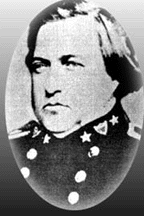
    General Humphrey Marshall

    On December 30, 1861, Marshall was still incensed about Chilton, "...I sent to Pound Gap as a prisoner one Doctor Chilton and have him there in custody. He ought to have been shot, for he is one of the very worst men in this country and has been a scourge to our friends. I propose to send my prisoners to Pound Gap, where the battalion stationed there can easily guard them and the winds of the Cumberland Heights can ventilate them properly. I have a long house erected there for their especial accommodation. Mr. Chilton is the only tenant as yet."

    During the first week of January 1862, Samuel J. Filson, a lawyer from Morgan Co. KY, went to Paintsville and was promptly arrested. "In January last I went to Paintsville; was arrested and taken into the camp of Gen. H. Marshall, commanding the Confederate forces, then near Paintsville."

    Also in January of 1862, Frederick Stumbough (Stumbo) from Floyd Co. KY, was arrested by a group of Confederate soldiers who were not uniformed but most likely operated under the command of Humphrey Marshall. Stumbough was taken to Pound Gap and later to Gladesville, VA. He gained his freedom after the Battle of Middle Creek. Years later, Stumbough sued his captors in Pike Co. KY.

    Arrests continued in the Big Sandy Valley until the end of the Civil War but probably never again on such a large scale as was witnessed during the beginning stages of the conflict.


    Information for this article compiled and researched by Marlitta H. Perkins, Jan. / Feb. 2011.

    Sunday, February 6, 2011

    William "Bill" W. Wright, Confederate Renegade

    During the Civil War, the Big Sandy Valley saw its share of partisan rangers, guerrillas and irregular bands who roamed the mountains of Eastern Kentucky and fought on more unconventional terms than regular troops.

    William “Bill” W. Wright was a member of several of these groups and made quite a name for himself during the Civil War. William was born abt. 1827 in Southwest Virginia, the youngest of six children of James Wright and Rebecca Herrell. William never knew his father since he died before or soon after his birth. On July 1, 1827, his mother Rebecca married Revolutionary War soldier James Pratt in Floyd Co. KY. Based on records, it appears that William, along with his older sister Louanna, did not spent his early childhood years with his mother and her new husband, but was raised, perhaps, by extended family.

    On June 19, 1853, William Wright married Sarah J. Rose in Lawrence County, KY and set up housekeeping on Irish Creek. Soon their first child, Sintha, was born on April 13, 1854, followed by two more children in 1855 and 1857. Within the next two years, the family moved to Catts Fork where their last child, Lavinia, was born on October 9, 1859.

    Meanwhile, a national crisis was brewing in the United States. Talk of disunion was sparked into action with the election of Lincoln as president on November 6, 1860 and secessionists made it clear that they intended to leave the Union, by force, if necessary. William Wright was an ardent supporter of the Southern cause. During the election, Wright assaulted an election officer in Lawrence County and was promptly indicted for the deed. This was just the beginning of William Wright’s long and violent career during the Civil War.

    William soon began settling his affairs and sold his small property on Catts Fork. On April 12, 1861, the Civil War officially began. In June 1861, he joined Wm. A. Roberts, a son of St. Clair Roberts, who was making up a company in the Catts Fork neighborhood to go to the Confederate army. In September, 1861, some twenty-five or thirty had enlisted and Roberts took the recruits to the army, including William Wright. Since the army was not quite organized yet, William Wright soon managed to obtain a pass to come home. According to Wright, “A. J. Marcum was then recruiting in Lawrence and I got in with him. He had a hundred men at one time. He however left us and Jerry Riffe took command of us.”

    Scene on Catts Fork, Lawrence County, KY

    At the end of November 1861, Wright experienced his first fight with Union forces. Riffe’s men were at A. J. Auxier’s house near Brammer Gap when they were attacked by a Union scout from Louisa. “They fired into us and we returned the fire and brought one man from his saddle,” noted Wright. “The Yankees then fled and left us the field.” When it was discovered that the man wasn’t dead, two or three fired into him and killed him. Wright insisted that he had nothing to do with the shooting. When the Union patrol returned the following day to renew the fight, Wright made his escape from Emmanuel Brammer’s house where he was staying at the time, possibly hiding out at his brother Calvin’s place on Dry Fork, together with some, “twenty five or thirty Confederate soldiers” who were on their way to the Confederate Army in Prestonsburg.

    Site of Emanuel Brammer's Farm, Brammer Gap

    William Wright did not spend his time being idle. He and some of his comrades, namely William Sawyers, Johnson Griffith, Frank Young, James Rose, William Brown and William Large, fell upon Andrew Cooksey’s house twice, and robbed him of one rifle and two muskets, “by putting him in fear of some immediate injury to his person.”
    The relative safety at Calvin Wright’s place was soon shattered when yet another Union patrol, under command of Captain O. D. Botner, 14th KY Infantry, raided the farm, arrested Calvin, confiscated his stock of brandy and took him to Louisa.

    William Wright decided it was time to leave Lawrence County and put out for the regular army at Prestonsburg. He enlisted on December 11, 1861, in Captain Hawkins’s Co. C of the 5th KY Mounted Infantry, for the duration of 12 months. His brother Bayless also enlisted in the 5th KY but served in Captain Blevins’ Co. K. William Wright participated in the Battle of Middle Creek on Jan. 10, 1862 and continued with the 5th KY Mounted Infantry until June 11, 1862, when he was discharged at Camp Calfee due to a hernia.

    William W. Wright Service Record
    5th KY Mounted Infantry (CS)

    After leaving the service, William Wright made his way back to Floyd Co. KY. “I hurt some men in that county, noted Wright. “I killed one man through mistake. I thought he was a Home Guard. They were after me to kill me. I was some distance from him when I shot. I had some acquaintance with him but could not recognize him from the distance I was from him. His name was Wesley Barnett.”

    In the summer of 1862, William Wright associated himself with Co. D, 2nd Batt. KY Mtd. Rifles, commanded by Captain “Rebel Bill” Smith. He enlisted as a private on Aug. 26, 1862 in Logan County, Virginia (now WV) and was elected 2nd Sgt. on Nov. 20, 1862. In October, 1862, Smith’s company went to Lawrence County and remained there for nearly a month until ordered out. During this time, Wright and a number of others were indicted by the Grand Jury of Lawrence County for the crime of invading the State of Kentucky, “as a part of an armed force of the so-called Confederate States… to make war upon her, against the peace & dignity of the Com"' of Kentucky.”

    William W. Wright's Service Record
    2nd Battlion KY Mounted Rifles

    While in Lawrence County, William Wright, together with Harvey Derifield, William Brown and John Sansom, also raided the home of Oliver D. Botner, and robbed him of one pistol, one hat, saddle-pockets, one vest, some money & numerous other articles. This may have been an act of personal revenge for Wright since it was Botner who arrested his brother Calvin in late 1861.

    In November, Smith’s company left Eastern Kentucky and crossed the Big Sandy at the mouth of Whites Creek. “The day after we crossed we had a fight with Bob McCall, noted Wright. “Bob fought very well but we made him trot and captured ten head of horses and accoutrements. We then went to Russell County, Virginia.” The 2nd Battalion also spent some time in Eastern Tennessee and in March of 1863, was ordered back into Eastern Kentucky. Along the way, William Wright fell sick and was left in Morgan County. As soon as he got well he rejoined his command and then was sent into Kentucky to gather up the stragglers of his company. William Wright started out in August, 1863 and made an appearance at Charles Barrett’s house on August 18, 1863, together with Harvey Derifield, John Sansum, William Brown & John Kitchen (son of Jack), and robbed the man of a silver watch, clothing, money & divers other things.

    William Wright soon fell in with Sid Cook’s Company who were briefly associated with Prentice’s 7th Confederate Cavalry. Between April and October in 1863, Cook’s company raided Star Furnace (Carter County), Poplar Plains, Flemingsburg, Pennsylvania Furnace (Greenup County), Olive Hill and Morehead, Kentucky. During a raid on Buffalo Furnace in Greenup County, KY, on Oct. 11, 1863, Wright was captured, along with John M. Auxier, Bunyon Oney & John H. Smith from Cook’s company.

    Ruins of Buffalo Furnace
    Greenup County, KY

    Wright was sent to prison in Louisville and tried by a military commission for the murder of a Union prisoner in October 1862 and sentenced to death. He tried to break guard and as a consequence had his arm shot off. The Union authorities commuted his death sentence to imprisonment with hard labor at Camp Nelson, where he remained until after the war had ended. He was finally released in July 1865 and returned home to Lawrence County. Soon he learned about the indictments against him for his war-related crimes and went into hiding to dodge the officers who were after him. Before long, he joined forces with James Lyon, a Union deserter from the 5th WV and former member of Cook’s company, and his brother John Lyon, a lad of 18 years. According to Wright, the trio “formed a great many plots.” In 1866, the three men were still prowling the hills of Lawrence Co. where they made quite a reputation for themselves. On April 19, 1866, the Lawrence County Court indicted the Wright and the Lyon men for "shooting with intent to kill", a probable reference to the wounding of Hiram F. Adams who was shot down while working in the fields with his son.

    This act was followed by the murder of George P. Archer, a merchant who lived at the mouth of Bear Creek in Lawrence County, on April 27, 1866, which would eventually bring on the demise of William Wright and James and John Lyons. The robbery had been planned well in advance by Wright and Lyon men. On the day before the night of the robbery and murder they went to Louisa to Joe Botts’ barber shop. “Uncle Joe” cut the hair of Jim and John Lyons and shaved off the long beard of Bill Wright. In requesting “Uncle Joe” to shave off the beard, Wright said “it was spring now” and he didn’t want to wear it during the summer. It was later brought out in court that this was just a part of a disguise that he hoped would keep Archer and Mrs. Hatton from recognizing him. On the evening of the tragic murder, Bill Wright and Jim and John Lyons stopped at the house of an old woman on Catts Fork, believed to be an aunt of William Wright, and told her they were on their way to the mouth of Bear Creek to rob a store.

    The trio arrived at Archer’s store on Bear Creek late at night. They knocked on the door, pretending to be rafts men, and asked for tobacco. Archer came down the stairs in his night-clothes and handed them what they had asked for. The men then concluded to buy of every thing freely, and soon three large sacks were filled and tied up, when one of the robbers demanded money. Archer, on reaching under the counter for his pistol, was riddled by bullets fired by the men. Leaving George Archer to die where he had fallen, two of the men carried their stolen bags of merchandise to the outside where their horses were waiting. The other went upstairs in search of the money they thought was hidden somewhere. Upon hearing a noise (he thought someone had heard the shots and was coming to investigate) he very quickly grabbed Archer’s clothes, including a jeans coat that were on the foot of the homemade bed and fled.

    The murder created intense excitement in Lawrence County. Meanwhile, the trio had returned to the house of the old woman on Catts Fork, and after she made them breakfast, divided much of the property with her. Soon Archer's wife remembered the jeans coat, and that it could nowhere be found. Hope revived that the tell-tale garment would lead to the apprehension of the murderers. Men went everywhere to spy out the coat. At this juncture the old woman living on Cat's Fork sent word to the county seat that Wright and James and John Lyon had been at her house before and after the robbery, and leaving part of their loot with her in payment for breakfast. Almost simultaneously with the old woman's story the coat was seen on Jim Lyon’s back. He was arrested with the fatal coat, and taken to Louisa. John Lyons was soon found in Greenup County, and brought to Louisa.

    William Wright was still at large on June 25, 1866, when Judge Clayton informed Governor Bramlette, "There has been a monstrous murder committed in this county..." He urged the governor to "offer a liberal reward” for the apprehension of Wright, who was believed to be skulking about in the Little Sandy country. William Wright was described as, “as being "about 5 feet 7 inches high, slightly pockmarked, with his left arm off, tolerably close off & stutters very much when excited." He was finally captured in Magoffin County, after he had entered the store of a Mr. Allen who, recognizing him from the published description quickly covered him with a pistol. With the help of two other men, Allen brought him to Louisa on horseback and William Wright was placed in jail. The three were put in irons, and the jail was guarded to prevent escape as it was feared that they would be liberated by other desperados still at large in the area.

    At the preliminary trial the stolen goods that had been given the Catts Fork lady was brought in, the evidence of “Uncle Joe” the barber was taken and the “jeans coat” was identified by Archer’s wife. The guilt of the parties was proven beyond a doubt. Archer's friends concluded that there was danger in delaying the execution of justice, and a group of about 150 to 200 men, of the lower part of Lawrence County, Ky., and Wayne County, West Va., without any disguise, rode into Louisa, ordered a gallows erected, dispersed the guard at the jail, forced the jailer to surrender the keys, and brought out the prisoners, telling them to prepare for death, for that within a few hours they must die. The prisoners were escorted to the blacksmith shop, where they were relieved of their manacles.

    Appeals by Frederick Moore, Rev. Mr. Medley, and Mr. Hall, at the Court House, in behalf of law and order, proved to be fruitless. The mob listened, but went on with the preparations. The condemned men proceeded to the place of the execution at the Salt Water Branch, now known as Sammon’s Bottom, just off Pike Street, in Louisa. It was now three o’clock in the afternoon.

    Jim Lyons made a confession while on the way to the gallows, which was pronounced false by the other two. John Lyons and Bill Wright also made voluntary confessions as soon as they reached the make-shift scaffold. They all ascended and took their positions on the same. Col. Milton J. Ferguson pleaded with the crowd to let the law take its course but his words fell on deaf ears. Reverent Medley stepped forward and asked to be allowed to pray again. He asked God to forgive the mob for what they were about to do, and to so burden the hearts of the murderers that they would cry out as the thief on the cross did, and ask forgiveness. As his prayer ended the three were asked if they had a final word to say.

    As soon as quiet was restored, Bill Wright made a speech, and in his remarks he requested that his confession should not be read, as he preferred to have it published to the whole world after he was dead. This, however, was not granted. The truthfulness of Wright's confession was pronounced false by the Lyons brothers, and the controversy between the prisoners finally ended in a quarrel.
    John Lyons was only eighteen, but he told the crowd, "The world will lose nothing by my death. I was old enough to take part in the crime, and I’m old enough to die with my partners.”

    A correspondent of the Catlettsburg Herald described the hanging, “The prisoners manifested very little fear, and otherwise showed themselves to be bold ... John Lyons sent word to his brother that he hoped to meet him in a better place than that dirty hole, at the same time sending an old pocket handkerchief for a keepsake. The time had now arrived for the termination of the lives of these miserable men and, on receiving the notification, the Lyons brothers joined hands and kissed each other. The caps were then drawn over their heads, and they shouted good bye to the throng, and they, in connection with Wright, were launched into eternity. After hanging about fifteen minutes life was pronounced extinct.” They were pronounced dead by Dr. Kincaid of Catlettsburg and Dr. Yates of Louisa. When the bodies were cut down it was discovered that the men were still alive. They were taken to the Lawrence County court house and laid out on the floor to die. Dr. H.S. Swetnam and Dr. G. W. Wroten were called in and soon it was apparent that at last they had gone to meet their Maker.

    Article of the hanging, Catlettsburg Herald, July 28, 1866,
    re-printed in the New York Herald, August 6, 1866

    During the night coffins were made ready for burial. Colonel Jay H. Northup offered space on a part of his land at the mouth of Lick Creek for a final resting place. In the 1930’s, according to local lore, the skull and leg bones of two of the culprits were found where they had washed up on the banks of the mouth of Lick Creek, near where the Creek enters into the Levisa River. The skull was displayed in the window of one of the local hardware stores for a number of years but has disappeared since without a trace.
    However, the correspondent of the Catlettsburg Herald noted that the bodies were taken to Blaine for burial. The world may never know their true burial site, but it seems befitting that William Wright, James and John Lyon remain controversial in death as they were in life, up to their violent and ghastly demise in 1866. It also has remained a mystery what happened to William Wright's wife Sarah and their four children - all of them vanished without a trace.


    Article written and researched by Marlitta H. Perkins, Feb. 2011.
    Photographs are property of the author and copyrighted.

    Sunday, January 30, 2011

    History of the Stewart House in Louisa, Kentucky


    Hidden from view by a mighty boxwood hedge and an old fashioned wrought iron fence stands the Stewart House, built between 1846 and 1847, quite possibly the oldest structure still in existence in Louisa. Situated on Main Street in the downtown area, the large two-story house has stood the test of time. Nevertheless, the house has remained empty since the death of its last occupant, and, void of the loving human touch, is beginning to show its age and falling into disrepair.


    Front Gate

    Looking at the original plat map of Louisa, the Stewart House is situated on lots # 71/72, as part of a city block bound by Main Street, Lock Avenue, East Perry Street and South Jefferson Street, and formed by lots # 71 - # 74.


    Louisa Plat Map
    Location of the Stewart House.

    The first documented owner of lots #71-74 was Richard Apperson (1799-1863), a well known lawyer from Mt. Sterling, Montgomery County, KY. Born in New Kent County, VA, Apperson settled in Kentucky in 1814/15, and began teaching school for several years, while reading law at the same time. He was licensed to practice in the Court of Appeals in 1823 and admitted to the bar in Richmond, KY where he pursued his profession until 1830. He then moved to Mt. Sterling, and represented Montgomery County in the state legislature for two terms and was a member of the 1849 Kentucky Constitutional Convention. Apperson held the original patent to a 2084 acres tract, originally surveyed by George Washington for one John Fry under the Proclamation of 1763, and granted in 1792, which was located on both sides of the Big Sandy River and included the present site of Louisa.

    Ownership of lots #71-74 passed from Richard Apperson to Dr. Zattu Cushing, a medical doctor with entrepreneurial aspirations. It may be noted that he was the uncle of two well known Civil War heroes - Alonzo Hereford (Lon) Cushing, commander of the famed Cushing's Battery, who died during Pickett's Charge at Gettysburg, next to the artillery guns he refused to leave, and William Barker Cushing, one of the most daring Naval commanders of the Civil War. His two most famous acts were the nighttime raid and destruction of the formidable Confederate ram CSS Albemarle and his leading of the naval brigade in the assault upon Fort Fisher, North Carolina.

    Dr. Zattu Cushing was born on December 7, 1802, at Paris, N. Y., the son of Zattu and Rachel (Buckingham) Cushing. His father was a pioneer settler from Plymouth, Massachussetts, who founded the town of Fredonia, NY. Dr. Zattu Cushing came to the tri-state area at an early time, possibly before 1820. He settled in Cabell County, Virginia and began operating a mercantile store near "The Islands of The Guyandotte", which is now Logan, Logan Co. WV. Here he went into partnership with Anthony Lawson, an English man from Longhorsby, Northumberland, and began buying and transporting the local farmers' produce down the Guyandotte River in push boats to other locals. By 1828, Cushing had moved to Gallipolis, Gallia Co. OH and married Mary A. Cushing, a native of Belpre, Ohio. He returned to the area after his wife's death and in 1838, purchased 400 acres of land on the Tug Fork of Big Sandy River from David Garrett. Cushing and his brother-in-law Edward Tupper, began operating a wholesale/retail store in Lawrence County, known as "Cushing & Tupper".

    On May 30, 1840, Cushing and Tupper sold a tract of land on the Tug River in Wayne County, Virginia, to William Ratcliff, for the sum of $1500. Two months later, on July 2, 1840, Dr. Zattu Cushing married Nancy Ann White Smith, a daughter of Thomas and Rachel (Moss) Smith, at Louisa, Lawrence County, Kentucky, where the couple set up housekeeping. 1840 was also the last year that Cushing and Tupper operated their store. Cushing's brother-in-law returned to Zanesville, OH and Cushing took up practice as a medical doctor. He soon became also involved in local affairs. The "Kentucky State Register" for the Year 1847 lists Dr. Zattu Cushing as one of the physicians in Louisa, as well as a Justice of the Peace.

    During this time period, Cushing's family grew steadily. On July 22, 1841, his wife Ann gave birth to Edward Narrette Cushing, who later became adjutant on Major General Sherman's staff during the Civil War. The next child to be born was Madeline Lamoine Cushing, on April 4, 1843.

    According to tax lists, Zattu Cushing acquired lots #71 - 74 in 1846, valued at $300. The following year, this property was valued at $1500, indicating that Cushing had made improvements on the lots, building a house and barn on the property. His daughter Romaine Vinton Cushing, was reportedly born in the house on June 22, 1847, followed by Ada Byron, on Aug. 9, 1848, who died there the following year, on June 5, 1849.


    Barn

    In 1849, three slaves (one over 16 years old) became part of the Cushing household. This is an interesting fact, considering that Zattu's brother Milton Buckingham Cushing, who had died in Gallipolis, OH, in 1847, was regarded as one of the pioneers in the anti-slavery movement. At his funeral an eulogist said "...He was a conscientious and active antislavery man and gave liberally of this money, and his time and thought, to assist in bringing freedom to the colored race..."
    In 1850, a 13 year old male slave was the only one who remained with the family. The small structure behind the main house may have served as quarters for Cushing's slaves.


    Possible Slave Quarters

    In the 1850 Lawrence County, KY Census, Dr. Zattu Cushing's family lived in HH # 916 and was enumerated as follows:
    CUSHING, Z., 47 years old, Male, Doctor, $3000, b. NY
    Cushing, Nancy A., 29 years old, Female, b. VA
    Cushing, Nary, 9 years old, Male, b. KY
    Cushing, M. L., 7 years old, Female, b. KY
    Cushing, Romane V., 5 years old, Female, b. KY

    Perhaps motivated by the death of his daughter Ada in 1849, Dr. Zattu Cushing made the decision to leave Louisa and move to Catlettsburg with his family. A decree by the Lawrence Co. KY Circuit Court enabled Dr. Zattu Cushing to acquire lots # 71 -74 from Apperson on Nov. 7, 1850 for $300, possibly the outstanding balance owed on the property by Cushing. On the same day, in turn, Cushing sold the same to James Lawson, the son of his former business partner Anthony Lawson of Logan Co. VA, for $3,000.

    Lawson retained ownership of the house for the next 13 years but there are no indications that he ever lived in the house. Lawson, a surveyor, lived with his family on Island Creek, Logan Co. VA. His wife Matilda died on April 19, 1860 of consumption and left Lawson a widower with a number of teenage children to raise. When the Civil War began, the family was decidedly pro-Southern. One of the more prominent members was James' nephew Melvin B. Lawson, who had a gained notoriety during the Civil War as captain of the 5th VA State Line and captain in the 10th Kentucky Cavalry. He was also associated with "Rebel Bill" Smith's VA Battalion as captain and participated in raids in Floyd County and Pike County, KY, during the summer of 1864 and in a raid on Peach Orchard, Lawrence County, KY, in October 1864.

    Early on in the war, perhaps due to the Southern sympathies of the owner, the house was commandeered by the Union Army and used as a hospital for the soldiers as well as to retain prisoners. The choice of this particular house may also have been a matter of convenience since Dr. Yates, regimental surgeon of the newly formed 14th KY Infantry, lived next door on one of the neighboring properties (lot # 82). It was also in close proximity to another building that had been converted into a hospital - the First Methodist Church on Main Street (lot # 86).

    It appears that James Lawson moved with his family from Logan to Wythe County, VA during the war. On June 2, 1863, Lawson sold lots # 71-74 to John B. Carter, specifying that the purchase price of $1,200 was to be paid in Confederate money.


    James Lawson to John B. Carter Deed, June 2, 1863

    John B. Carter and his wife Lucretia retained ownership of the property until 1868 when the lots were conveyed to John J. Jordan who in turn sold them to George Carter on July 20, 1868. On the same day, Carter executed a title bond to Greenville McHenry who assigned the same to James E. Stewart, a lawyer living in Paintsville, Johnson Co. KY.

    Stewart was born on Oct. 1, 1832 in Lawrence Co. KY, the son of Ralph J. Stewart and Emma America Canterbury. James E. Stewart read law with Judge James M. Rice and was admitted to the Kentucky Bar Association in late 1854. He moved to Paintsville, Johnson Co. KY on December 31, 1854 and opened a law office the following year. On January 11, 1860, James E. Sewart married Cynthia F. Mayo, daughter of Lewis Mayo, who was one of the leading men of the Middle Sandy Valley. From September, 1861, to April 1865, Stewart resided part of the time near the mouth of John's Creek, and a part of the time on a farm about two miles from Paintsville.

    When the Civil War began, Stewart, according to his own words, "sympathized with the southern people, but had no connection whatever with those in arms, or that was aiding the rebellion."

    After the Battle of Middle Creek on January 10, 1862, Paintsville served as temporary military base for Union commander James A. Garfield. During this time disloyal citizens were arrested, among them Stewart who was charged with "giving aid and succor to rebels." According to Stewart, he was arrested "at the instance of prejudiced acquaintances, and upon false testimony." He was taken to Newport Barracks, KY and from there forwarded to Camp Chase, Ohio on March 19, 1862, where he remained a prisoner for nearly a year. On being released by exchange, he returned home and soon returned to the practice of law.

    In August of 1868, one month after acquiring the Main Street property in Louisa, Stewart was elected commonwealth attorney for the sixteenth judicial district of Kentucky, composed of the counties of Pike, Floyd, Johnson, Magoffin, Lawrence, Carter, and Boyd. According to Stewart, he was, "was elected to that position by the people in August, 1868, by a majority of near a thousand majority."

    It was not until 1872, that Stewart, with his wife and three children, finally moved from Johnson County to Louisa and took up abode in their new home on Main Street. Their child Neva Sharon Stewart was born here in 1875.

    In the late 1870's, Eastern Kentucky was rocked by activities by groups of so-called "Regulators". Judge James E. Stewart was appointed special judge of the Criminal Court, 16th District, in an attempt to bring peace and order to the counties of Carter, Elliott and Lawrence. Despite frequent death threats, Judge James E. Stewart vowed to uphold the law against the Regulators and called on Gov. Luke P. Blackburn for state troops. Stewart's firm stand, the threat of military force, and the promise of executive clemency for Regulators who voluntarily surrendered, proved to be successful to end the violence in Lawrence County. On May 28, 1880, several hundred Lawrence and Carter County Regulators surrendered to Judge Stewart at Louisa. On February 2, 1881, Stewart recommended pardons for 390 Regulators.

    In 1884, Judge James E. Stewart's son James Lewis graduated with a Bachelors of Law from the Ann Arbor Law School, University of Michigan. During the closing ceremony, he was exposed to cold which turned into pneumonia. He returned to Louisa and died at the home of his parents on July 18, 1884, at the age of 23 years.

    The Stewart family continued to live in Louisa and in 1900, James E. Stewart was listed in the census as living with his wife Cynthia and son Forest Lee, also a lawyer, and daughter Neva Sharon, a music teacher. In 1902, Neva married their neighbor Albert M. Campbell, an engineer. Soon thereafter, Judge Stewart's health began to decline and, after sustaining "a stroke of paralysis", he died at his Louisa home on Jan. 18, 1903.


    Judge Stewart Obituary, Morning Herald, Jan. 19, 1903

    On March 10, 1904, Cynthia Stewart finally received the deed for their Main Steet home, "the entire consideration in said title bond [executed on the 20th July, 1868] having been paid in full..."

    In 1905, Forest Lee Stewart married Nannie Lee Watson Hays, a widow from near Webbille. This family eventually became the next occupants of the Stewart home. After Forest Lee's death on June 9, 1930, his widow Nannie continued to reside in the house until her death. Up to the present day, the house still remains in possession of the family.


    Article researched and compiled by Marlitta H. Perkins, January 2011.
    Images are copyright of the author.

    Monday, January 10, 2011

    The Battle of Middle Creek, January 10, 1862

    Middle Creek Battle Field

    Today marks the 149th Anniversary of the Battle of Middle Creek. It was here that Confederate forces under Brigadier General Humphrey Marshall and the 18. Brigade, Department of the Ohio, under the command of Colonel James Abram Garfield, clashed on a cold morning near Prestonsburg in Floyd County, Kentucky.

    More than a month after Confederate Col. John S. Williams had left Kentucky,following the fight at Ivy Mountain, Brig. Gen. Humphrey Marshall led yet another force into southeastern Kentucky to continue recruiting activities. From his headquarters in Paintsville, on the Big Sandy River, northwest of Prestonsburg, Marshall recruited volunteers and had a force of more than 2,000 men by early January, but could only partially equip them.

    Union Brig. Gen. Don Carlos Buell directed Col. James Garfield to force Marshall to retreat back into Virginia. Leaving Louisa, Garfield took command of the 18th Brigade and began his march south on Paintsville. He compelled the Confederates to abandon Paintsville and retreat to the vicinity of Prestonsburg. Garfield slowly headed south, but swampy areas and numerous streams slowed his movements, and he arrived in the vicinity of Marshall on the 9th.

    Heading out at 4:00 am on January 10, Garfield marched a mile south to the mouth of Middle Creek, fought off some Rebel cavalry and turned west to attack Marshall. Marshall had put his men in line of battle west and south of the creek near its forks. Garfield attacked shortly after noon, and the fighting continued for most of the afternoon until Union reinforcements arrived in time to dissuade the Confederates from assailing the Federal left. Instead, the Confederates retired south and were ordered back to Virginia on the 24th of January, 1862. Garfield's force moved to Prestonsburg after the fight and then retired to Paintsville. Union forces had halted the Confederate 1861 offensive in Kentucky, and Middle Creek demonstrated that their strength had not diminished. This victory, along with Mill Springs a little more than a week later, cemented Union control of Eastern Kentucky until Gen. Braxton Bragg [CSA] launched his offensive in the summer and fall. Following these two January victories in Kentucky, the Federals carried the war into Tennessee in February of 1862.


    Union Headlines
    The Ironton (OH) Register
    February 6, 1862


    Confederate Account
    Richmond (VA) Daily Dispatch
    January 16, 1862


    Union and Confederate Reports


    HEADQUARTERS DEPARTMENT OF THE OHIO,
    Louisville, January 14, 1862.

    Colonel Garfield, commanding Eighteenth Brigade, reports that on the 7th instant he attacked and drove the enemy from his intrench-merits at Paintsville, killing 3 and wounding several; our loss 2 killed and 1 wounded.
    On the 10th he attacked the main body of the enemy, under Humphrey Marshall, posted on the hills at the Forks of Middle Creek. Skirmishing commenced at 8 a.m.; engaged from 1 p.m. until dark. The enemy was driven from all his positions, and in the night burned most of his stores and fled precipitately. Our force was 1,800 infantry and 300 cavalry. The enemy had 2,500 infantry, three pieces of artillery, and six companies of cavalry. Our loss at Prestonburg, 2 killed, 25 wounded. The enemy's loss at Prestonburg, 27 found dead on the field. He carried off his wounded and many of his killed.
    We took 25 prisoners, 10 horses, and a quantity of stores. Colonel Garfield had crossed the Big Sandy to Prestonburg on the 11th.

    D.C. BUELL,
    Brigadier-General, Commanding.

    [OR SERIES I--VOLUME 7, p. 21]


    HEADQUARTERS EIGHTEENTH BRIGADE,
    Prestonburg, Ky., January 11, 1862.

    I left Paintsville on Thursday noon with 1,100 men, and drove in the enemy's pickets 2 miles beyond Prestonburg. The men slept on their arms. At 4 o'clock yesterday morning we moved toward the main body of the enemy at the Forks of Middle Creek, under command of Marshall. Skirmishing with his outposts began at 8 o'clock, and at 1 o'clock p.m. we engaged his force of 2,500 men and three cannon posted on the hill. Fought them until dark. Having been re-enforced by 700 men from Paintsville, drove the enemy from all their positions. He carried off the majority of his dead and all his wounded.
    This morning we found 27 of his dead on the field. His killed cannot be less than 60. We have taken 25 prisoners, 10 horses, and a quantity of stores. The enemy burned most of his stores and fled precipitately..
    To-day I have crossed the river, and am now occupying Prestonburg. Our loss 2 killed and 25 wounded.

    J. A. GARFIELD,
    Colonel, Commanding Brigade.

    [OR -- SERIES I--VOLUME 7, p. 29]


    CAMP AT MARTIN'S MILL, ON BEAVER CREEK,
    Floyd County, Kentucky, January 14, 1862.

    ....On the morning of the 10th I learned from my pickets that the enemy was passing in force from Abbott's Creek to Middle Creek, and were apparently pursuing me, the Fortieth Ohio having effected a junction with the rest by passing down Paint Creek. I was on my way to this place, because it is the nearest point to my camp of January 8 at which I could get meal to make bread. I permitted my transportation train to move along the road I was traveling, and I halted and formed my command for battle.

    The enemy came in sight about 10 a.m. and we engaged about 12 m. He was very slow in making his advance and general dispositions. I send inclosed a sketch of the ground upon which the battle took place, from which you will see that my battery was at first placed in the gorge of the mouth of the Left Fork of Middle Creek.
    Williams' regiment, Moore's regiment, and part of the mounted battalion, fighting on foot, occupied the spurs and heights upon my right; Trigg's regiment occupied the height covering the battery; Witcher's and Holladay's companies in reserve in rear of the battery; Thomas' and Clay's companies, dismounted and armed with Belgian rifles, thrown forward on the opposite side of Middle Creek to the heights commanding the plain of main Middle Creek, and resisted any advance of skirmishers from the opposite heights.

    The enemy, having come through a defile to the left of main Middle Creek, first deployed a large force on the heights to his right, then advanced a regiment to the middle of the plain, covered by cavalry, and rested his left and his reserves at the base of the hills, which were manned by my right. Our lines thus rested at an acute angle to each other. He first advanced his cavalry and center, but three discharges of artillery put the cavalry to flight, and if they did anything more during the day it was done on foot. We plainly heard the command to "Force the cavalry forward," but the cavalry did not make its appearance again. The enemy charged up the points above the mouth of Spurlock's Branch three times, but were repulsed with great loss.

    In the evening I shifted our smooth-bore 6-pounder, so as to bring it to the summit of the dip in the hill occupied by Trigg's regiment, and obtained a fair flank fire at the enemy, while occupying a piney point in front of Moore's regiment. This soon attracted a hot fire upon the gun, but no further damage than the shooting of one of the artillery horses through the head.

    After an action which lasted about four hours the enemy withdrew his force, it then being night, and retired down Middle Creek, on the route to Prestonburg, whence, the next day, he retraced his steps to Paintsville.

    I submit herewith Colonel Moore's report, and will send others as soon as the officers make them out. They have been called for, but are not yet prepared. I send Dr. Duke's report of casualties. I think our loss will amount to 11 killed and 15 wounded; not more.
    I can only say to you, general, that my troops acted firmly and enthusiastically during the whole fight; and, though the enemy numbered some 5,000 to our 1,500, they were certainly well whipped. If I had had bread for my men (some of whom had had nothing to eat for thirty hours) I should have renewed the action after night; but an enemy greater than the Lincolnites (starvation) summoned me to reach a point where we might obtain food for man and horse.

    I pursued next day my march to this place, distant from the scene of action some 16 miles, which I accomplished in three days. My scouts informed me the enemy was at the same time returning to the points on the Sandy whence he came to disperse the "rebel force" I have the honor to command.

    This is the first mill where I could get bread. I halted here and pitched my camp, perfectly satisfied that unless the enemy shall be strongly re-enforced he will not seek to renew our acquaintance.....

    Respectfully,
    H. MARSHALL,
    Brigadier-General.

    [OR-- SERIES I--VOLUME 7, pp. 46 - 50]


    HEADQUARTERS TWENTY-NINTH VIRGINIA REGIMENT,
    January 13, 1862.

    SIR: The present being the first opportunity which has presented itself since our engagement with the enemy at the Fork of Middle Creek, in Floyd County, Kentucky, on the evening of the 10th instant, I will now give you briefly a hasty report of the part taken and the consequences resulting therefrom to the three under my command. The Twenty-ninth Virginia Regiment was the greater part of the time--that is, during the battle, which lasted some three hours--in the head and front of the fire, and all, without a single exception, so far as my information extends, conducted themselves in the bravest and most gallant manner. The loss to my regiment was 5 killed and 7 wounded.

    In this my brief and imperfect report I ought not, perhaps, to make any invidious distinctions by mentioning the names of any of my men or officers, who conducted themselves most gallantly in the battle; but I think my whole command will bear me out in giving to Lieut. Col. William Leigh, Maj. James Giles, and to Lieut. William J. March, of Captain Bryant's company, great credit for the gallant and daring part acted throughout the entire engagement.
    In conclusion, I will say that all acted nobly and achieved for themselves a reputation and a name which old Virginia may and will be ever proud to honor.

    A. C. MOORE,
    Colonel, Commanding Twenty-ninth Virginia Volunteers.

    [OR SERIES I--VOLUME 7, p. 61]


    Middle Creek Historical Marker


    Links of Interest
    Prestonsburg, Floyd County, Kentucky
    Mentor, Ohio
    University of Richmond

    Article researched and compiled by Marlitta H. Perkins, January 2011


    Monday, January 3, 2011

    Election dispute in 1867 reveals names of former Confederates in Greenup County, KY

    The hunt for new source material sometimes takes me to unexpected areas of discovery during my Civil War research. When I located the papers of the election dispute case Samuel McKee versus John D. Young, I knew I had found an invaluable source and a veritable goldmine.

    On June 9, 1867, Samuel McKee notified John D. Young that he intended to contest Young's right to a seat in Congress because he, "did not remain loyal to the government of the United States,"during the late rebellion" and awowed himself, "in favor of raising and arming troops in Kentucky to resist the federal government .."

    One of the documents contained in the papers was a deposition given by Benjamin Franklin Bennett, of Greenup County, KY. Bennett, a native Ohioan from Scioto County, who had settled in Greenup County in December of 1855, after purchasing the saw and cornmills at the old Globe Furnace on Tygert Creek, then known as Darlington Mills. Bennett rebuilt the mills, installed new equipment and produced the first flour in Greenup County. His business became known as Bennett's Mill. With the help of his brother Pramley, Bennett also built a covered bridge over Tygart Creek in order to accommodate their customers.

    Bennett's Mills Covered Bridge
    Located on the East side of SR 7
    0.9 miles north of SR 10(AA Highway)

    When the Civil War began, Benjamin F. Bennett enlisted in the 56th OVI and saw action at Fort Donelson, Pittsburg Landing and Corinth, Mississippi. Bennett fell sick and was discharged on July 25, 1862, on account of disability, with the rank of sergeant. In Aug. 1863, after having regained his health to some degree, Bennett entered the U.S. Service as a Deputy Provost Marshall for the 9th Congressional District of Kentucky and served in that capacity during the war. In March of 1866, having read law during his convalescence, Bennett was admitted to the Bar as a practicing attorney and opened an office in Greenup.

    On August 14 and 15, 1867, Benjamin F. Bennett was called upon to give a deposition in Greenup in the Samuel McKee - John D. Young election dispute case. The following is a transcript Bennett's statement:

    Deposition taken at the office of John Seaton and before Judge McCoy, in the town of Greenupsburg, Greenup county, Kentucky, on the 14th day of August, 1867, to be read as evidence in the case wherein Hon. Samuel McKee is contesting the right of John D. Young to a seat in the fortieth Congress of the United States.

    By George M. Thomas, attorney for Mr. McKee:

    Q. State your age, and how long you have lived in Greenup county, Kentucky, and state your occcupation.

    I will be 38 years old in October, 1867. I have lived in Greenup county twelve years next December. I am a practicing lawyer at this time.

    Q. State, if you know, whether any persons voted for John D. Young for Congress, in May last, in Greenup county, who had been in the rebel army; and if so, give their names.

    The following named persons, I understand, were in the rebel army, who voted at the last May election in Greenup cunty for John D. Young, as appears from the poll books which I have examined, viz: Williams S. Kawns (Kouns), David Smith, Edward Howe, Henry C. Horton, David E. Carroll, Enick Lewis, James K. Music, P. B. Byrne, Charles Wamack, William Sanford (Lanford?), Ridan Butram, William Bagby, R. W. Cooper, Robert Gibbs, Joseph C. Blenthinger (Blentlinger), Henry E. Huffman, John Cooper, B. F. Huffman, Aaron Huffman, J. C. Huffman, J. Huffman, Solomon Huffman, S. P. Felty, W. H. Clifton, William Huff, G. W. Hurst, and David Colley, making in all twenty-seven, (27) Some of the above named persons have informed me that they had been in the rebel army, and the balance were generally understood in the county to have been in the rebel army, and I never heard it disputed.

    Q. State if you know of any persons who voted at the last May election, in Greenup county, for John D. Young for Congress, who had been in the Union army and deserted the same?

    (Excepted to by Young)

    The following named persons voted for John D. Young in May last, in Greenup county, who were reputed to be deserters from the Union army, viz: David McNeil, T. J. Soper (Loper), Nelson Traylor, and James T. Bagby, and Joseph Fisher. I think hat McNeil, Soper (Loper), Traylor, and James T. Bagby belonged to the 22d Kentucky infantry, and Fisher belonged to the 2d Kentucky cavalry. I was special agent of the provost marshal during a part of the war.

    Q. Do you know of any persons who voted for John D. Young in May last, in Greenup county, who started to the rebel army and were captured on their way or returned?

    Samuel Wamack, John White, Robert Stuart, Amos Thompson, and Columbus Kirtly voted for John D. Young in May last, in Greenup county. I understand that they started to the rebel army and were captured and brought back. I have heard Kirtley speak of his capture.

    Q. Do you know of any persons who voted for John D. Young in May last, in Greenup county, who were arrested during the war upon charges of treason and disloyalty, and sent to Camp Chase and other prisons?

    (Excepted to both questions and answer)

    The following named persons, viz: J. M. Bevins, Milton Boyd, Eli Cooper, William A. Wamack, E. F. Cooper, and Thomas Warring voted for John D. Young last May. I saw all of the above-named persons, except Warring, while under arrest and charged with disloyalty, and I heard Warring say he was arrested and sent to Camp Chase. I know he had a suit pending in this court against the parties who arrested him, and Bevins has a suit pending in this court at this time against the parties whom he charges arrested him.

    Q. Do you know of any persons who voted for Young in May last, in Greenup County, who had no right to vote by the laws of Kentucky?

    A. G. W. Marshall voted for Young at the May election. I understand he is under twenty-one years of age. Joseph Morgan voted for Young at the election in May last, and I understand he had been here but about eight months, and he came from Ohio. I see a great many names on the poll-book that I know nothing about.

    Cross-examined by Young:

    Q. State, if you know, how many rebel soldiers voted for John D. Young on the 4th of May last for member of the 40th Congress of the United States, who were in the rebel army at the close of the war.

    I think Lanford, David Smith, Hurst, H. C. Horton, P. B. Byrne, and Music are the only ones that remained in the army at the close of the war.

    Q. State, if you please, how many of the rebel soldiers you state voted for John D. Young at last May, came home under President Lincoln's proclamation, and how many took the amnesty oath?

    I do not know of any who came home under President Lincoln's proclamation; Dr. W. S. Kouns was gone only about six weeks, and then returned; the balance not named above served one year and then returned and remained at home.

    Q. State how many rebel soldiers voted at the last May election in this county for Samuel McKee.

    I don't know of one.

    Q. State how many soldiers served in the Union army from the county of Greenup during the war.

    In my judgement there were from seven to eight hundred soldiers in the Union army from Greenup county.
    .
    .
    .
    Q. State, if you know, at what time in the year 1861 or 1862 there was a rebel raid on Boone furnace in this county, and by whom made?

    It was made in the fall of 1862; I think it was made by Colonel Trigg's command; Boone furnace was in Carter county in 1862.

    Q. State whether any other raid was made in the county of Greenup, or no any other furnace during the years 1861-1862, or at any other time during the war.

    I think there was a raid made on Pennsylvania furnace in the year 1863, after harvest; by whom I do not know.

    Q. For whom did you vote for member of the 40th Congress of the United States on the 4th day of May last?

    Samuel McKee

    By McKee's attorney:

    Q. At what time was the line between Carter and Greenup changed so as to include Boone furnace in Carter County?

    I think it was in 1860 or 1861.

    B. F. Bennett

    August 15, 1867
    Met in pursuance to adjournment; B. F. Bennett being recalled by Mr. Young:

    Q. State whether there was any raid at any time during the war made on Racoon furnace in Greenup county; and if so, by whom?

    I know of no rebel raid having been made on Racoon furnace in Greenup county; there were some arrests made at or about said furnace, but by whom I do not know; I do not think they were rebels who made the arrests.

    Q. State whether or not the rebel soldiers who you spoke of having voted for John D. Young, and had served in the rebel army for twelve months and returned home, did not have to take the amnsety oath, or the oath to support the United States, &c., before they were permitted to remain.

    I do not know whether they took any oath or not; some of them were arrested and taken to Camp Portsmouth, Ohio, and were released.

    Q. How do you know that these men joined the rebel army?

    From reputation; some of them told me so themselves. One of the above-named persons, viz: W. H. Clifton, after he returned home from the rebel army was indicted in this court under the State law for invading the State to make war on the same, which indictment was disposed of in some manner, how I do not know; he afterwards enlisted in the Union army, as I understand.

    B. F. Bennett

    Closer examination of Bennett's list revealed that a number of men had, indeed, served in the Confederate Army. For others, no records could be found, which does not necessarily indicate that these men did not serve, given the lack of records that may have survived or simply were not kept. This applies especially to Confederate records.

    Confederates
    David Smith, Pvt. 5th Kentucky Mtd. Infantry
    Henry C. Horton, Sgt. 5th KY Mtd. Inf./Partisan Rangers
    Enick (E.M.?) Lewis, Sgt. 5th KY Mtd. Inf./Partisan Rangers
    P.[Payton] B. Byrne, Pvt. 5th KY Mtd. Inf.
    Charles Wamack (Womack), Pvt. 5th KY Mtd. Inf.
    Ridan (Redman/Ridden) Butram, Pvt. 5th KY Mtd. Inf./Field's Partisan Rangers
    Robert Gibbs, Pvt. Pvt. 5th KY Mtd. Inf./Field's Partisan Rangers
    Aaron Huffman, Pvt. 5th KY Mtd. Inf.
    Henry E. Huffman, Pvt. 5th KY Mtd. Inf.
    Solomon Huffman, Pvt. 5th KY Mtd. Inf.
    S. P. (Simon) Felty, Field's Partisan Rangers
    W. H. Clifton, 1. Sgt., Ficklin's Battalion
    G. W. Hurst, Pvt. 5th KY Mtd. Inf.
    James M. Bevins, 2. Lt. by brevet, 10th KY Cavalry (Diamond's)

    Union Deserters
    James T. Bagby, 16th KY Infantry [US]
    Thomas J. Loper, 22nd KY Infantry [US]
    Nelson Traylor, 6th Kentucky Cavalry [US]
    Joseph Fisher, 2nd KY Cavalry [US]


    Deposition transcribed and researched by Marlitta H. Perkins.

    Sources
    Papers in the case of Samuel McKee against John D. Young. Ninth Congressional District of Kentucky. Date: 1868-01-01; Publication: Serial Set Vol. No. 1349, Session Vol. No. 1; Report: H. Misc.Doc. 13; pp. 34 - 36

    Photograph of Bennett's Mills: Library of Congress, Prints and Photograph Division HAER: KY-49-1

    Monday, October 11, 2010

    Louisa During the Civil War


    Louisa, the county seat of Lawrence County, KY, lies at the confluence of Tug and Levisa Forks of the Big Sandy River, on a two-thousand acres tract of land surveyed by George Washington in 1769, the corners of which were well-marked with Washington's initials. Settlement was attempted in 1789 at The Point, between the forks, but it was abandoned. A settlement called Balclutha existed for a short time afterward west of The Point. The settlement that became Louisa began about 1815. The sources of the names are obscure.

    Louisa Plat Map, surveyed June 10, 1823

    The Forks of Big Sandy post office opened in 1819 and the Louisa post office opened in 1822. In 1823, a court house was erected in the center of the public square. The building was a two-story frame house, 35x30 feet, weatherboard side, and a wood shingle roof. The first story was 12 feet high, with sleepers 2 feet apart. According to old records, there were "two 12 light windows in the end of this large room." The second story had two partitions forming three rooms. Each room had "one 18 light window in the side." The old town pump was located near the court house, on the corner of Main and Main Cross Streets.

    By 1830, Louisa had 87 inhabitants. In 1846, the town contained a court-house, church, post-office, four stores, two doctors, two lawyers, and several mechanics' shops. River traffic opened up in 1837 with the first steam boats chugging down the Big Sandy. Push boats and flatboats were still in use, especially when the river was low. The steamboat landing in Louisa was located near the end of Main Street. Many of the boats would go as far as Pikeville when the river stage permitted, which was often in the spring of the year. They would be heavily loaded with supplies and return with local products for markets east, such as ginseng, feathers, wool, beeswax, chestnuts, as well as dried apples and peaches.

    Old Steamboat Landing, view from Water Street [now S. Vinson Ave.]

    In 1843, Daniel Bayless Vaughn moved from Wood Co. VA to Louisa where he kept the "Big Hotel" and pursued his trade of merchant tailor. He was a steamboat man from 1852 to 1860, running the "Tom Scott" on the Sandy River. He built 5 large steamers, and 4 smaller ones to run on Sandy.

    In 1860, Archibald Borders, an influential businessman and first Lawrence County judge, built the famous steamer "Sandy Valley". Judge Borders owned a large brick house which stood at the grade and was facing Main Street. The house was built before the Civil War. Also situated on the property were the Borders Servants Quarters. Archibald Borders owned half the block between Main and Madison Streets.

    His son, A. P. Borders shipped goods on the steamer to various ports along the Big Sandy Valley. A freight bill, dated Dec. 18, 1860, for a shipment to J. Richmond, to be delivered "at the Port of Louisa, KY," shows every product imaginable that was taken up the river, such as crockery, yellow ware, sugar kettles, grass rope, stoves, hats and shoes, liquor, cheese, fish and specifically herring, black powder and German steel, raisins, paper, soda, pepper, coffee, indigo and madder, etc.
    The steamboats also represented the main means of transporting passengers to and fro the Big Sandy Valley until the advent of the railroad in the 1880's.

    Big Sandy River, near steamboat landing, Louisa

    A stage coach line to Mt. Sterling, a distance of 103 miles, connected Louisa with the interior of the state. Weary travellers could rest at the Gallup Hotel, acquired by George W. Gallup in the summer of 1860 which stood on the banks of the Big Sandy River, near the steamboat landing, on Main Street in Louisa. The hotel keeper was Henry S. Bussey. A ferry, operated by George R. Miller, crossed the river at the end of Main Street just below the mouth of Levisa and Tug to Cassville, Virginia [now Fort Gay, West Virginia].

    Louisa continued to grow and by 1855, the town had a court-house, a church, 4 stores & about 100 inhabitants. In 1860, Louisa was a small town with a population of 258. There were two churches in the downtown area. The brick Methodist Episcopal Church, South stood on the south-east corner of the public square, a commodious and attractive structure for that day. The First United Methodist Church, a brick building in Gothic style, with diamond-shaped glass windows, was located on the east side of Main Street.

    First United Methodist Church, Louisa

    In 1860, Lawrence County's chief economic resources were timber, minerals and tobacco but the beginning of the Civil War soon halted timber and coal production. In 1840, Louisa was the geographic center of American hog production but had lost its importance by 1850.

    An 1860 business directory for Louisa

    Granville Frasher, merchandising
    Wm. Moore, merchant
    Pleasant Savage, merchant
    Greenville Lackey, merchant
    Noah Wellman, merchant
    James A. Wellman, merchant
    Peter I. Livingston, merchant
    John McHenry, dealer in minerals & merchandise
    Amelia A. Cook, widow merchant
    Mary J. Ferguson, widow merchant

    George R. Miller, Ferryman

    John P. Armstrong, teacher/pedagogue
    Verlinda Davenport, school teacher
    John Laidly, school teacher

    George W. Gallup, lawyer
    Laban T. Moore, lawyer
    Jake Rice, lawyer
    Kenas F. Prichard, lawyer

    Marcus L. Hodge, carpenter
    Robert Moore, carpenter
    J. J. Taylor, carpenter
    Jake [?] Bradley, carpenter

    James M. Frazer, tanner & currier
    Strother J. Yates, physician
    Stephen L. Davenport, saddler
    S. J. Small, seamstress

    John W. Jones, deputy clerk
    M. B. Goble, clerk of court

    Boon Salter, shoemaker
    John Frasher, boot & shoemaker

    James M. Pigg, cabinet maker
    Robert C. W. McKenzie, machinist

    George Martin, blacksmith
    John Pigg, blacksmith
    Charles Hambleton, blacksmith
    Willis Pigg, blacksmith
    Armstead Burchett, blacksmith
    Drury Burchett, blacksmith

    William L. Allen, artist
    Allen C. Hutchinson, artist

    Calvin Wellman, lumber merchant
    Jessee Meek, timber merchant

    Henry S. Bussey, hotel keeper
    William Troy, painter
    Abraham Neal, waggoner

    During the war, Louisa was chosen as a Union strong-hold. In the fall of 1861, a military camp named "Camp Wallace" was established by the 14th KY Infantry, named in honor of Thomas Wallace. In December 1861, a soldier from Ohio described Louisa as, "at best a straggling, unpainted hamlet, but the hostilities of six months had greatly increased its thriftless, untidy aspect. The men were nearly all in the army on one side or the other; the courthouse had been used as a barrack by the half barbarous volunteers of the mountain region, and a shabby brick tavern with its kitchen dismantled and its windows broken, still struggled against extinction as a public house by keeping a red nosed ex-hostler and a jug of new apple-jack behind the bar. Early in the War, as it was then, Louisa had been occupied and re-occupied by Federals and Confederates until its women no longer stared at the passing soldier as an object of interest, but charged him fifty cents for a dried peach pie, and as promptly besought the commanding officers to post sentries around their potato mounds and hen roosts, as though taught by the campaigns of a dozen years."

    A month later, a Kentucky officer offered a glimpse of Louisa, "I suppose ... in summer with its circle of towering hills it must be a beautiful place, but just now everything is marred with the oceans of mud which surrounds one on all sides and literally flows through its streets; even the sidewalks are unpaved."

    During the fall of 1861, as well as during Garfield's Eastern Kentucky Campaign, 1861/1862, several buildings in town served as military hospitals, including the First United Methodist Church, as well as what is now known as the Judge Stewart House which at the time belonged to James Lawson, a Southern sympathizer from Logan Co. VA. Both buildings are situated on Main Street. A third hospital, a two-story brick building, was located at the corner of Perry and Main Streets, at the top of the Grade.

    Judge Stewart House

    A temporary commissary was established in John McHenry's brick store [formerly belonging to Daniel W. Eba] and later in one of the buildings owned by Thomas Wallace. The courthouse was converted into barracks for the soldiers.

    Louisa became the seat of the Military District of Eastern Kentucky which included a Provost Marshall's office, and thus functioned as a main point for prisoner transportation down the Sandy River for transfer to Camp Chase, Ohio, as well as other military prisons. The jail near the courthouse served as a guardhouse.

    Throughout the war, various regiment encamped at Louisa, including the 14th, 22nd and 39th KY Infantry, 10th KY Cav, 4th VA Infantry, 5th VA CAV [US], 40th and 42nd OVI, McLaughlin's Squadron of Cavalry, and the 65th Illinois Infantry, 109th USCI, and the 68th Kentucky Enrolled Militia.

    Some of the military camps established in Louisa during the Civil War

    Camp Lookout
    Louisa, Kentucky, a permanent Union camp.

    Camp McClure
    Louisa, Lawrence County; Camp of McLaughlin's Squadron.

    Camp White
    Louisa, Lawrence County; Permanent Union camp, summer 1863.

    With the influx of regiments, the town was also occupied by many civilians, mostly family members of the soldiers, which caused the population to increase to more than twice its normal number. In October 1861, John Frew Stewart, who was employed in the Quartermaster Department of the 14th KY Infantry, boarded in the house of Pleasant M. Savage. In June of 1863, a 14th KY Infantry soldier wrote to his family, "for the women folks I will not say for maw to com fore they are so crowdid here that it is a hard mater for 2 person to git a place to stay." In 1863 , until the end of the war, several officers of the federal army were boarding with John M. Rice, including James D. Foster, 14th KY Infantry.

    Map of Louisa, 1864

    Due to its Union occupation and heavy fortifications on a high hill near the town, Louisa was never taken by the Confederates. On March 25, 1863, Gen. Humphrey Marshall considered an attempt, and skirmished with Union troops in Smokey Valley. The following morning, the Confederates carefully edged their way to within a 1/2 mile of Louisa when they discovered, "on a sudden turn of the road ... the position of the enemy, their artillery, & forces in line of battle - high up on a Gibraltar of a hill." Marshall immediately abandoned his plans and retreated toward Blaine.

    During the summer of 1864, the US military began construction of Fort Bishop on the hill towering above Louisa to protect the town against Confederate raids. The fort was 3/4 completed, including the magazine, and was armed with 7 field guns, when the project was finally abandoned in 1865, due to the end of the war.

    Site of Fort Bishop

    On April 9, 1865 General Robert E. Lee surrendered the Army of Northern Virginia near Appomattox Court House Virginia. After General Lee's surrender, CS soldiers were instructed to go to the nearest union post and surrender. Most of the Kentucky men from Giltner’s Brigade, the only Confederate force of any consequence left in Eastern Kentucky, surrendered on April 30, 1865, at Mt. Sterling, KY and were later paroled to their homes. Remnants of Giltner's command as well as other CS soldiers made their way to Louisa where they surrendered to the US Provost Marshall.

    The Civil War and the presence of the military left some of the buildings in town in shambles. In February 1865, Judge R. F. Vinson requested the Commander of the Military Post in Louisa to surrender up to the Civil authorities the public buildings "in this place now held and occupied by them." It was stated that, "While the army was here, they took possession of the courthouse and jail of Lawrence County and used the jail as a guardhouse and the courthouse as commissary for storage of forage and while hauling to and from the same, run the wagons against the outside corners, broke and knocked out bricks from walls, greased and soiled the floors and inside walls, broke down the stairs and floors, cut and mutilated columns, destroyed and carried away the seats, broke the frames out of two outside doors, and knocked out bricks from sides and overhead, destroyed the well in the public square by getting a horse in it and filling it up. In order to hold court, the officers were forced to procure a house to hold court in, they held court in a church building."

    The Methodist-Episcopal Church did not fare much better. The trustees of the church stated that, "during the Civil War, the United States forces, by proper authority, took possession of the house of worship and used and occuied the same as barracks, as a commissary, for hospital purposes, and as a stable, for a period of about three and one-half years, or until the spring of 1865. That during said occupancy, the troops removed from said building the windows, doors, flooring, altar, pulpit, and seats; damaging the walls and ceiling so as to necessitate replastering and refinishing; destroyed the fencing inclosing said building, and otherwise greatly injured said property."

    Methodist- Episcopal Church, Louisa, 1917

    None of the above claims were ever paid by the US Government.