April of 1865 proved to be one of the most pivotal months of the American Civil War. A series of key events changed the course of history and ultimately led to the end of hostilities between the North and the South.
On April 2, 1865, US General Grant's forces began their advance and broke through Lee's lines at Petersburg who subsequently evacuated the city. The following day, Richmond, the Confederate capital, fell and Union troops entered the city and raised the Stars and Stripes.
Less than a week later, on April 9, 1865, General Robert E. Lee surrendered the Army of Northern Virginia near Appomattox Court House, Virginia. This devastating news reached the soldiers of Morgan’s former command near Christiansburg, Virginia, while on the march toward Richmond. After the initial shock and disbelief, it was impossible to ignore the overwhelming evidence of Lee’s surrender any longer. According to Edward O. Guerrant, on April 12, 1865, while at Christiansburg,
“the commanding officers (Generals Echols, Cosby, Duke, and Wharton, and the Colonels Giltner, Preston, and Trigg), held a consultation, and determined to leave it optional with the Commands whether they would be disbanded or endeavor to reach the forces of Gen. Joseph E. Johnston in North Carolina. The Infantry Commands (the large portion of which had already left) were all disbanded, furloughed for sixty days, in case any future occasion should arise for their services. Gen. Echols, with Generals Duke and Vaughn, with the larger part of their Commands, determined to make an attempt to reach Gen. Johnston's army.”
Col. Diamond and Captains Barrett, Scott, Rogers, and Willis, and Lieut. Freeman with some 75 or 100 men determined to proceed South with Echols who met up with Jefferson Davis and his cabinet at Charlottesville, NC, thereafter forming his cavalry escort. Gen. Cosby’s and Col. Giltner’s commands, as well as a portion of Duke's, determined to move into the mountains of Eastern Kentucky instead of North Carolina. Cosby turned the command of his soldiers over to Giltner who divided the troops in order to subsist them while on the march. Cosby’s and Duke’s men were sent through Pound Gap, whereas Giltner took his men down the Levisa Fork of the Big Sandy River. The two divisions met at Prestonsburg and slowly made their way in direction of Hazel Green.
While in the Big Sandy Valley, Giltner’s men received word of President Lincoln’s assassination. On April 14, 1865, Lincoln was shot at Ford's Theater, Washington, D. C, by John Wilkes Booth. Lincoln died the following day of his wounds. Knowing how unreliable grapevine news tended to be, the news of Lincoln’s death was generally not credited by Giltner’s men. When they reached Salyersville, Magoffin Co., about April 23, 1865, more devastating news awaited them. On April 17, 1865, Confederate Gen. Joseph E. Johnston had entered into peace talks with Sherman near Durham in North Carolina. With Lee’s surrender and Johnston’s pending capitulation, no alternative was left for Giltner but to follow their example and secure the most favorable terms possible for his men.
On April 23, 1865, a letter was addressed to the commanding officer of the Department of Kentucky. Major Thomas J. Chenoweth, 13th KY Cavalry, was the officer detailed to carry the letter and was sent in advance under Flag of Truce to
Mt. Sterling, the nearest post of United States Forces, with the authority to negotiate terms of surrender.
Headquarters Confederate States Force
Salyersville, Ky., April (23), 1865
To the Officer Commanding Department of Kentucky.
Sir:
A combination of unfortunate events have separated us from the Confederate Army, we are perhaps driven to the necessity of surrendering ourselves prisoners of war. The object of this communication is to ascertain the terms of such a surrender. We have waged an honorable warfare, and we will have honorable terms or none. We speak by authority of the men under our command. The officer bearing this letter is instructed to await your reply three days.
Very respectfully,
Henry L. Giltner, Col. Com'dg. Brig. Ky. Cavalry
J. Tucker, Col. Com'dg. Brig. Ky. Cavalry
Thomas Johnson, Major Com'dg. Ky. Cavalry
Chenoweth arrived at the outskirts of Mt. Sterling on April 25, 1865 where he was received by post commander Major Horatio N. Benjamin, 185th OVI. Benjamin immediately telegraphed Brig. General Edward H. Hobson, commanding 1st Division, Department of Kentucky. *
I have a flag of truce. The object of the flag is to ascertain the terms of surrender.-They claim to have waged an honorable warfare and will have honorable terms or none. Said to be about 1,000 to 1,500 men. The officer in command of flag is Major Chenoweth, and the dispatches signed H. L. Giltner, colonel, commanding division. Answer immediately.
H. N. BENJAMIN,
Major, Commanding.
Hobson, in turn, forbade Chenoweth to enter Mt. Sterling with the flag. He also instructed Benjamin to keep out strong pickets and to discourage communications between the citizens and Chenoweth.
 |
| Brig. General Edward H. Hobson |
Negotiations at Mt. Sterling spanned over two days. The delay allowed Hobson to confer with Captain J. Bates Dickson, Assistant Adjutant-General on the staff of Maj. Gen. J. M. Palmer, commanding Department of Kentucky, about acceptable terms of surrender. It also enabled Hobson, without exciting suspicion, to dispatch Union troops (the 39th KY Mtd. Infantry and part of the 14th KY Infantry) from Paintsville, and the Sandy Valley on to West Liberty road, in order to get behind the main body of Giltner’s troops, so as to prevent their retreat if the negotiation did not succeed, as well as strengthen the defenses at Mt. Sterling which was only garrisoned by two companies of the 185th OVI and a detachment of the 53rd KY Infantry. On April 26, 1865, the following dispatch was sent to Colonel David A. Mims, post commander at
Louisa:
There are about 1,500 rebels near Mount Sterling negotiating for surrender and from their exorbitant terms it does not promise success. Move Thirty-ninth Kentucky (mounted men) between West Liberty and Mount Sterling at once, and if they do not surrender we will whip them into terms.
By order of Brigadier-General Hobson:
J. S. BUTLER,
Assistant Adjutant-General.
According to Captain J. S. Butler, General Hobson’s assistant adjutant-general, the Confederates, “tried to extort broad terms because of our weak force at Mount Sterling…” Outlines of conditions asked for:
To be received and treated as prisoners of war; to retain all private property, horses, side-arms, &c.; to be paroled until exchanged; to take no oath of allegiance to the United States Government, or to take up arms in its defense or against any foreign; to imprison officers of any grade or otherwise subject them to insult or violence; to guarantee our safety of life and property while in Federal limits, and give us a safe-conduct beyond them to any neutral power whenever desired. We propose to be subject to all civil laws and military regulations established for the government of prisoners of war. Whenever the Confederate Government shall no longer claim an existence, we propose to return to our allegiance to the United States Government or remove to some other country, to which we claim a safe transit.
Needless to say, these demands, being much more liberal than what had been allowed Generals Lee and Johnston, were rejected by Hobson. On April 26, 1865, the following terms of surrender were handed to Major Chenoweth:
Surrender of men to be paroled. All public property and horses and arms to be given up. Officers can retain their side arms when they are paroled.
Major Benjamin telegraphed Butler that,
“Flag will not accept your proposition, unless they are allowed to retain their horses.”
After much negotiating Benjamin informed Butler that,
“The flag will accept the following terms: Surrender of officers and men, to be paroled; all public property to be turned over to Government; officers and men to retain their horses and the officers their sidearms. The flag claims their horses to be private property.” In regard to the surrender of officers' horses the negotiations seemed to have reached an impasse. On April 27, 1865, Chenoweth was handed the final terms of surrender.
H. L. Giltner
Colonel Com'dg. Div. C.S.A.
You will be allowed the following terms to surrender your Command: Surrender of men to be paroled. All public property and horses and arms to be given up. Officers can retain their side arms when they are paroled. They must wear citizen dress while in Kentucky. They will be treated kindly. These terms will be given and none other.
By order of Brig. Gen. Hobson
H. N. Benjamin, Maj., 185th Reg't. O.V.I.
Com'dg.
Subsequently, Major Benjamin informed Capt. J. S. Butler by telegraph:
The major commanding the flag says he cannot accept the terms, but will take a copy of the terms and submit it to Colonel Giltner, commanding division, C. S. Army. Shall I send an officer and escort through with them? They wish to start in the morning. Please give me instructions.
H. N. BENJAMIN,
Major, Commanding.
LEXINGTON, April 27, 1865.
Maj. H. N. BENJAMIN,
Mount Sterling, Ky.:
Send a flag of truce and twenty-five men under good officer to escort rebel flag not farther than West Liberty or Hazel Green, if the rebels should be that far. Let the officer be intelligent and prudent enough to learn near the force they have. In the meantime more troops are being sent you.
By order of Brigadier-General Hobson:
J. S. BUTLER,
Assistant Adjutant-General.
Butler felt confident that
“By the time they reject the terms proposed there will be enough troops to alter the whole thing, and we will get many deserters before they can get away, with or without a fight ... We have given them very liberal terms, and they will be bound to accept them or lose half their men.”
On April 28, 1865, Chenoweth and his men left Mt. Sterling, accompanied by a flag of truce and an escort commanded by Captain Benj. T. Nix and Lieut. H. S. Rawls. The same day, Captain Nix sent a courier back to Mt. Sterling, who stated that, according to citizens reports, some 300 of Giltner's forces were within eighteen miles of Mt. Sterling and had fallen back. It was also reported that Giltner, with his command, was falling back to Salyersville, to disband to try and save their horses.
The flag of truce finally caught up with Giltner at McCormick’s in Bath Co. KY, where he was handed a copy of the terms offered. Giltner gave in on the issue of the horses and accepted the terms, but insisted on reassurances that officers were to be paroled immediately after their surrender.
The following post script was added to the terms of surrender:
McCormack's, Bath Co. Ky.
29th April, 1865
All officers are included in the terms of capitulation, promising an immediate parole to all the men.
H. L. Rawls
Benj. T. Nix
Commanding escort of flag of truce
Col. Giltner’s official response to the surrender terms offered was as follows:
Headquarters Cavalry Commands,
McCormack's, Bath Co., Ky.
29th April, 1865
Major H. N. Benjamin
Com'dg. U. S. Forces at Mt. Sterling.
With the assurance of Capt. Benj. T. Nix and Lieut. H. S. Rawls, U.S.A. accompanying escort of the Flag of Truce, of the immediate parole of all officers, I am compelled to accept the terms of capitulation tendered by Brig. Gen. Hobson. I shall reach Mount Sterling by 3 p.m. tomorrow the 30th inst.
Most respectfully,
Your humble servant,
H. L. Giltner, Col. Com'dg. &tc.
Thus Giltner and his men prepared for their last march and proceeded to Mt. Sterling, “amid the tears of nature and of men, the saddest funeral procession that ever trod the soil of Kentucky.”
On April 30, 1865, on the hill South of Mt. Sterling, overlooking the town, the last Confederate corps on Kentucky soil laid down their arms and received their parole. The Louisville Journal noted, “The men looked as though they had seen hard service, and such a thing as a complete uniform was a circumstance. No doubt these poor fellows are heartily glad to be relieved from a hard campaign, short rations and hardships, and once more allowed to remain quietly at home after so long a period of danger and exposure.”
Capt. J. S. Butler, who was vested with full power by Hobson, “as the representative of the brigadier-general commanding in all matters connected with the surrender and paroling of the division of Confederate troops commanded by Col. H. L. Giltner” immediately went to work of paroling Giltner’s men. Butler noted,
“They accepted terms and would have given more if it had been requested. I have papers signed and am now busy paroling officers; seventy-three done. About 105 officers and 800 to 1,000 men, Giltner in command. I cropped his wings first one.”
In regard to the horses, some of Giltner’s men were able to make arrangements as was the case with Captain Adcock and his horse “Billie Roan.” Adcock gave a woman $30 to bring the faithful steed through the lines, and thence he was brought home by other parties--at a cost of $65. In later years, when he was 27 years old, “Billie Roan” attended a Confederate veteran reunion and received more honors than any of the men. “He was caparisoned and ribboned on the parade ground and attracted much attention.” Captain Sebring, Co. C, 10th KY Cavalry, was not so fortunate. Upon signing his parole, Major Benjamin kept Sebring’s horse, saddle and bridle.
 |
| Captain W. T. Havens parole |
(Parole)
Mount Sterling, April 30, 1865
I, Capt. W. T. Havens, Co. E, 3d Ky. Cav., solemnly swear that I will not take up arms against the United States, or give information to the enemies thereof until I am regularly exchanged as a prisoner of war.
W. T. Havens, Capt.,
Co. E, 3d Ky. Batt. Cav.
Subscribed and sworn before me this 30th day of April, 1865
H. N. Benjamin, Maj.
185 O. V. I., Com'd U. S. F.
(Reverse)
Cap. W. T. Havens "E" 3d Ky. is paroled until regularly exchanged.
By order of Brig. Gen. E. H. Hobson
J. S. Butler
Asst. Adj. Gen.
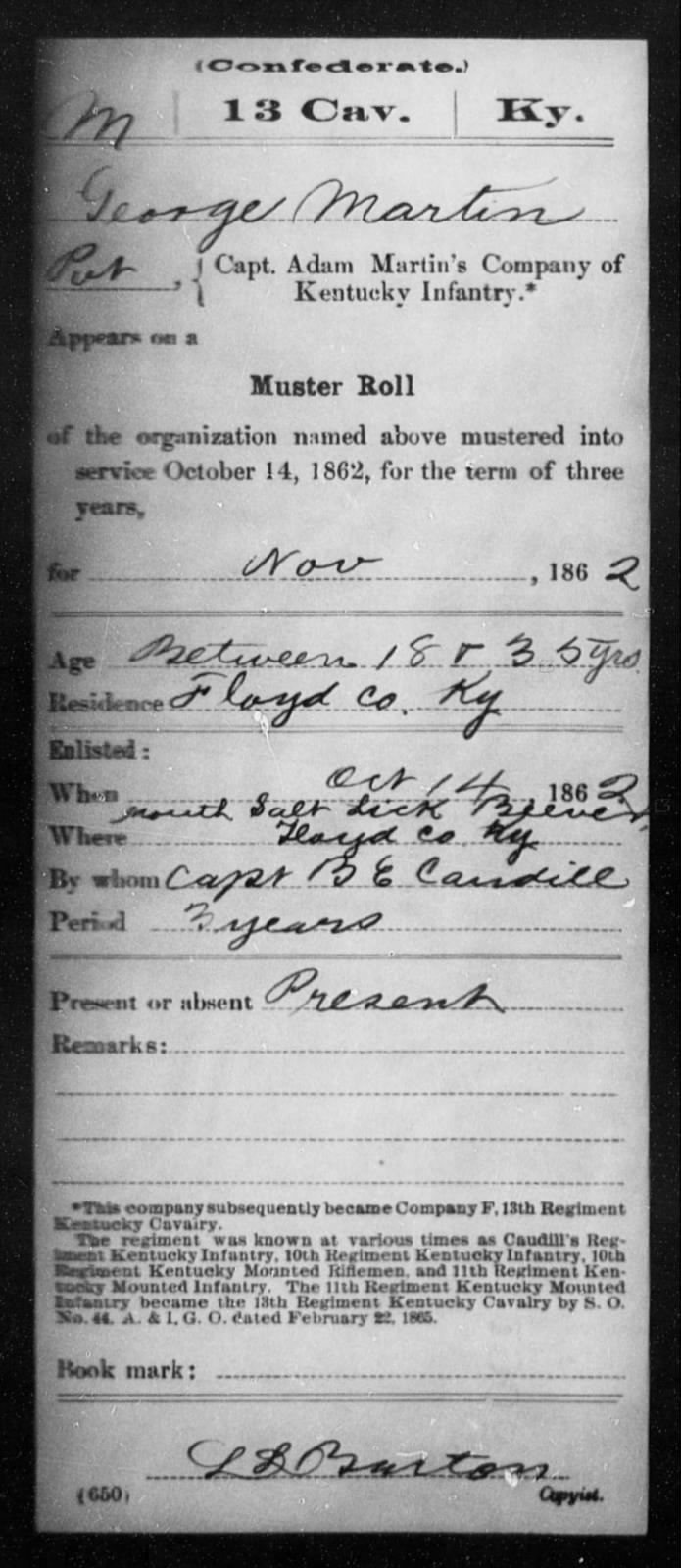
Meanwhile, on April 27, 1865, a small part of Giltner’s Brigade, the remnants of the Col. Benjamin Caudill's regiment (also known as 13th KY Cavalry), surrendered to Colonel David A. Mims at Louisa, KY. He reported:
LOUISA, KY., April 27, 1865.
Capt. J. S. BUTLER:
The Tenth Kentucky (rebel), of Colonel Giltner's command, has surrendered to me at this place. Terms, release upon the amnesty oath.
D. A. MIMS,
Colonel, Commanding.
The following is a copy of the Oath of Allegiance the soldiers had to sign at Louisa before their release.
Headquarters U. S. Forces
1st Division, Department of Kentucky
Office Provost Marshal
Louisa, Ky., April 30 1865.
United States of America } SS.
State of Kentucky }
I,____ do solemnly swear, in the presence of Almighty God, that I will henceforth Faithfully support, protect, and defend the Constitution of the United States, and the Union thereunder; and that I will, in like manner, abide by and faithfully support all acts of Congress passed during the existing rebellion with reference to slaves, so long and so far as not repealed, modified, or hold void by Congress or by decision of the Supreme Court; and that I will in like manner abide by and faithfully support all proclamations of the President made during the existing rebellion having reference to slaves, so long and so far as not modified or declared void by decision of the Supreme Court: So help me God.
____ (signature of paroled man)
Subscribed and sworn to before me this 30th day of April A.D. 1865.
J. W. Allison
LIEUT. and PROVOST MARSHAL.
The above named has ____ complexion, ____ hair, ____ eyes, and is ___ feet, ___ inches high, ___ years of age.
Last Military Organization:
 |
| James W. Adams, 13th KY Cavalry, Oath of Allegiance |
Thus ended the service of John Hunt Morgan’s old command – it was no more but a memory. After the war, Edward O. Guerrant reflected on the surrender, adopting a somewhat idealistic view characteristic of the “Lost Cause.” “They had fought a good fight, and kept the faith, and though the crown of victory did not encircle their brow, the triumph of the deathless principle they defended so heroically, will ultimately crown them conquerors – with an imperishable fame.”
 |
Reunion Ribbon, 4th KY Cavalry
with image of Col. Henry L. Giltner
Courtesy: Kraig McNutt, author of
The Battle of Franklin |
Notes
*By a twist of fate, it was Brig. Gen. Edward H. Hobson who negotiated the terms of surrender of Giltner’s division, which, in essence, was General John Hunt Morgan’s old command. During Morgan's Raid in July 1863, Hobson was involved in the pursuit and capture of Morgan and his men, after inflicting a severe defeat upon the raiders at the Battle of Buffington Island, Ohio. Ironically, Hobson and about 750 men of the 171st Ohio Infantry were captured by Morgan near Cynthiana, KY, in June 1864. Hobson was able to negotiate his release.
Links of Interest
General Edward H. Hobson’s Frock Coat, c. 1863
Image provided by "A State Divided: Exploring the Civil War Through Images"
Article researched and written by Marlitta H. Perkins, October 2012. Unauthorized use and/or duplication without express written notice by the author is strictly prohibited. © 2012. All Rights Reserved.